Research with animals in figures 2023
Research with animals in figures 2023
At the University of Oldenburg, mainly mice, Mongolian gerbils, fish and birds are used as laboratory animals. Of the animals used, 88% are contaminated in an animal experiment with a low degree of severity. (Status: 2023).


Animals killed for scientific purposes 2023
in accordance with §4 para. 3 TierSchG
The killing of an animal for scientific purposes within the meaning of §4 TierSchG is not an animal experiment. However, animals that are used for scientific purposes, e.g. for the removal of organs or the extraction of cells, may also only be killed by competent persons and after notification to the animal welfare officer. Killing must not be carried out without good reason. It may only be carried out using methods that are admitted for the animal species concerned.


The principle (§ 1) of the German Animal Welfare Act as amended on 25 May 1998 stipulates that "no one may inflict pain, suffering or harm on an animal without reasonable cause". The legislator sees a reasonable reason in § 7 in animal experiments. This paragraph takes into account the freedom of science guaranteed in the constitution and allows experiments on vertebrate animals if the expected pain, suffering or harm to the animals is ethically justifiable with regard to the purpose of the experiment. This obliges scientists and authorities to examine the necessity and appropriateness of the planned animal experiment and weigh it up against the expected suffering: The greater the suffering, the greater the scientific benefit must be.
When the number of laboratory animals is reported annually, information on the degree of distress and severity of the animal experiments is therefore also submitted to the competent authority. The classification of the degree of distress is defined in Directive 2010/63/EU of the European Parliament and of the Council of 22 September 2010 on the protection of animals used for scientific purposes.
Severity 1 - low stress
Procedures are considered to be low-stress if there is no significant impairment of well-being and general condition or if it can be expected that minor pain, suffering or anxiety will be caused for a short period of time.
Such treatments would also be carried out on humans or animals in medical or veterinary practice without anaesthesia or other protective measures. This includes, for example, injections or minor blood sampling. Ear piercing or the removal of the tip of the tail for genetic identification of mice also fall into this category.
Other examples: Injections under the skin (subcutaneous) or into the muscle (intramuscular) with little effect of the substance on the animal, administering anaesthesia, breeding genetically modified animals in which a phenotype with only minor effects is to be expected.
Severity 2 - medium load
Procedures that are unpleasant or painful according to human judgement are classified as medium stress. Both the animal's well-being and pain are taken into account as far as possible. Procedures that cause prolonged minor pain are also categorised as medium stress.
Examples: Surgical procedures under general anaesthesia with adequate analgesia and sequelae such as post-operative pain, distress or impairment of general condition; frequent administration of test substances that show moderate clinical effects; models for the induction of tumours or spontaneous tumours that are expected to cause moderate pain or moderate distress or lead to moderate impairment of normal behaviour.
Severity 3 - severe stress
These are procedures that are expected to cause severe pain, suffering or distress to the animals and procedures that are expected to cause severe impairment of the welfare or general condition of the animals. Even if a procedure causes only moderate pain, moderate suffering or distress, but then persists for a long time, it is categorised as severe distress.
There are currently no animal experiments categorised as "severe" at the University of Oldenburg. Nevertheless, three animals are listed in the statistics. These were found dead during the daily inspection, and it could not be ruled out that the death was related to the ongoing animal experiment. The animals were therefore reported as "severe".
No recovery of vital functions (non recovery)
Procedures that are performed entirely under general anaesthesia, from which the animal does not wake up, are classified as "no restoration of vital function".
Example: Painless killing for scientific purposes, for example to take cell or tissue samples.
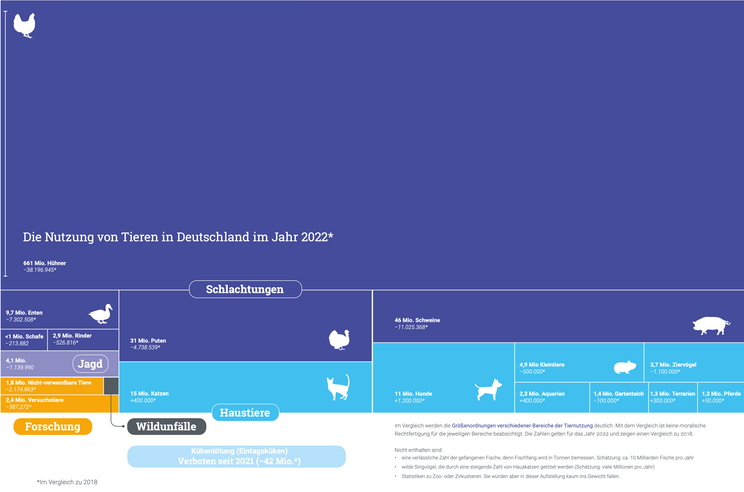
Use of animals in Germany in 2022
Compared to the general use of animals in Germany, only a very small proportion of the animals used in Germany are used for research and in animal experiments.
The most commonly used animals are chickens - 620 million animals.