
Course structure and modules

Course structure and modules
Curriculum of the Bachelor of Computer Science
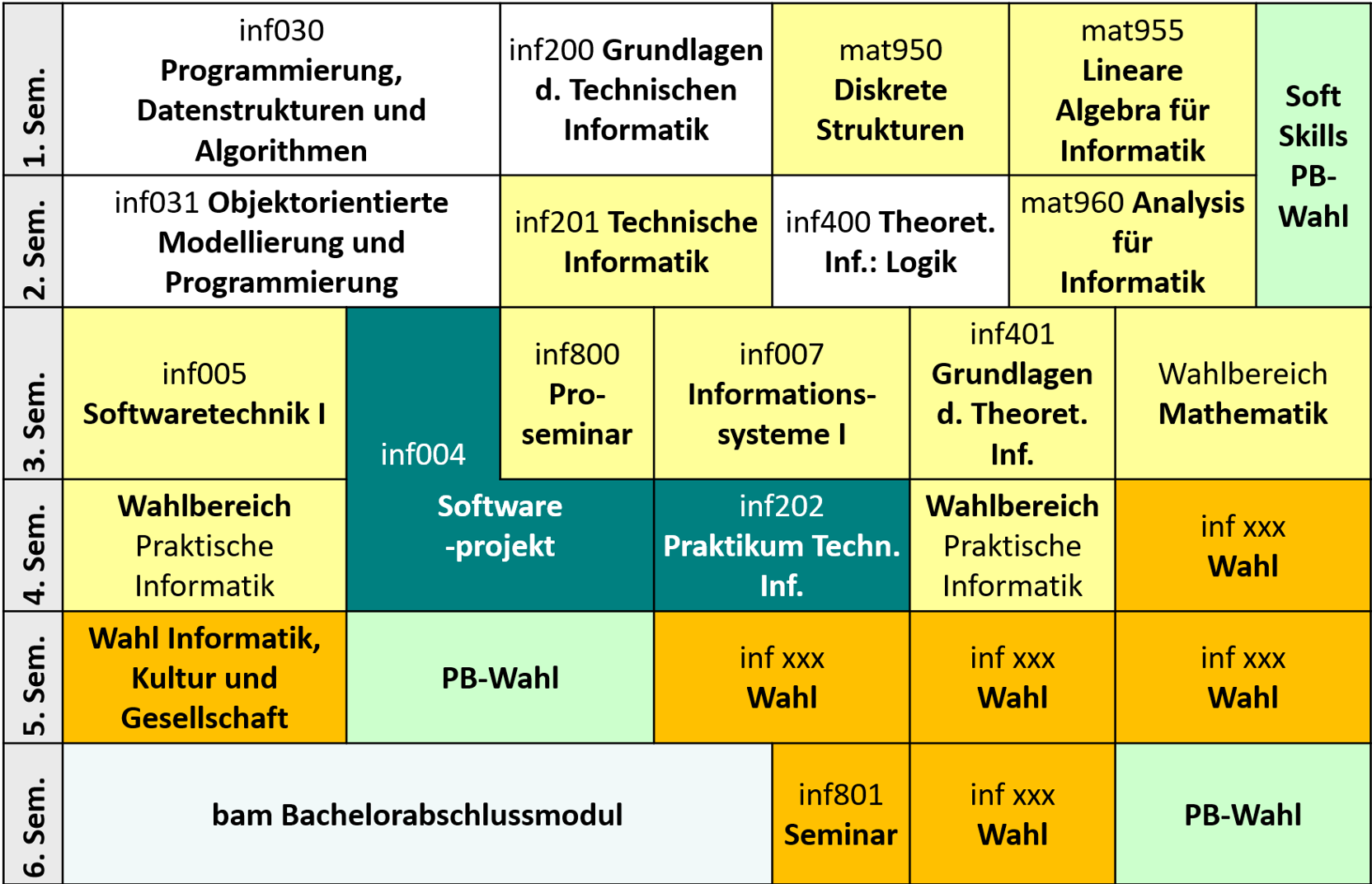
The recommended structure of the Bachelor's programme provides for five modules per semester. Studying the basic and advanced modules according to this plan is recommended, as the order of the modules in this plan takes into account content dependencies between modules.
However, the assignment of the modules to the individual semesters is not fixed - especially in the case of the accent modules, it may turn out that a different, individual sequence makes more sense. The programme advisors will be happy to help you if you need to deviate from this model study plan.
You can also find the module descriptions and event times of the computer science modules offered in the current semester via the module directory.
If you are not studying according to this study plan, you can contact the subject study advisor when having questions selecting modules.
Recommended study plans
Restructuring in 2026/27 and 2027/28
The Bachelor’s degree programme in Computing Science is currently being restructured and modernised. This process will not be largely completed until 2027, so there are specific recommendations for students starting their studies in the 2026/27 winter semester.
Among the changes is the inclusion of the important subject of ‘IT security’ as a compulsory module on the degree programme. To make it easier for students to start their studies and settle in at the university, the number of credit points to be earned in the first semester has been reduced to 27 CP. This will be made up during the lecture-free periods in the second and third semesters.
Start of studies in the winter semester 2025/26 or earlier
Please note: From the 2026/27 winter semester onwards , the latest examination regulations and programme-specific annexes will also apply to students who are already enrolled. However, it is possible, upon proposal, to continue studying under the previous regulations for a limited period. Transitional and transitional provisions in the examination regulations have, however, largely ensured that this transition should be possible for everyone without any problems. These have not yet been published. In the ‘Student Colloquium’ course on Stud.IP, there is a list of frequently asked questions (FAQs) where students in higher semesters can find more detailed information. To access this, you must be logged into Stud.IP and be a member of the ‘Student Colloquium’.
On 14 October, there will also be an information session on this topic in the Department’s ‘Student Colloquium ’. If you still have any questions, please book an appointment with your subject adviser, Dr Ute Vogel-Sonnenschein.
Study plan prior to 2026
Start of studies in the winter semester 2026/27
First-year students starting in the winter semester of 2026 can choose between three options for structuring their degree programme:
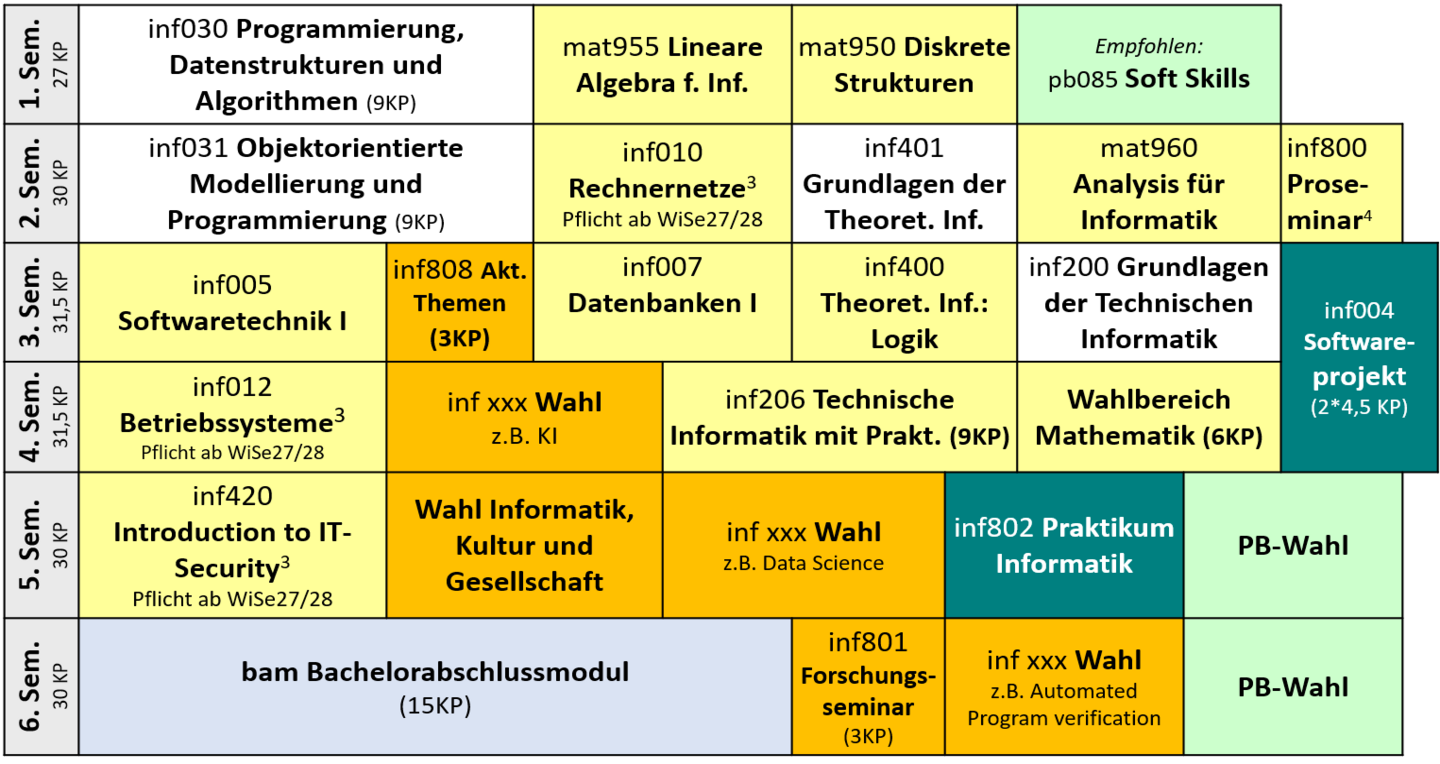
Study Plan 2026 – Option 1
You will take the Linear Algebra module in the first semester. (For students who are undecided between Computing Science and Mathematics, it is also an option to take the Linear Algebra module mat050 for mathematicians, worth 9KP, instead of the mat955 module.)
By moving inf200 to the third semester, you will take the sequential modules inf200 and inf206 one after the other, as well as the new inf206 module worth 9KP with an integrated practical placement. This option enables a smooth transition to the new examination regulations for 27/28.
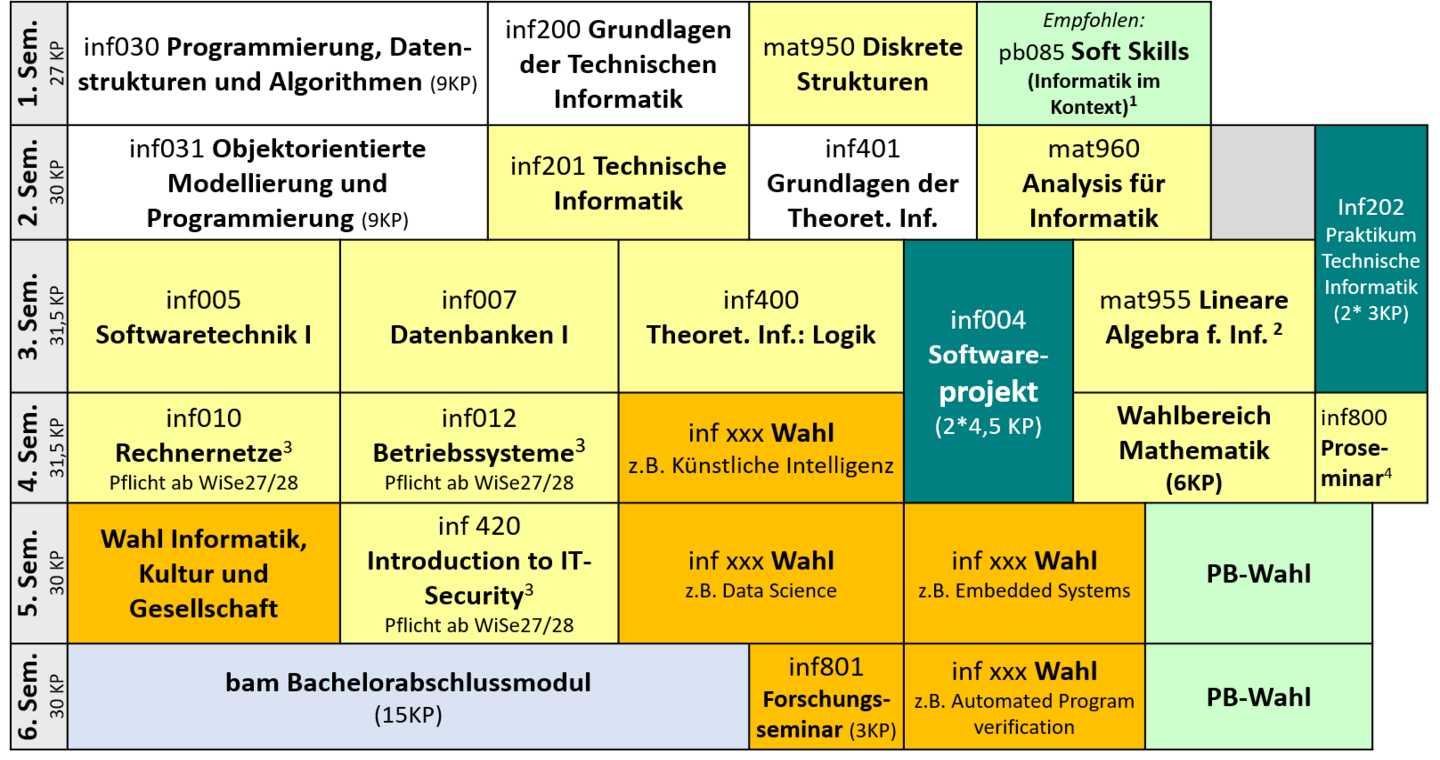
Study Plan 2026 – Option 2
You will take the modules inf200 in the first semester and inf2010 Computer Networks and the introductory seminar as early as the second semester. However, you will not deepen your knowledge of Technical Computing Science with the 9KP module inf206 Technical Computing Science with Placement until the fourth semester.
In the modules inf808 ‘Current Topics in Computing Science ’ (3KP) and inf802 ‘Computing Science Practical’ (6KP), you have the choice between courses on various topics in Computing Science.

Study Plan 2026 – Option 3:
In this variant, you will largely follow the existing study plan, meaning that when transitioning to the 2027/28 examination regulations, you may need to seek advice and submit the relevant proposals: You will take the 6KP modules inf200 and inf201 on Technical Computing Science in the 1st and 2nd semesters and begin the associated course inf202 Technical Computing Science Practical Training during the lecture-free period (in September 2027) . The practical course will then be completed before Christmas 2027.
Further flexibility and changes:
- The new module‘Computing Science in Context’ (still listed under the old module title ‘Soft Skills’ in the winter semester 26/27) introduces you to the diversity of Computing Science topics you will encounter during your degree. It also explains where these are important in practice, i.e. for your future career aspirations.
However, first-year students with an affinity for mathematics can also take the module mat955 Mathematics for Computing Science: Linear Algebra instead, or in addition to this, as early as the first semester. Please note: If you take the module inf955 in addition to this, the workload in the first semester will be very high! We therefore recommend following Option 2. - If you have already taken the module mat955 in the first semester, you should take the module ‘Computing Science in Context’ (then as module inf850 Computing Science in Context) in the third semester – or reschedule one of the other (elective) modules to this point.
- The modules inf010, inf012 and inf420 will be compulsory modules from the winter semester 2027/28.
- Introductory seminars and the module inf808 are offered every semester, so they can also be taken in a later semester. However, the introductory seminar must be completed before registering for the Bachelor’s thesis, as it provides practice in academic work, which is important for the Bachelor’s thesis.
- From the 2027/28 academic year onwards, the modules inf201 and inf202 will be replaced by the new module inf206.
- The previously compulsory Technical Computer Science placement (inf202) will be replaced by a general placement in Computing Science, optionally on the topic of databases, but also covering other topics.
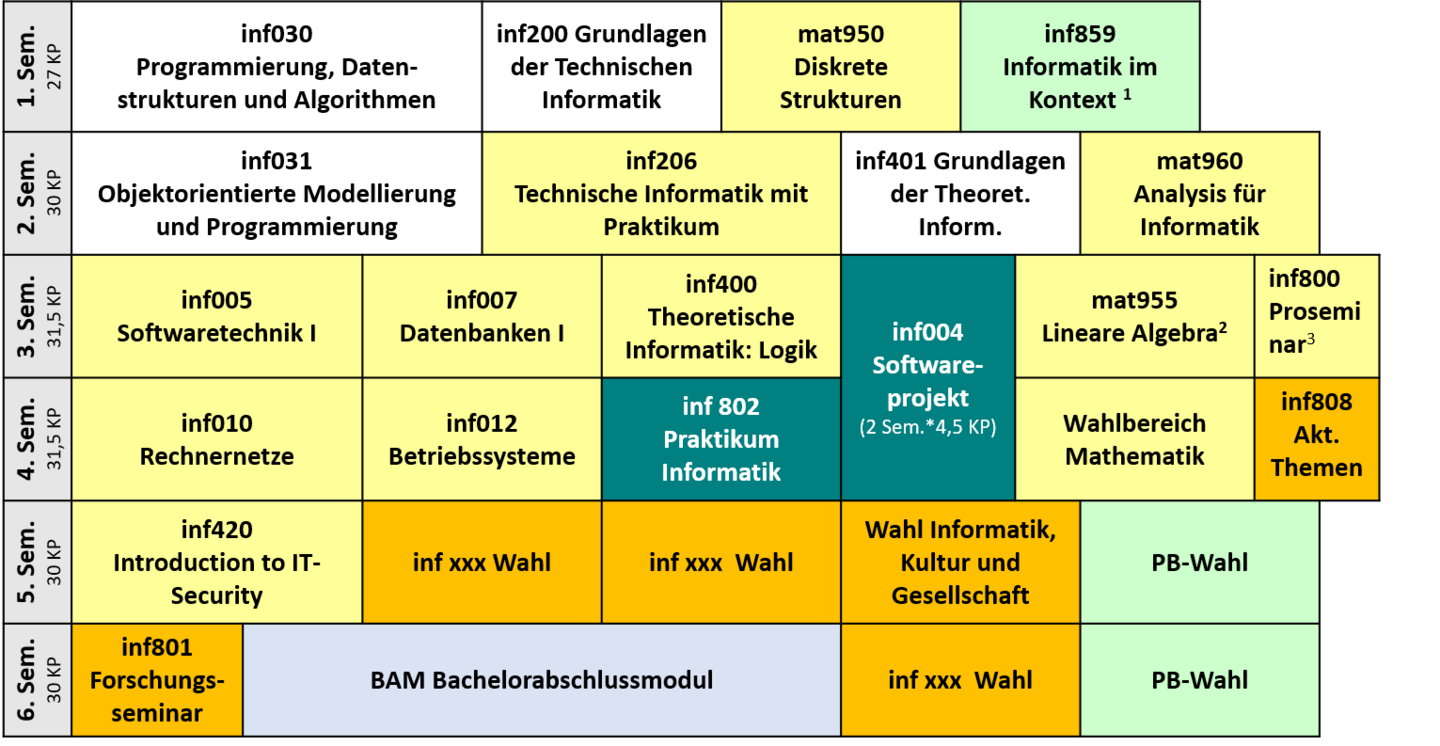
Start of studies in the 2027/28 winter semester
From the 2027/28 winter semester onwards, the following study plan will apply to all students on the Bachelor’s degree programme in Computing Science. Studying under the previous regulations will then only be possible with a proposal.
Flexibility in the course of study
- The new module‘Computing Science in Context’ introduces you to the wide range of Computing Science topics you will encounter during your degree. It also explains where these are relevant in practice, i.e. for your future career aspirations.
First-year students with an affinity for mathematics may, instead or in addition, take the module mat955 ‘Mathematics for Computing Science: Linear Algebra’ as early as the first semester, or take the mathematics module inf050 ‘Linear Algebra’. (Please note: if you take the module inf955 in the first semester in addition to this, the workload in the first semester will be very high at 33 CP!) - If you have already taken the mat955 module in the first semester, you should take the module ‘Computing Science in Context’ (then as the inf850 module ‘Computing Science in Context’) in the third semester – or reschedule one of the other (elective) modules to this point.
- Introductory seminars (inf800) and ‘Current Topics’ modules(inf808, inf809) are offered every semester, so they can also be taken in a later semester. However, the introductory seminar must be completed before you register for your Bachelor’s thesis, as it provides practice in academic research, which you will need later in your Bachelor’s thesis.
What do the colours in the study programme mean?
And what will I learn in the modules?
The Bachelor’s degree programme has a standard period of study of six semesters – in order to complete the programme within this timeframe, we recommend following the recommended study plan for the Bachelor’s degree programme in Computing Science and consulting your academic adviser if you deviate from it.
 30 CP | Core modules: Core modules provide introductory knowledge of the most fundamental areas of Computing Science. They are compulsory modules and must all be passed before you begin your Bachelor’s thesis. However, as later modules build on the content covered in these modules, you should enrol in and pass them as early as possible.
|
 72 CP | Advanced modules: These modules also provide essential basic knowledge in Computing Science and are therefore almost all compulsory:
|
 30 CP | Specialisation: Inf-choice:
|
 15 CP | This colour indicates training modules; in the Bachelor’s degree in Computing Science, the following is compulsory
Anyone who has completed a recognised vocational training programme can have this credited as inf802 Computing Science Placement. |
 18 CP | Area of specialisation modules (PB modules) can be freely selected from the Area of specialisation catalogue. In the first semester, we recommend the module pb085 Soft Skills or inf851 Computing Science in Context. These also include, for example, language modules, as well as other modules on a wide variety of topics (astrophysics, philosophy, etc.). However, they may also be replaced (on proposal) by subject-specific modules (e.g. further Computing Science modules or modules from another subject with no entry requirements). |
Part-time study
It is also possible to undertake a part-time study.
You can find the application form to be submitted, as well as the University of Oldenburg’s part-time study regulations, at uol.de/studium/studierendenstatus.
Your academic adviser must advise you on part-time study to ensure the best possible selection of modules and must sign the proposal. You must submit the proposal to the Admissions office when you complete your re-registration.
The form asks for the reasons for the part-time study solely for statistical purposes – these are not relevant to the approval process.