
Research focus of School I
Research focus of School I
Participation and education
This research focus, which combines the research of the three Institutes of School I, focuses on research into education and social inequality from a social and educational science perspective. The research spectrum includes basic and application-oriented regional, supra-regional and international (partly multidisciplinary) co-operation projects.
From a social science perspective , the focus is on analysing educational inequalities. This involves analysing the intergenerational mobility of education and social status, the dynamics of educational inequalities in the life course and the concrete diffusion channels of inequality. It is also concerned with the accumulation and consolidation of social disadvantages, as unsuitable educational profiles often go hand in hand with disadvantages and marginalisation in other fields. This raises the question of how the accumulation of disadvantages can be counteracted through the further development of labour market, education and social policies and the importance of international organisations such as the EU or the OECD in this regard.
From an educational science perspective , the focus is on analysing systemic permeability and participation in education. On the one hand, the focus is on the institutional and structural barriers and interfaces of the education system itself, which lead to selectivity, drop-outs and a lack of participation by underrepresented, educationally disadvantaged and impaired groups. On the other hand, the structures, processes and effects of educational policy and pedagogical interventions for participation and inclusion and for quality improvement in the education system are investigated. In addition, research is conducted into how successful educational trajectories, processes and transitions of children and young people as well as personal and social skills can be promoted.
The perspectives pursued in several major research projects are also reflected in the promotion of academics in qualification phases, which is of particular importance at School I. PhD students actively participate in the activities of the Graduate School 3GO.
In the following sections and pages you will find a description of the institutes, their research focus and an overview of the currently ongoing third-party funded projects.
Institute of Educational Sciences
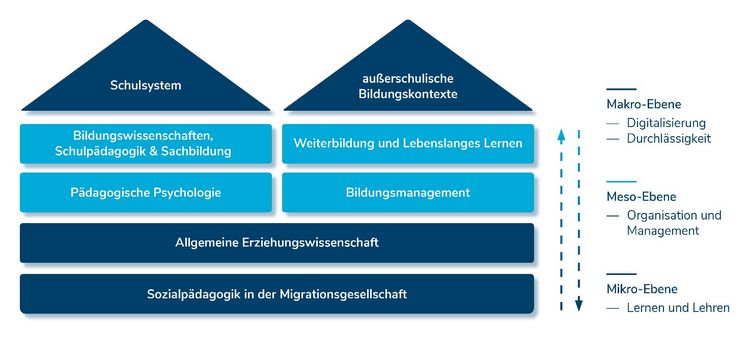
Research structure of the Institute
Research in educational science is linked to the university's key theme of "Society and Education". It makes important contributions to the key areas of "Participation and Education" and "Professionalisation Processes in Teacher Training".
The specialist focus is on the school system and extracurricular educational contexts. Particular interest is focussed on the expectations of an inclusive education system that takes into account the principles of individual empowerment and learning in community. Against this background, the topics of digitalisation and inclusion and their connections are focused on. The resulting research questions are addressed across the macro level (digital transformation, permeability and social participation), the meso level (organisation and management of educational institutions) and the micro level (teaching and learning in inclusive educational spaces) (see figure below). The research projects are located both in basic research and in application-oriented research and development and also pursue a participatory approach in cooperation with actors from educational practice.
Institute of Special Needs Education and Rehabilitation
Research Structure of the Institute
Since its foundation, the Institute of Special Needs Education and Rehabilitation has focused on empirical and applied research to support evidence-based practice in special and rehabilitation education, encompassing prevention, intervention and rehabilitation. Given the complex, multi-causal nature of issues in the field of special and rehabilitative education and the associated diversification of the subject, a pluralistic approach to research content and methodology is both necessary and appropriate.
The Institute’s research activities support the School’s profile, ‘Participation and Education’, and pursue this through the following key areas of special educational needs research:
‘Barriers, multiple disadvantages and impairments’. This area of focus examines the specific developmental and living conditions of people with (or at risk of) multiple impairments and conducts empirical studies that clarify the interaction of various dimensions and individual factors throughout the developmental process, whilst identifying possible courses of action within special and rehabilitative education. The identification, design and evaluation of special educational and rehabilitative approaches for prevention, intervention and rehabilitation for children, young people and adults with (multiple) impairments are the centre of this area of focus.
‘Professionalisation in the training of specialists’. This priority area focuses on the in-depth training of special needs teachers, rehabilitation educators and other professionals (teachers in mainstream and vocational schools, educational staff in out-of-school education) based on international, empirically grounded and reflective professionalisation models.
‘Digitalisation and Assistive Technologies’. The aim of the Institute of Special Needs Education and Rehabilitation’s work in this area is both to understand the processes of digitalisation and their implications for participation and education, and to develop, conduct evaluation and implement new digital support solutions. Research into assistive technologies focuses here on tailored, interdisciplinary provision processes and the effects of their implementation.
‘Communication’. The ‘Communication’ research area is highly relevant to development opportunities in the face of barriers, multiple disadvantages and impairments. The establishment of an inclusive system for sustainable education (UN CRPD, SDG Goal 4) requires an in-depth understanding of communication, which generates intensive research activities at the interfaces with the other three priority areas (e.g. comorbidity and language, communication as a medium and subject of professionalisation, and supported communication through assistive technologies).
The Institute already possesses expertise and conducts research in this area that is recognised both nationally and internationally.
The Institute attaches particular importance to supporting early-career researchers. Early-career researchers have the opportunity to take advantage of relevant support programmes for further qualification, e.g. within the framework of the ‘SPARK’ doctoral college, the Institute’s Doctoral Centre (DOZ), the departmental doctoral centres (Fachgruppen-DOZ) and the ‘3GO’ Graduate School.
KoggE as a central facility at the Institute. The Inclusive Centre of Excellence for Joint, Holistic Developmental Support in Childhood, Adolescence and Adulthood (KoggE) brings together programmes in applied research, practice-oriented teaching and regional networking through professional development programmes and research-related services. The Centre of Excellence has evolved from the former Outpatient Rehabilitation Clinic.
Institute of Social Sciences
Research structure of the Institute
For the social sciences, questions of social differentiation and the cultural, economic, social and political conditions of social cohesion are at the centre of interest. When analysing current challenges, the Oldenburg social sciences rely on a combination of sociology and political science and are guided by the central difference between these two disciplines: While sociology analyses social orders (and their threats) as a condition and consequence of situational action or communication, political science focuses on the study of political action and decision-making processes and thus the conditions and consequences of collective action. The orders of modern societies and the threats posed by the erosion of social cohesion are thus analysed from a political science and sociological perspective.
Here, the social sciences in Oldenburg build on a theory-method foundation that seeks to penetrate the connection between institutions and socialisation processes from the perspective of social and democratic theory and combines this with a solid methodological basis. This integration of methods and theories is bundled in the claim of theory-led empirical research. The aim of empirical research is to question and substantiate theoretical findings through empirical analyses.
The general question of the conditions, forms and threats to social cohesion is specified for two subject areas:
(1) Knowledge and organisation: This topic examines the prerequisites for and threats to social cohesion and social differentiation. One focus is on the introduction and use of digital media in a wide variety of knowledge-based production and innovation processes. This goes hand in hand with questions of the creation of meaning through labour and the availability of material resources.
(2) Social and political inequalities: Here the focus is on the distribution of resources, opportunities and risks in different, increasingly digitalised social fields. This is also linked to the possibilities of access to social goods and social positions, which are endowed with unequal opportunities for power and interaction.
Both topics together characterise not only the Institute's teaching - especially in the specialisation areas of the Bachelor's and Master's degree programmes - but also its research activities, for example in dissertation projects and externally funded research projects.
With the Oldenburg Laboratory for Experimental Social Research (OLExS), the IfS has the resources and technical equipment to carry out social science decision-making experiments under laboratory conditions (experiments.uni-oldenburg.de), in the field and embedded in representative online surveys.