
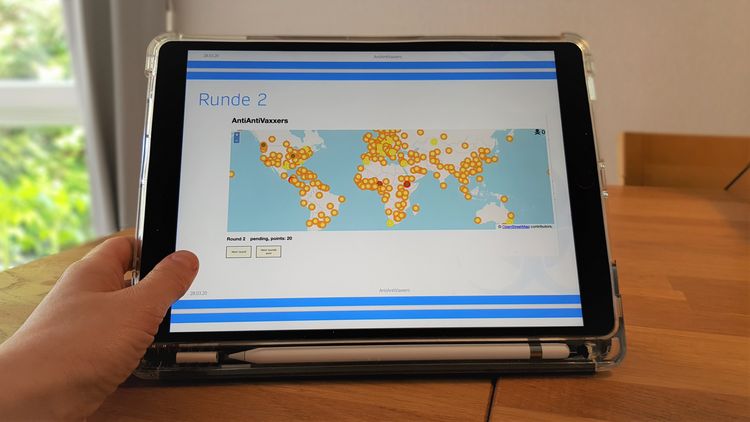
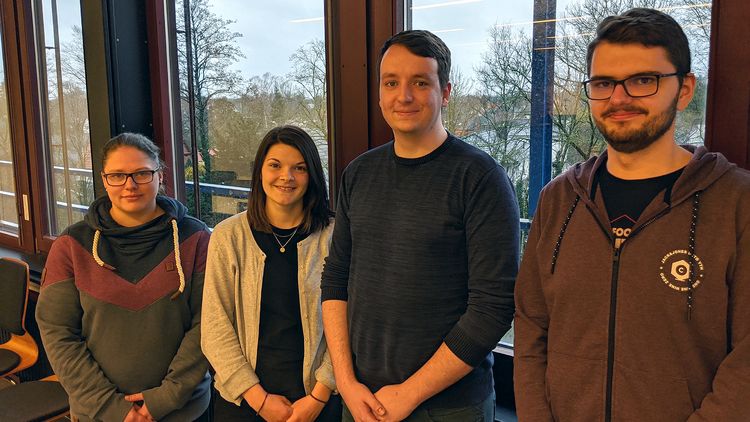


“Save humanity from a pandemic”: It was with this challenge that the InformatiCup 2020 – an annual student competition organised by the German Computing Science Society – got underway last autumn. Twenty-nine teams from across Germany took part and developed programmes designed to contain the spread of fictional diseases as effectively as possible. Among them were the “AntiAntiVaxxers” from Oldenburg, who even made it onto the podium in the final – little realising how real the scenario would become shortly afterwards. A conversation with Computing Science students Mathis Bückmann, Lea Bünting, Marius Lewrick and Alexandra Söhnitz.
You came third with your strategy for containing a pandemic. What exactly was simulated in the competition and what were the rules of the game?
Mathis Bückmann: “The core of the game was simple: in each round, diseases broke out in various locations around the world. Which pathogens spread in which cities was random. Our task was to deploy various measures sensibly to contain the spread. For example, we could impose quarantines, close airports, develop vaccines and medicines, or launch information campaigns. In doing so, we had to take into account the characteristics that defined the cities and pathogens in the game – such as population size, hygiene standards, the number of flight connections to other cities, and the infectiousness or lethality of the pathogens.”
Lea Bünting: “It’s important to note that the game did not have a visible game board, as one might be familiar with from computer strategy games. Instead, a programme provided the score information as text, for example: ‘In Berlin, pathogen XY broke out in round four. It has the following characteristics…’. The programme also played several games simultaneously. It wasn’t clear which of these games the respective scores belonged to. So we couldn’t devise a separate strategy for each game.”
That sounds rather abstract…
Alexandra Söhnitz: “It is. This game mechanic prevented us from writing a programme that could only win by following a specific course of play. We had to find universally applicable solutions for how to react as effectively as possible in different situations.”
What approach did you take?
Mathis Bückmann: “Put simply, our programme works with ‘if-then’ rules, known as ‘if’ statements. We put our heads together to work out how to respond to specific game scores. So, rather than programming artificial intelligence – which was the approach taken by many other teams – we relied on our own intelligence.”
Marius Lewrick: “As the parameters were manageable, that worked quite well. The other teams in the final also worked without AI. But that was probably mainly a question of resources: it takes a relatively large amount of computing power and time to train an AI. If the competition had lasted longer, an AI would probably have achieved better results than we did.”
A few weeks before the planned final, the new coronavirus began to spread in Germany and across Europe as well – did the project make you feel better prepared for this?
Lea Bünting: “Not really, because the data in the game is very simplified. You can’t apply that to real life.”
Mathis Bückmann: “It was interesting, though, that in the game we followed a similar approach to that taken by policymakers at the outset: we relied primarily on quarantine as a strategy.”
Due to the pandemic, the final at the end of March could not take place in Wolfsburg as planned. Instead, it was held at short notice via video conference and streamed live on YouTube. What was that like for you?
Mathis Bückmann: “It was certainly a bit strange being in a video conference with 30 people. But it went well, including the moderation. However, there were no longer any live demos of the programmes; all the teams simply gave their presentations.”
Alexandra Söhnitz: “Unfortunately, the supporting programme was cancelled as well. The nice thing about this format was that friends and family could watch via the live stream – they were delighted!”
Marius Lewrick: “What was missing, though, was the applause at the prize-giving ceremony.” (laughs)
The InformatiCup took place for the 15th time in the 2019/20 winter semester. The competition is open to enrolled students of all years and all disciplines at universities and universities of applied sciences in Germany, Austria and Switzerland. It aims to challenge participants to familiarise themselves independently with new technologies and to develop solutions as a team. Dr Dietrich Boles from the Department of Computing Science at the University of Oldenburg has been offering students the opportunity to take part in the InformatiCup for several years as part of the modules ‘Advanced Java Technologies’ and ‘Modern Programming Technologies’.