
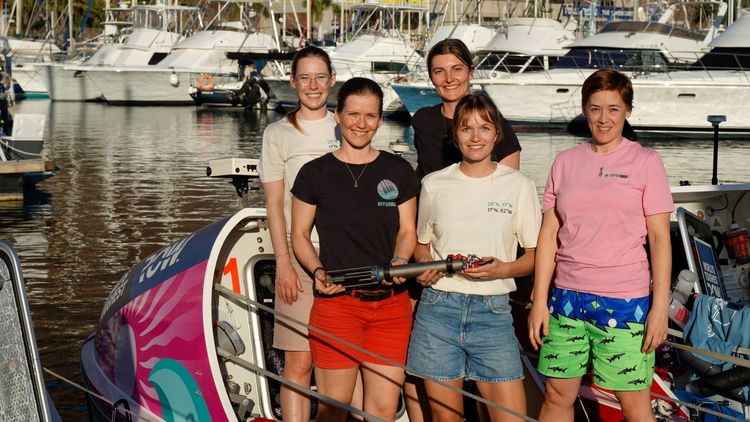
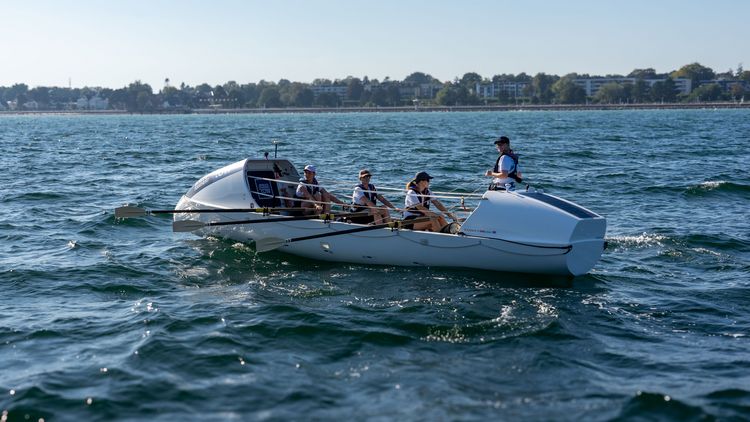


An unusual alliance for ocean science is being forged by four extreme rowers together with Prof Dr Oliver Wurl and Leonie Jaeger of the Institut for Chemistry and Biology of the Marine Environment (ICBM) at the University of Oldenburg. Jana Stahl, Clara Düntsch, Jana Golz and Christiane Kienl make up the team “Offshoare” and will cross the Atlantic in a rowing boat in the World’s Toughest Row event.On board their ocean‑rowing boat „Alles Paletti“ a camera and various measuring instruments will be installed to gather scientific data during the voyage.
The four women want to cover around 4,800 kilometres from the Canary Islands to the Caribbean in the world's toughest rowing race. "We're not one of those teams that only aim for speed and hardly take time to eat," says Jana Stahl. "We also see it as an expedition. You rarely get this close to the ocean. We want to enjoy it and of course hope to see whales and dolphins."
And so the four rowers also want to take time to carry out measurements for the Wilhelmshaven researchers along the way. Prof Dr Oliver Wurl and his team are investigating the surface layer of the seas - where the ocean and atmosphere meet. This layer is up to 1 millimetre thick, omnipresent and like the skin of the ocean. Everything that the ocean and atmosphere exchange - gases, heat, fresh water and particles - must pass through this layer. Under certain conditions, the ocean surface layer forms a slime-like biofilm full of algae and microbes. Then certain substances change the properties of the surface film so that the light is reflected differently there, making the surface films visible. These visible films are called slicks. "All physical, chemical and biological processes that take place at the boundary between the ocean and the atmosphere can be influenced by slicks," says Leonie Jaeger, PhD student at the ICBM. "We can't measure from large ships because they swirl the water too much and destroy the slicks, so we hope to get valuable data from Team Offshoare." Using a camera on board, the team will take a series of photos of the sea surface to document slicks and record their size, shape and distribution. Below the waterline, a probe will be attached to the rowing boat to continuously record water temperature and salinity. This data will later be used to analyse the photo series, for example to track changes in the water masses. The data from a wind sensor can later be used to analyse how different wind speeds affect the formation of slicks and up to what wind force slicks occur.
The competition started on 14 December on La Gomera. ICBM doctoral student Leonie Jaeger travelled there to assemble the mounts and install the measuring equipment with the rowers. "We've done the final touches. Everything is ready for the World's Toughest Row! The excitement and anticipation are palpable throughout the harbour," says Jaeger.