
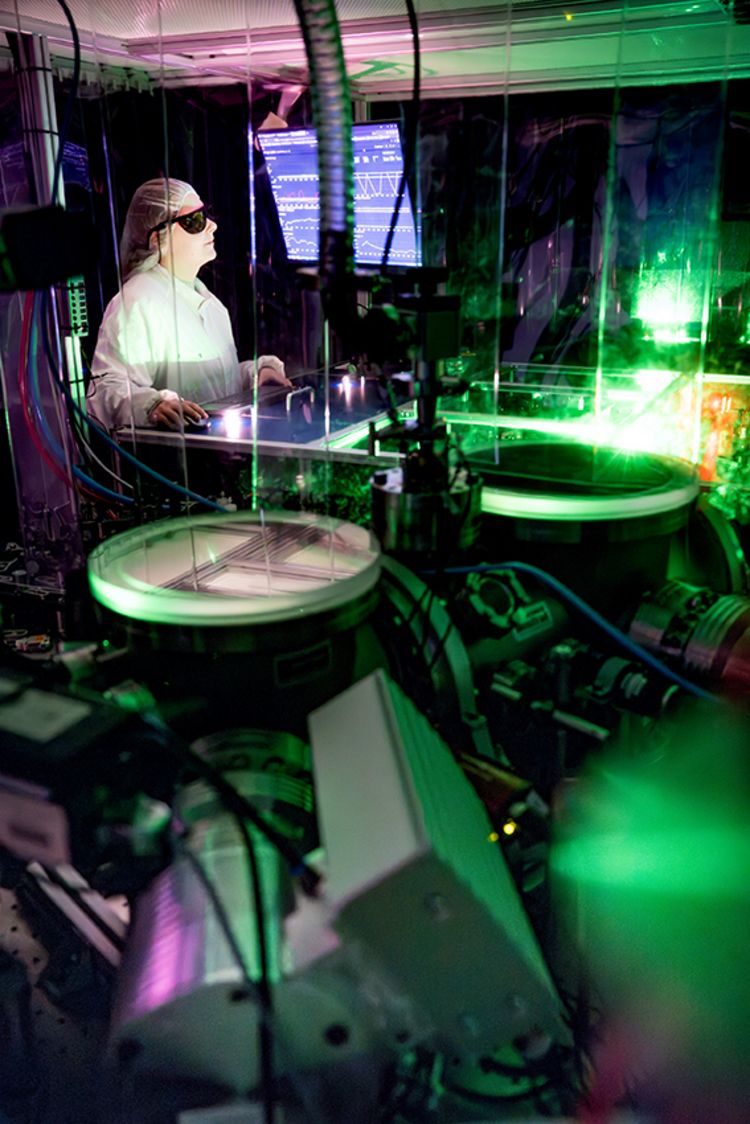

Precisely controlling the electric field of light in order to, in turn, control the movement of individual electrons in experiments: this is a challenge that researchers at the Institute of Physics at the University of Oldenburg are working on, and one in which a team from the Attosecond Microscopy Research Group led by Dr Jan Vogelsang has now taken a decisive step forward. In the journal ‘Applied Physics B – Lasers and Optics’, the researchers present a laser system they have developed themselves, which generates 200,000 light pulses per second. A total of six researchers from Oldenburg collaborated with members of the research group led by Nobel Laureate Prof. Dr Anne L’Huillier at Lund University (Sweden) to carry out a detailed characterisation of the laser system. The precise position of the light wave – which consists of light in the infrared spectrum that is invisible to the human eye – proved to be exceptionally stable, even over a period of hours. These stable light fields, with consistently identical light pulses, will in future enable experiments on electron control – fundamental research that could, in the long term, pave the way for the development of ultra-fast transistors operating at the speed of light.
According to lead author Katrin Meier, what is new about this work is the record-breaking similarity between all 200,000 laser pulses per second. The team succeeded in determining the stability of the electrical field oscillations, ranging from individual laser pulses to periods lasting hours. Central to this is the so-called carrier-envelope phase (CEP), which describes the exact shape of the light wave together with other parameters: “You can imagine the pulse as a brief flash of lightning, in which there is room for only a few wave crests and troughs of the electromagnetic field’s oscillation. The CEP determines where these crests and troughs are located within the flash,” explains the PhD student in the research group funded by the German Research Foundation (DFG). “Without a stable CEP, one pulse or flash would look completely different from the next – and targeted experiments that utilise the fields within the pulse would be impossible.”
As the CEP is extremely sensitive to temperature fluctuations, air movements or even the slightest vibrations, a meticulously planned and executed laser setup, together with the exceptionally stable conditions in the Oldenburg attosecond laboratory, contribute to its stability. Nevertheless, the CEP’s exceptionally high stability took the team by surprise, according to Meier. Although it describes only a very small quantity, it can have a major influence on measurement results: “A minimal shift in the CEP can determine how electrons react to the laser pulse – much like a precisely timed ‘nudge’ determines the direction in which a swing swings.” The fact that the CEP proved to be so stable in the setup now tested will enable future experiments in which it was previously impossible to record any measurement signal at all.
Original publication: Meier, K., Klösgen, A., Harland, K. et al. Multiscale carrier-envelope phase characterization of 2-µm pulses delivered by a 200-kHz optical parametric amplifier. Appl. Phys. B 132, 97 (2026). doi.org/10.1007/s00340-026-08699-w