
Rogue Waves
Rogue Waves
Understanding the nature of monster waves
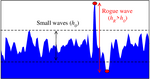
Physicists in Oldenburg link extreme events to the laws of thermodynamics
Oldenburg. Investigating the phenomenon of monster waves: an international team of researchers led by Oldenburg-based scientists has succeeded in estimating the probability of a monster wave – a ‘water mountain’ up to 30 metres high – occurring, based on the waves in the surrounding area. The findings, published in the latest issue of the specialist journal ‘Europhysics Letters’, challenge the previously prevailing view that monster waves are unpredictable phenomena that appear out of nowhere and vanish without a trace. This new research could one day help us to better predict these extreme events. The lead author of the publication is doctoral candidate Ali Hadjihosseini from the research group of Oldenburg-based turbulence researcher Prof. Dr Joachim Peinke. Also involved are Dr Pedro G. Lind from the University of Osnabrück, as well as other researchers from Hamburg, the UK and Japan.
Monster waves – not to be confused with tsunamis – are individual waves on the open sea that are at least twice as high as the waves surrounding them. They generate enormous forces upon impact. Smaller vessels can sink, whilst larger ones risk losing manoeuvrability. Experts estimate that up to ten shipwrecks a year can be attributed to these giant waves. For a long time, monster waves were dismissed as sailors’ tall tales, but since satellite images proved their existence in the early 1990s, they have increasingly attracted the interest of the scientific community. Exactly how they form remains a matter of debate.
To get to the bottom of the phenomenon, the research team led by Hadjihosseini, as part of the ‘Extreme Ocean Gravity Waves’ research project funded by the VW Foundation, compared measurement data from the North Sea and the Sea of Japan, with the Japanese data including a monster wave. “We were able to show that monster waves do not occur at random, but follow precise thermodynamic laws,” says Hadjihosseini. The key term is entropy. Put simply, this physical quantity describes the order or disorder of the individual particles in a physical system. How orderly the arrangement is is closely linked to the laws of thermodynamics.
Against this background, the researchers analysed the waves in the North Sea and the Sea of Japan. They succeeded in assigning specific entropy values to individual waves: Small waves result from an increase in entropy, whereas the dreaded monster waves are characterised by a decrease in entropy. “These waves can therefore, despite their destructive effect, be regarded as islands of order in the sea,” summarises Lind. The change in entropy values thus serves as an indicator for the researchers of the probability of a monster wave: the greater the decrease in entropy, the more likely it is that a monster wave will occur in its vicinity. Another important finding by the researchers is that the disorder-generating increase in entropy and the order-creating decrease in entropy are balanced by a thermodynamic law that is fulfilled with great precision. Every monster wave must therefore be counterbalanced by a certain number of normal, disordered waves.
“With these results, we have established a new approach to characterising and modelling ocean waves. Now the risks posed by waves in general, and monster waves in particular, can be better assessed, and one day it may even be possible to make predictions,” says Peinke.
“Rogue Waves and entropy consumption” by Ali Hadjihosseini, Pedro G. Lind, Nobuhito Mori, Norbert P. Hoffmann and Joachim Peinke in Europhysics Letters, Volume 120, Number 3.
Web links
contact
Prof. Dr Joachim Peinke, Tel.: 0441/798-5050, email: peinke@uol.de