

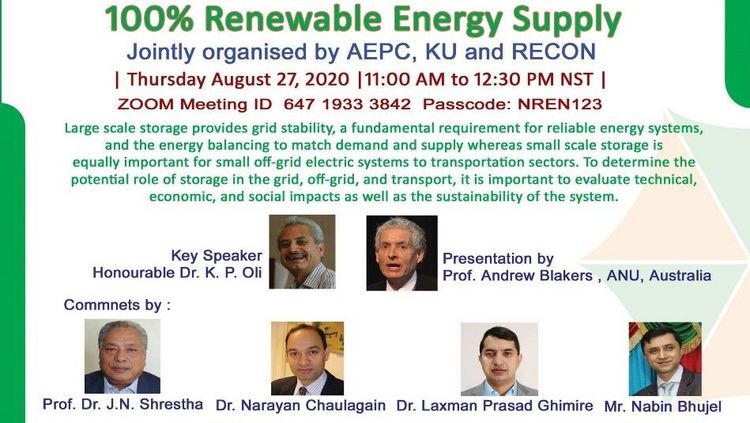

Renewable energy technologies (solar, biomass, and wind) have vast potential to reduce dependence on fossil fuels and greenhouse gas emissions. However, solar and wind energy have variable and uncertain generation potential. To integrate fluctuating renewable energy into the national grid and/or off-grid system, smart grid and/or energy storage technologies are essential. Large scale storage provides grid stability, a fundamental requirement for reliable energy systems, and the energy balancing to match demand and supply whereas small scale storage is equally important for small off-grid electric systems to transportation sectors. To determine the potential role of storage in the grid, off-grid, and transport, it is important to evaluate technical, economic, and social impacts as well as the sustainability of the system. Besides, it is also important to evaluate the techno-economic of a variety of potentially competing technologies. To share the research experience among government, academia, and industrial sectors working in renewable energy, the webinar on “100% Renewable Supply” has been conducted on 27th August 2020.
A renowned solar scientist Prof. Andrew Blakers from Australian National University was a key presenter. His message to the government, academia and private sectors working in renewable energy issues were loud and clear that “100% Renewable Energy Supply” is possible and the country should target to achieve 100% Renewables for sustainable livelihoods and the climate change mitigation. He elaborated that Solar, Wind with pump storage hydro for large scale energy storage supported by batteries storage is an established technology and economically viable across the globe. Hydrogen generation and storage is by far expensive, inefficient, and not competitive to other on-shelf technologies solar, wind supported by pump storage and batteries.
Dr. K. P. Oli Member of National Planning Commission addressed the webinar as keynote speaker. He mentioned the provisions for renewable energy to develop in Nepal described in the 15th Five Year Plan. The country will be fully electrified and will be able to export electricity to neighbouring countries as well, he added. He emphasized that biogas energy is a sustainable source of clean cooking energy and is a priority of the country.
Former Minister for Science and Technology Er. Ganesh Shah said that Nepal is going ahead to generate more energy from renewable resources. Agriculture should be a priority sector to utilise renewable energy for producing more food while storage of food utilising drying, cooling and processing should be well considered. Investment in RETs is also an important aspect to consider seriously, he emphasized.
Prof. Jagan Nath Shrestha mentioned that 100% renewable energy has been brought into action at CES-IOE, TU around 2 decades ago and it demonstrating as successful practice. Nepal still needs research and involve entrepreneurs collaborating academic institutions, he said.
Former Executive Director of AEPC Dr. Narayan Chaulagain elaborated that the government and development partners are working together to utilised RETs. Dr. Laxman Ghimire from AEPC and Mr. Nabin Bhujel fromprivate sectors also expressed views on perspectives of 100% renewable energy in Nepal's context.
The Chairperson of RECON Guna Raj Dhakal in his welcome remarks mentioned the current status of RETs in Nepal and potential to contribute to the economy by utilising RETs. Prof. Dr. Subodh Sharma, Registrar of Kathmandu University (KU) mentioned the KU activities on RETs. Mr. Daniel Tuladhar, Head of Mechanical Department, KU delivered the vote of thanks on the occasion.
The webinar was attended by more than 120 Participants from across the globe at ZOOM platform and over 100 people watched at livestream on facebook. The webinar video has been viewed more than 2.5 K by now.
www.facebook.com/renewableenergyconfederation/videos/727494151430561
Participants in zoom platform were from Nepal, Australia, Germany, Oman, Rwdanda, China, Mongolia, India, Pakistan and Hongkong. Altogether PPRE Alumni were about 10 to 12.