

Office closed

The office and the dean's office of the School VI Medicine and Health Sciences are from December 22, 2025 to January 2, 2026 inclusive not occupied.

Contact

Dean´s Office

+49 (0)441 798-2499 

Dean of Studies Office

+49 (0)441 798-2510

Opening hours Office of the Dean of Studies

Monday and Wednesday from 15.00-17.00 hrs

Thursday from 09.00-11.00 a.m.

Anschrift

Postal address

University of Oldenburg
School VI Medicine and Health Sciences
Ammerländer Heerstraße 114-118
26129 Oldenburg

Visitor address

Building V03, 3rd floor, wing M
Ammerländer Heerstraße 138
26129 Oldenburg

Newsletter of University Medicine Oldenburg (German only)

School VI - Medicine and Health Sciences

The School VI Medicine and Health Sciences is the youngest School of the Carl von Ossietzky University Oldenburg. It was founded in 2012 and consists of the Department of Human Medicine, the Department of Medical Physics and Acoustics, the Department of Neurosciences, the Department of Psychology and Health Services Research.

New website of the University Medicine Oldenburg (UMO)

The website “universitätsmedizin-oldenburg.de” provides an overview of UMO's structures and news from university medicine. It complements the websites of the faculty and the cooperating hospitals and gives external visitors in particular an impression of UMO's diversity and unique selling points.

To the UMO website

The model course of study in human medicine is the first time in Germany that medical training is taking place across borders. 120 study places are currently available annually on the Oldenburg side at the European Medical School Oldenburg-Groningen.

Characteristics of the school VI are the highly regarded cross-border model course in human medicine - the European Medical School Oldenburg-Groningen (EMS) - as well as the close integration of basic research, clinical research and health care research. It thus offers students and scientists an excellent environment in which to acquire and apply the knowledge and skills necessary for the medicine of the future.

Current news

Insights into the School VI

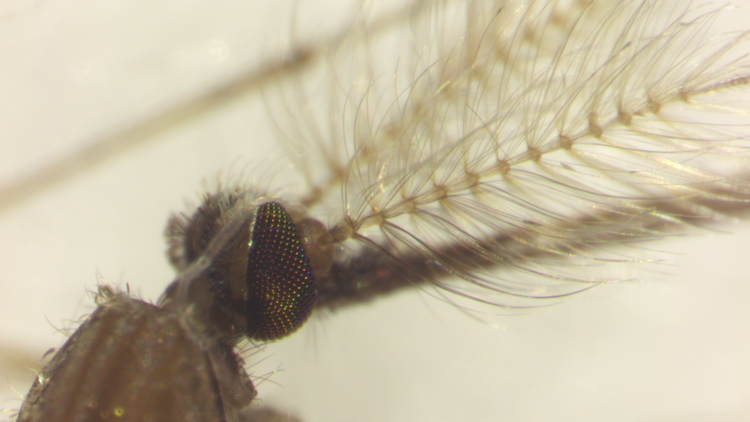
  • The raised hairs on their antennae help male mosquitoes to hear better. This is also important for mating: in a swarm, male mosquitoes recognise females by the deeper flight sound. Researchers have now identified one of the substances that enables malaria mosquitoes to "sharpen their ears". Photo: Judit Bagi / University College London

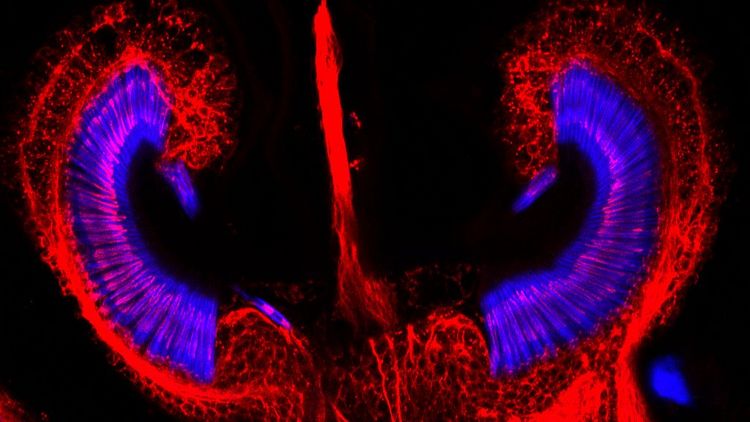
  • Under the microscope, the inner ear of the mosquito becomes visible: the blue and red shimmering sensory cells are highly sensitive and convert the vibration of the antenna into electrical impulses. Photo: Marta Andrés Miguel / University College London

Study finds that mosquito hearing could be targeted by insecticides

A new study by researchers from University Oldenburg and University College London (Great Britain) shows that specific receptors in the ears of mosquitoes modulate their hearing, which has implications for developing insecticides.

The ability of males to hear the females is a crucial requirement of mosquito reproduction. As a result, the finding could help develop novel insecticides or mating disruptors to prevent diseases like malaria.

This article first appeared on the website of University College London.

In the study, published in Nature Communications, the researchers focused on a signalling pathway involving a molecule called octopamine, and demonstrated that it is key for mosquito hearing and mating partner detection, and so is a potential new target for mosquito control.

Male malaria mosquitoes acoustically detect the buzz generated by females within large swarms that form transiently at dusk. Because swarms are potentially noisy, mosquitoes have developed highly sophisticated ears to detect the faint flight tone of females amid hundreds of mosquitoes flying together. The molecular mechanisms by which mosquito males ‘sharpen their ears’ to respond to female flight tones during swarm time have been largely unknown.

The researchers looked at the expression of genes in the mosquito ear and found that an octopamine receptor specifically peaks in the male mosquito ear when mosquitoes swarm. The study found that octopamine affects mosquito hearing on multiple levels: it modulates the frequency tuning and stiffness of the sound receiver in the male ear, and also controls other mechanical changes to boost the detection of the female. The researchers demonstrated that the octopaminergic system in the mosquito ear can be targeted by insecticides.

Mosquito mating is a bottleneck for mosquito survival, so identifying new targets to disrupt it is key to controlling disease-transmitting mosquito populations.

Dr Andrés said:

“Octopamine receptors are of particular interest as they are highly suitable for insecticide development. We plan to use these findings to develop novel molecules to develop mating disruptors for malaria mosquitoes.

“Because mosquito hearing is required for mosquito mating, it can be targeted to disrupt mosquito reproduction. An increased knowledge of mosquito auditory neuroscience could lead to the development of mosquito mating disruptors for mosquito control.”

Dr Albert said:

“The molecular and mechanistic complexity of mosquito hearing is truly remarkable. With the identification of an octopamine pathway we are just beginning to scratch the outer surface of the tip of an iceberg. Future studies will without doubt deliver deeper insights into how mosquito hearing works and also provide us with novel opportunities to control mosquito populations and reduce human disease.”

New appointees

  • The raised hairs on their antennae help male mosquitoes to hear better. This is also important for mating: in a swarm, male mosquitoes recognise females by the deeper flight sound. Researchers have now identified one of the substances that enables malaria mosquitoes to "sharpen their ears". Photo: Judit Bagi / University College London

  • Under the microscope, the inner ear of the mosquito becomes visible: the blue and red shimmering sensory cells are highly sensitive and convert the vibration of the antenna into electrical impulses. Photo: Marta Andrés Miguel / University College London

Study finds that mosquito hearing could be targeted by insecticides

A new study by researchers from University Oldenburg and University College London (Great Britain) shows that specific receptors in the ears of mosquitoes modulate their hearing, which has implications for developing insecticides.

The ability of males to hear the females is a crucial requirement of mosquito reproduction. As a result, the finding could help develop novel insecticides or mating disruptors to prevent diseases like malaria.

This article first appeared on the website of University College London.

In the study, published in Nature Communications, the researchers focused on a signalling pathway involving a molecule called octopamine, and demonstrated that it is key for mosquito hearing and mating partner detection, and so is a potential new target for mosquito control.

Male malaria mosquitoes acoustically detect the buzz generated by females within large swarms that form transiently at dusk. Because swarms are potentially noisy, mosquitoes have developed highly sophisticated ears to detect the faint flight tone of females amid hundreds of mosquitoes flying together. The molecular mechanisms by which mosquito males ‘sharpen their ears’ to respond to female flight tones during swarm time have been largely unknown.

The researchers looked at the expression of genes in the mosquito ear and found that an octopamine receptor specifically peaks in the male mosquito ear when mosquitoes swarm. The study found that octopamine affects mosquito hearing on multiple levels: it modulates the frequency tuning and stiffness of the sound receiver in the male ear, and also controls other mechanical changes to boost the detection of the female. The researchers demonstrated that the octopaminergic system in the mosquito ear can be targeted by insecticides.

Mosquito mating is a bottleneck for mosquito survival, so identifying new targets to disrupt it is key to controlling disease-transmitting mosquito populations.

Dr Andrés said:

“Octopamine receptors are of particular interest as they are highly suitable for insecticide development. We plan to use these findings to develop novel molecules to develop mating disruptors for malaria mosquitoes.

“Because mosquito hearing is required for mosquito mating, it can be targeted to disrupt mosquito reproduction. An increased knowledge of mosquito auditory neuroscience could lead to the development of mosquito mating disruptors for mosquito control.”

Dr Albert said:

“The molecular and mechanistic complexity of mosquito hearing is truly remarkable. With the identification of an octopamine pathway we are just beginning to scratch the outer surface of the tip of an iceberg. Future studies will without doubt deliver deeper insights into how mosquito hearing works and also provide us with novel opportunities to control mosquito populations and reduce human disease.”

Photo: University of Oldenburg

Webmaster (Changed: 12 Dec 2025)  Kurz-URL:Shortlink: https://uol.de/p29n8155en
Zum Seitananfang scrollen Scroll to the top of the page