

Office closed

The office and the dean's office of the School VI Medicine and Health Sciences are from December 22, 2025 to January 2, 2026 inclusive not occupied.

Contact

Dean´s Office

+49 (0)441 798-2499 

Dean of Studies Office

+49 (0)441 798-2510

Opening hours Office of the Dean of Studies

Monday and Wednesday from 15.00-17.00 hrs

Thursday from 09.00-11.00 a.m.

Anschrift

Postal address

University of Oldenburg
School VI Medicine and Health Sciences
Ammerländer Heerstraße 114-118
26129 Oldenburg

Visitor address

Building V03, 3rd floor, wing M
Ammerländer Heerstraße 138
26129 Oldenburg

Newsletter of University Medicine Oldenburg (German only)

School VI - Medicine and Health Sciences

The School VI Medicine and Health Sciences is the youngest School of the Carl von Ossietzky University Oldenburg. It was founded in 2012 and consists of the Department of Human Medicine, the Department of Medical Physics and Acoustics, the Department of Neurosciences, the Department of Psychology and Health Services Research.

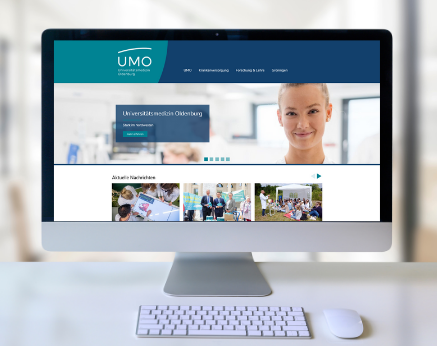
New website of the University Medicine Oldenburg (UMO)

The website “universitätsmedizin-oldenburg.de” provides an overview of UMO's structures and news from university medicine. It complements the websites of the faculty and the cooperating hospitals and gives external visitors in particular an impression of UMO's diversity and unique selling points.

To the UMO website

The model course of study in human medicine is the first time in Germany that medical training is taking place across borders. 120 study places are currently available annually on the Oldenburg side at the European Medical School Oldenburg-Groningen.

Characteristics of the school VI are the highly regarded cross-border model course in human medicine - the European Medical School Oldenburg-Groningen (EMS) - as well as the close integration of basic research, clinical research and health care research. It thus offers students and scientists an excellent environment in which to acquire and apply the knowledge and skills necessary for the medicine of the future.

Current news

Insights into the School VI

  • A young woman sits next to a doctor who shows something on a clipboard. The hands are in the center of the picture.

    Only some breast centres offer cancer patients the opportunity to participate in tumour conferences. In most cases, patients are presented with an already completed treatment plan. Photo: AdobeStock/smolaw11

Should cancer patients participate in tumour conferences?

Only a few breast cancer and gynaecological centres in Germany offer their patients the opportunity to take part in tumour conferences. A new study provides data to improve the assessment of the advantages and disadvantages of patient involvement.

Only a few breast cancer and gynaecological centres in Germany offer their patients the opportunity to take part in tumour conferences. A new study provides data to improve the assessment of the advantages and disadvantages of patient involvement.

The goal of tumour conferences is to determine the best treatment for patients with complex cancers. In these interdisciplinary meetings, doctors from various branches of medicine including oncology, radiology, surgery and pathology convene to talk about a patient's case ­– however, the patient is rarely present. In the PINTU study, which is funded by the German Cancer AID, a team of researchers from the University of Oldenburg and the University Hospitals of Bonn and Cologne has now investigated whether cancer patients can benefit from participating in these meetings. A key finding of the study was that most respondents perceived their participation as a positive experience, as the team reports in the medical journal Cancer Medicine. The findings are intended to contribute to the development of recommendations for hospitals that would like to include patients in tumour conferences.

"Whether patients really benefit from being involved in these often very technical discussions is a controversial – and unfortunately little studied – question," says Professor Lena Ansmann, a health services researcher at the University of Oldenburg and lead author of the study. Nonetheless, there is a growing international quest for ways to increase patients' involvement in the planning of their treatment. The goal of the research team was therefore to compile and analyse a large data set. "As far as we know, our study is one of the first large studies on this topic," says co-author Professor Nicole Ernstmann, an expert in health communication at the University Hospital Bonn.

What role do the patients play?

The majority of breast cancer patients in Germany are currently treated at certified cancer centres. Tumour conferences are mandatory there, but the participation of those affected by the disease is not. "We know from previous studies that about five to seven percent of patients have already participated in a tumour conference," Ansmann explains. But what role patients play in the conferences, how they are organized, and how the participants experience them has been unclear so far.

To reduce this knowledge gap, the researchers surveyed 87 patients with breast cancer or a gynaecological tumour before and immediately after their participation in a tumour conference and then four weeks later. For comparison, they also surveyed 155 patients who did not attend the tumour conference on their case. In addition, the team observed a total of 317 case discussions in tumour conferences – directly and also via video and audio recordings. Patients were involved in 95 of these case discussions.

The data gathered shows that the procedures at tumour conferences with patient participation varied greatly. Some hospitals allowed the patients to participate during the entire conference. Others held the actual conference without the patients, but allowed them to participate in a smaller meeting afterwards in which they were informed about recommended therapy options, for example. Other aspects of the conferences also varied, such as the duration and the seating arrangement.

Informative and to be recommended

The interviews showed that the patients played a rather passive role in the conferences. For example, only 61 percent reported being involved in the actual decision on what treatment they should receive. Overall, most patients perceived their participation in the conference as positive. They found them informative, for example, and recommended that others participate. However, some patients also reported that taking part in the conference had triggered feelings of fear and uncertainty – a factor that should be focused on more in future studies, Ansmann stresses.

New appointees

  • A young woman sits next to a doctor who shows something on a clipboard. The hands are in the center of the picture.

    Only some breast centres offer cancer patients the opportunity to participate in tumour conferences. In most cases, patients are presented with an already completed treatment plan. Photo: AdobeStock/smolaw11

Should cancer patients participate in tumour conferences?

Only a few breast cancer and gynaecological centres in Germany offer their patients the opportunity to take part in tumour conferences. A new study provides data to improve the assessment of the advantages and disadvantages of patient involvement.

Only a few breast cancer and gynaecological centres in Germany offer their patients the opportunity to take part in tumour conferences. A new study provides data to improve the assessment of the advantages and disadvantages of patient involvement.

The goal of tumour conferences is to determine the best treatment for patients with complex cancers. In these interdisciplinary meetings, doctors from various branches of medicine including oncology, radiology, surgery and pathology convene to talk about a patient's case ­– however, the patient is rarely present. In the PINTU study, which is funded by the German Cancer AID, a team of researchers from the University of Oldenburg and the University Hospitals of Bonn and Cologne has now investigated whether cancer patients can benefit from participating in these meetings. A key finding of the study was that most respondents perceived their participation as a positive experience, as the team reports in the medical journal Cancer Medicine. The findings are intended to contribute to the development of recommendations for hospitals that would like to include patients in tumour conferences.

"Whether patients really benefit from being involved in these often very technical discussions is a controversial – and unfortunately little studied – question," says Professor Lena Ansmann, a health services researcher at the University of Oldenburg and lead author of the study. Nonetheless, there is a growing international quest for ways to increase patients' involvement in the planning of their treatment. The goal of the research team was therefore to compile and analyse a large data set. "As far as we know, our study is one of the first large studies on this topic," says co-author Professor Nicole Ernstmann, an expert in health communication at the University Hospital Bonn.

What role do the patients play?

The majority of breast cancer patients in Germany are currently treated at certified cancer centres. Tumour conferences are mandatory there, but the participation of those affected by the disease is not. "We know from previous studies that about five to seven percent of patients have already participated in a tumour conference," Ansmann explains. But what role patients play in the conferences, how they are organized, and how the participants experience them has been unclear so far.

To reduce this knowledge gap, the researchers surveyed 87 patients with breast cancer or a gynaecological tumour before and immediately after their participation in a tumour conference and then four weeks later. For comparison, they also surveyed 155 patients who did not attend the tumour conference on their case. In addition, the team observed a total of 317 case discussions in tumour conferences – directly and also via video and audio recordings. Patients were involved in 95 of these case discussions.

The data gathered shows that the procedures at tumour conferences with patient participation varied greatly. Some hospitals allowed the patients to participate during the entire conference. Others held the actual conference without the patients, but allowed them to participate in a smaller meeting afterwards in which they were informed about recommended therapy options, for example. Other aspects of the conferences also varied, such as the duration and the seating arrangement.

Informative and to be recommended

The interviews showed that the patients played a rather passive role in the conferences. For example, only 61 percent reported being involved in the actual decision on what treatment they should receive. Overall, most patients perceived their participation in the conference as positive. They found them informative, for example, and recommended that others participate. However, some patients also reported that taking part in the conference had triggered feelings of fear and uncertainty – a factor that should be focused on more in future studies, Ansmann stresses.

Photo: University of Oldenburg

(Changed: 12 Dec 2025)  Kurz-URL:Shortlink: https://uol.de/p29n5323en
Zum Seitananfang scrollen Scroll to the top of the page