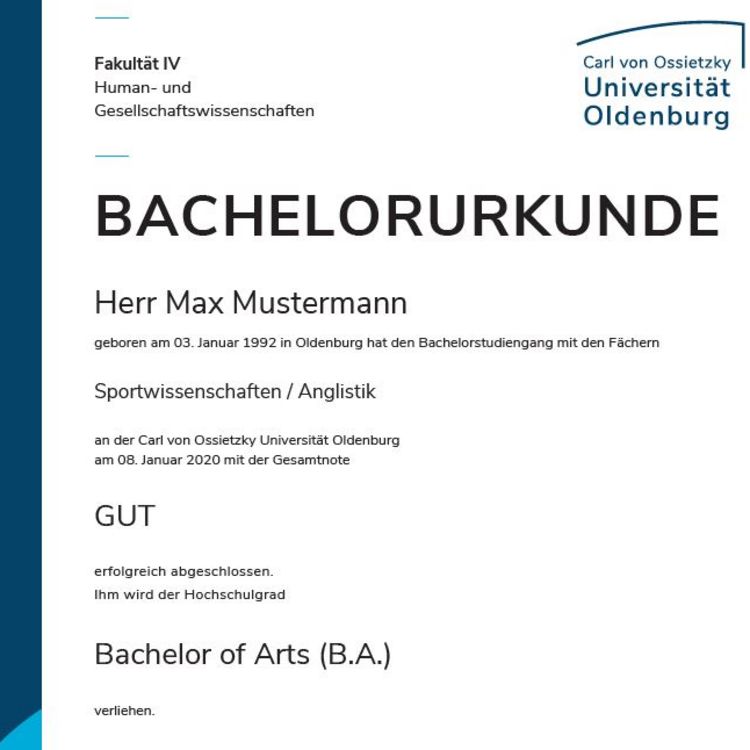

On 1 October 2004, the University of Oldenburg became the first higher education institution in Lower Saxony – and one of the first in Germany – to convert almost its entire range of degree programmes to Bachelor’s and Master’s degrees.
The new degree programmes had been under discussion for years. They replaced almost all ‘Diplom’, ‘Magister’ and ‘Staatsexamen’ degree programmes in Germany. This was because, in 1999, the education ministers of 29 European countries had agreed in Bologna to standardise higher education qualifications and introduce the European Credit Transfer and Accumulation System (ECTS). This was intended to facilitate the recognition of qualifications and international student exchanges. The then university president, Prof. Dr Siegfried Grubitzsch, described the changeover as the “greatest higher education reform since Humboldt”. However, there was also a great deal of criticism: the reform was accused of making degree programmes too ‘school-like’, imposing too many exams and leaving students with too few options. As a result, several adjustments were made to reduce the workload.
School V - School of Mathematics and Science – was particularly swift in implementing the changes. By the 2005/06 winter semester, all of its 16 Bachelor’s and Master’s degree programmes at the time had been accredited, meaning they were recognised as fully-fledged degree programmes. This made it the first School in Lower Saxony to offer exclusively the new Bachelor’s and Master’s degree programmes. Computer Science students had even been able to study for a Bachelor’s degree since 2001.
As of 2024, the University of Oldenburg offers 17 single-subject Bachelor’s programmes, 30 double-subject Bachelor’s programmes, 82 Master’s programmes in teacher training and 50 specialist Master’s programmes, as well as the state examination programme in human medicine. In the 2023 academic year, around 2,800 students graduated from the University of Oldenburg.