
Events organised by School IV
Events organised by School IV
School IV’s 3rd Research Day
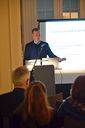
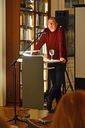
On 28 January 2026, School IV’s third Research Day took place at the Karl Jaspers-Haus. With a total of eight speakers, the event focused this time on newly appointed professors and current research projects. Between the presentations, there was an opportunity for exchange, discussion and networking.


2nd Research Day of School IV
On 11 June 2025, School IV held its second Research Day with guests from Faculties I and III at the Karl Jaspers House.











1st Research Day of School IV
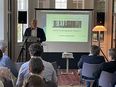
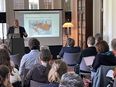
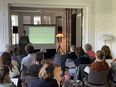
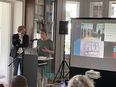
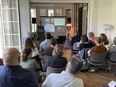
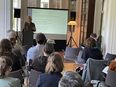
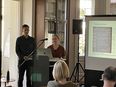
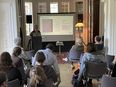
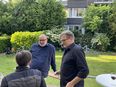
On 22 January 2025, School IV’s first Research Day took place at the Karl Jaspers Haus. Through a total of six short presentations, researchers from all four Institutes provided an insight into their current research projects. The programme was put together on the basis of feedback. Professors and research staff were invited. Between the presentations, there was an opportunity for discussion and for participants to get to know one another. Dean Freist stated in her welcome address that this format for exchange is to be continued at irregular intervals.


Quo vadis, university?
Threats and visions for the future of an indispensable institution, conference 7 - 9 November 2024
Universities are, ideally, one of the key places where scientifically sound knowledge is generated, new findings are debated and validated, and made available to society. Universities thrive on open discourse and critical reflection on their subjects and findings. And they are founded on the freedom to conduct research and teach. Academic freedom is a crucial prerequisite for the independent acquisition of knowledge. Only on this basis can academia critically reflect upon and help shape the manifold socio-political challenges. Conversely, there is a growing expectation that academia should enter into co-operations with non-academic partners and thus serve the interests of business and society. The massive upheavals we are currently experiencing are leading to social uncertainty and to conflicts over the authority to interpret our present, as well as over the guiding principles for action that should be derived from this to shape change. In this situation, academia has a role to play for society as a whole, not least in clarifying the distinction between opinions and scientifically verifiable findings.
However, a look at the current framework conditions for universities in Germany raises the question of whether universities are capable, both now and in the future, of living up to this self-image and fulfilling this scientific and societal role. Academic freedom is confronted with an economic logic centred on commercialisation, competition and growth, as well as quality criteria that are gradually eroding the framework conditions for research and teaching. Recently, academic freedom has been called into question on the basis of political arguments.
The conference combines a critical assessment of the university’s strengths and the threats it faces with reflections on how the increasing restriction of freedom in research and teaching can be countered. The following key questions are at the heart of the discussion:
- What should a university look like in the 21st century that, on the one hand, preserves its unbeatable core – research without specific objectives – whilst, on the other hand, does not ignore the demands and challenges of the present?
- Are there political limits to academic freedom?
- Do current scenarios for the future threaten to unduly prejudice the content and methods of knowledge production?
- Who determines the relevance of research – the scientific community, an economic logic of exploitation, or socio-political debates?
- How can conditions be shaped so that the university can protect itself from a neoliberal logic of competition, commercialisation and growth without retreating into an ivory tower?
- Do substantive criteria or quantitative indicators determine the quality of research and the academic abilities of researchers?
Finally, a panel discussion will summarise the findings and engage in a lively debate on them.
Programme
| Thursday, 7 November 2024 | Lambertus Hall (St Lambert’s Church, Market Square) |
|---|---|
| 17.00–18.00 | Welcome: Prof. Dr Ralph Bruder (President of the University of Oldenburg) Opening: Prof. Dr Dagmar Freist / Prof. Dr Thomas Etzemüller (University of Oldenburg) |
| 6.00 pm–7.00 pm | Opening lecture: The present and future of the Universityof Jürgen Kaube (co-editor of the *Frankfurter Allgemeine Zeitung*) |
| 8.00 pm | Dinner |
| Friday, 8 November 2024 | BIS Hall (University, Haarentor campus) |
|---|---|
| 09.00–10.30 | Humboldt University as an ideal The Genesis of the Neoliberal University |
| Break | |
| 11.00–12.30 | Creating spaces for freedom, strengthening democracy – a humanities perspective on today’s university Current analyses and future scenarios for the university |
| Lunch break | |
| 14.00–15.30 | Algorithms and ‘Excellence’ – Quality Standards, Quality or Academic Freedom Ways out of digital immaturity |
| Break | |
| 16.00–17.30 | Cloned academia? Standardised career paths, regimes of profile-building. What does the ideal early-career researcher look like? Beyond the Professorship. Reflections on a reform of personnel structures in academia |
| 18.30 | Dinner |
| Saturday, 9 November 2024 | BIS Hall (University, Haarentor campus) |
|---|---|
| 09.30–10.15 | Are transformative activities by universities a source of conflict? Prof. Dr Remmer Sassen (Business Administration; TU Dresden) |
| Break | |
| 11.00–13.00 | Panel discussion: Is there room for scholarship in the neoliberal university? Prof. Dr Dr h.c. Jutta Allmendinger (Chair of the Lower Saxony Scientific Commission, former President of the Berlin Social Science Centre) Min.Dir. Rüdiger Eichel (Lower Saxony Ministry of Science and Culture) PD Dr Ariane Leendertz (Munich Historical Commission) Prof. Dr Thomas Alkemeyer (University of Oldenburg) Moderator: Anja Reiter ( science journalist, Munich) |
| Closing | Lunch, departure |