Contact

Do you have any suggestions or comments on the co-operation? Then write to

Lively co-operation between city and university

The good cooperation between the City of Oldenburg and the University of Oldenburg has a long tradition. In November 2023, both partners opened a new chapter: shortly before the university's 50th anniversary, the city administration and the university set joint priorities for the future as part of a new strategic cooperation agreement.

Collaboration between university and city on the rise

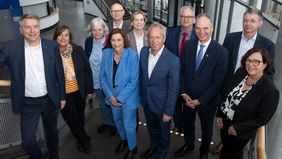
  • 13 people in suits and costumes stand as a group on the stairs of the auditorium centre.

    The leaders of the city and university, led by Lord Mayor Jürgen Krogmann (left) and University President Ralph Bruder (below, 2nd from left), met for their most recent meeting in the lecture theatre centre on the Haarentor campus. University of Oldenburg / Daniel Schmidt

Collaboration between university and city on the rise

The heads of the city and university drew a positive interim balance at the annual meeting. The co-operation will focus on the start of construction of the medical campus in 2026 and the promotion of new medical start-ups.

The heads of the city and university drew a positive interim balance at the annual meeting. The co-operation will focus on the start of construction of the medical campus in 2026 and the promotion of new medical start-ups.

On Tuesday, University President Prof Dr Ralph Bruder and Lord Mayor Jürgen Krogmann met with the heads of the city administration and members of the university management for the thirteenth annual meeting between the University and the City of Oldenburg. At the joint meeting, the university and city leaders gave a positive interim assessment. This year's work programme focuses on the fields of medicine and innovation: construction of the medical campus is scheduled to begin in the summer. The programme will also focus on promoting start-ups in the medical sector. The two partners are also continuing projects that have already begun and are planning new projects in the areas of climate neutrality and start-up culture, for example.

"In 2025, we have continued and deepened our exchange of expertise in all five core areas of our co-operation and beyond," emphasised University President Bruder. "With projects such as 'Age Friendly Cities', in which our researchers collect data on how age-friendly Oldenburg is, or the Lower Saxony-wide energy network project TEN.efzn, the university is increasingly putting its knowledge into practice."

"The collaboration between the city and the university has experienced a noticeable boost in just two years since the strategic cooperation agreement was signed. In 2026, many projects will be stabilised and further developed," says Lord Mayor Jürgen Krogmann. "The outstanding success of the university, which was able to successfully apply for all clusters of excellence last year, also has a very positive impact on the city as a whole, both in terms of construction and the development of skilled labour. This would be further enhanced by a successful proposal as a University of Excellence this year. The city is doing all it can to support the university."

A new project in the area of "climate neutrality" is the "Climate Garden": the transformation of the university's Botanical Garden towards climate neutrality has been underway for some time - the aim is to have green roofs and facades, a heat supply from geothermal energy and electricity from photovoltaic systems. A highlight of the project, in which the city is also involved, is a new exhibition building in the entrance area of the Botanical Garden, which will be completed this year. University and municipal activities relating to climate change and climate adaptation will be presented there.

Construction is due to start on the medical campus

In the area of "Further development of the university", the priority this year is on medicine: construction will soon begin on the new teaching and research buildings for university medicine. In the first construction phase, almost 4,000 square metres of laboratory and office space, including a wet anatomy unit, will be built by mid-2030.

Another major joint project between the city and the university is the development of a medical innovation cluster as part of University Medicine Oldenburg. Under the name "MediTech-Cluster", it is intended to network players from the healthcare industry, science and technology in order to bring together partners who will jointly provide new impetus for the healthcare sector. The 6.3 hectare MediTech site between Klingenbergstraße and Alter Postweg offers ideal conditions for setting up a business. The immediate proximity to the hospital offers companies direct contact with university medicine and thus with potential clinical research partners.

The city and university are currently jointly recruiting a project leader and a project assistant to drive forward the development of the MediTech cluster over the next two years. The aim is to develop an attractive concept for how established companies and start-ups from the healthcare sector and Oldenburg institutions can work together profitably. Establishing partnerships and expanding networks is an important first step. In the long term, a dedicated innovation centre is also to be established on the site.

Among other things, the EU-funded project "Gründung findet Stadt" (Founding finds a city) is ensuring that Oldenburg's successful start-up culture becomes more visible in the city - keyword "Campus Oldenburg". The opening of a "start-up showcase" and a market research laboratory in the Smart House are planned for this year. The city is involved through co-financing and also in terms of content.

Startup Factory commences operations

The "hoi startup factory", which will start operations this year, will provide an additional boost to the start-up culture. The project, led by the universities of Oldenburg and Bremen, was not selected for the hoped-for federal funding last year. However, thanks to financial support from industry, the facility, which is backed by a total of eight universities and aims to promote start-ups from the world of science, will nevertheless be launched. "The Oldenburg start-up network has come much closer together," emphasised Lord Mayor Krogmann. New networking formats have been created and the connection to Bremen and the region has become stronger.

The next meeting of the university and city leaders is planned for the middle of the year.

Background:

The city and university concluded a strategic cooperation agreement on 29 November 2023, which aims to consolidate, strengthen and further develop cooperation in five core areas: Climate neutrality, further development of the university, campus Oldenburg, start-up culture and internationalisation. The co-operation is based, among other things, on historical ties - the council's decision to establish a university dates back to 1959 - a first co-operation agreement from 2002 and annual talks between the heads of the university and the city since 2016.
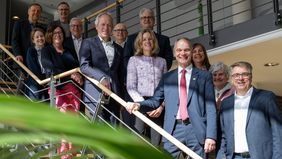
Joint work programme takes shape

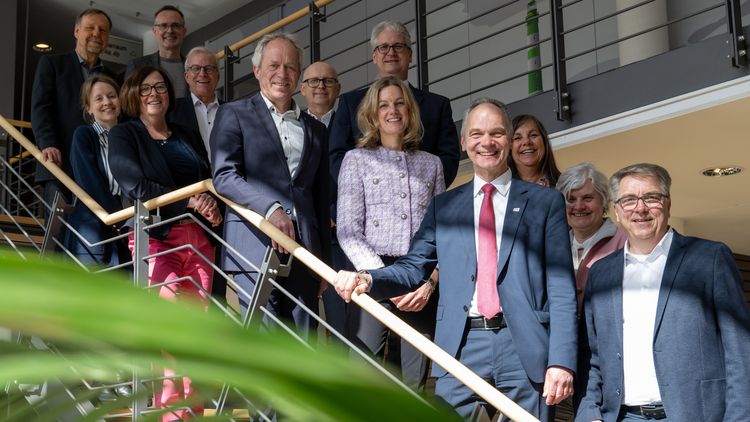
  • Men and women stand on a staircase and look into the camera. The President of the University is in the centre of the picture, alongside the Lord Mayor of Oldenburg and members of the University's Executive Board as well as top city administration officials.

    University President Ralph Bruder (front, second from right) and Lord Mayor Jürgen Krogmann (first from right) met with the heads of the city administration and members of the university's Executive Board for what is now the twelfth annual meeting. Sascha Stüber

Joint work programme takes shape

The dozen is full - but the ideas for further joint topics, projects and synergies are almost endless: the 12th annual meeting between the University of Oldenburg and the city leadership took place on Monday.

The dozen is full - but the ideas for further joint topics, projects and synergies are almost endless: On Monday, Lord Mayor Jürgen Krogmann and University President Professor Dr Ralph Bruder met with the heads of the city administration and the members of the University's Executive Board for the twelfth annual meeting of the City of Oldenburg and the University of Oldenburg. The meeting venue this time was the Oldenburg Technology and Start-up Centre (TGO).

The focus of this meeting was once again on the joint work programme for the coming years, which was divided into five core areas: climate neutrality, further development of the university, campus Oldenburg, start-up culture and internationalisation.

Lord Mayor Jürgen Krogmann praised the goal-oriented, intensive further work on the programme: "Since our last meeting in mid-November, a number of good ideas have been developed and concretised that will jointly advance both the university and the city - and from which not only both sides, but above all the people of Oldenburg will benefit in various areas. The close cooperation makes sense on so many levels. I look forward to us now actively tackling these issues together."

University President Professor Dr Ralph Bruder added: "For us as a university, it is noticeable every day how closely, trustingly and easily we work together with colleagues from the city administration. Be it in the major development steps of the university, for example in the area of excellence strategy or medicine, or in the many other topics that we can simply work on better and more purposefully together."

Concrete project ideas from the five core areas

In the area of "climate neutrality", for example, the already agreed, ongoing and new project ideas were presented and prioritised. Topics such as cycle path infrastructure, urban greenery and climate adaptation are therefore now at the top of the agenda for 2025.

In the area of "Further development of the university", new projects will be initiated this year, particularly in the areas of social affairs / health and medicine / innovation / start-ups, which should also have a positive impact on the city and university in the longer term. Examples of this include the "age-friendly cities" co-operation, which began in 2024 and will be strengthened with a follow-up project, and the collaboration on "student housing". In addition, the exchange on culture and sport is to be intensified in order to identify potential joint projects.

Two joint projects are in the starting blocks this year in the two areas of "Campus Oldenburg" and "Start-up culture": the city centre start-up project "Gründung findet Stadt" and the application for the "hoi startup-factory" of the Universities of Oldenburg and Bremen with the support of the City of Oldenburg.

According to Bruder, there is still a lot to be done together in the area of internationalisation: "The need for supervision and support for international students and visiting academics will continue to increase as we intensify our internationally oriented research as well as our English-language Master's degree programmes. I see our challenges here primarily in terms of adequate accommodation."

Krogmann sees further positive effects for the city, especially in the further expansion of the existing co-operation between the University of Oldenburg and the RUG Groningen as part of the "Northwest Alliance" of universities: "The long-standing partnership between Oldenburg and Groningen could also benefit from this."

Other topics on the agenda

Other items on the agenda included a report on the status of the Excellence Strategy as well as compact presentations on the WEALTH innovation cluster and the "Suicide prevention in schools" co-operation project. The Powerhouse North and the upcoming "USA Encounters" this autumn were also the subject of the annual meeting.

The next meeting in this round is planned for autumn 2025.

University and city provide each other with a tailwind

  • A well-rehearsed team: The city and university leaders around Lord Mayor Jürgen Krogmann (left) and University President Ralph Bruder (3rd from right) came together for their most recent meeting in the lecture theatre centre on the Haarentor campus. University of Oldenburg / Daniel Schmidt

University and city provide each other with a tailwind

With a strategic cooperation agreement, the city and university have been writing a new chapter in the history of their collaboration for a year now. In a joint meeting, the university and city leaders gave a positive interim assessment.

With a strategic cooperation agreement, the city and university have been writing a new chapter in the history of their collaboration for a year now. At their most recent joint meeting, the university and city leaders gave a positive interim assessment.

"Together we are strong," said Lord Mayor Jürgen Krogmann and University President Prof Dr Ralph Bruder. "Thanks to the many years of successful cooperation between the university and the city, this realisation may not be new - but the even closer interlinking of strategic core areas already shows after just one year that we are mutually advancing each other all the more." Both sides rated the progress made in areas such as climate neutrality, the development and visibility of the university within the city centre and the start-up culture as consistently positive.

Striving for the age-appropriate city

Against the backdrop of demographic change, the city and university have jointly focused on the topic of age-friendly cities and developed a German-language questionnaire based on guidelines from the World Health Organisation (WHO). An initial survey in Oldenburg was very well received, with over 900 responses out of a total of 2,000 distributed. The presentation of the initial results in October also met with great interest. The team of urban social planners and prevention and rehabilitation researchers from the university are planning a representative survey every two years in future to identify successful measures and potential for improvement.

The German-language Oldenburg questionnaire, which has since been adopted by the WHO, is based on a predecessor developed in The Hague in the Netherlands, which has already been used internationally by cities to analyse their age-friendliness. "The project illustrates the efforts of the city and university to face the social challenges of our time in a scientifically sound and practice-oriented manner," emphasises Lord Mayor Krogmann.

Tackling future tasks together

With regard to another future task - the transformation of the energy system - both sides also believe that Oldenburg is ideally positioned as a centre for energy research: In a recently approved programme of the state of Lower Saxony, the university is involved in four of six sub-projects, in three of them in a leading role and additionally with the university's C3L - Center for Lifelong Learning in the transfer programme. In total, the "Transformation of Lower Saxony's Energy System" programme bundled at the Energy Research Centre of Lower Saxony (efzn) has a volume of over 58 million euros over five years. The city administration was also involved in the preparation of the successful university proposal via the Oldenburg Energy Cluster OLEC e.V., and the city's economic development agency provided financial support for the conceptualisation of the transfer concept.

The aim is to make research results usable for society, for example with regard to wind energy and the hydrogen economy, be it in the training and further education of skilled workers or in the promotion of start-ups. "The energy transition continues to need new ideas and well-trained specialists," emphasises President Bruder. "We would like to thank the city for its support in the application process and the perfect cooperation."

Oldenburg's entrepreneurial spirit is also illustrated by the first success in the proposal for a "Startup Factory" in north-west Germany under the aegis of the universities of Oldenburg and Bremen - with the support of regional businesses and seven other universities. The Federal Ministry of Economics has selected the project entitled "Lighthouse Northwest" as one of 15 nationwide and is funding the concept development until February 2025. The aim, also supported by the city of Oldenburg, is to combine start-up support in Lower Saxony and Bremen and to create a seamless path from the initial business idea to market entry with complementary services. The universities of Oldenburg and Bremen are planning an event for all supporting stakeholders in January.

Making the start-up spirit visible in the city centre

"Start-up finds the city" is the title of another project that the university and the city have successfully acquired together from the European Regional Development Fund (ERDF) and which will start at the turn of the year in the Schlaues Haus on Schloßplatz. The plan is to set up a "start-up showcase" and a market research laboratory in the city centre. The university's start-up and innovation centre (GIZ) and the city's business development department will cooperate during the three-year implementation phase - as they did when preparing the proposal. "This project further increases the visibility of the university in the city centre - keyword: Campus Oldenburg," says Bruder.

The city is also on board with the AHOI_MINT educational project at the Schlaues Haus under the direction of university physics didactics expert Prof Dr Michael Komorek - be it in the strategy group, on the project advisory board or as a financial sponsor of the AHOI-MINT days, which were last held on the Schloßplatz in the summer. And when the project team, which aims to get young people in the region interested in maths, Computing Science, natural sciences and technology, founded its own support association together with other stakeholders these days, the city also provided support - for example in drafting the association's statutes.

Making progress on the path to climate neutrality

The university and the city continue to actively work together to protect the climate and support each other in their ambitious goals, for example in achieving climate neutrality (University 2030, City 2035). This is currently particularly evident when it comes to cycling in the immediate vicinity of the university. While the city has recently promoted the "green wave" on Ammerländer Heerstraße - thanks to LED displays, cyclists can adjust their cycling behaviour to the traffic lights - the university recently put a new bicycle parking facility into operation on the Haarentor campus.

In 2025, urban developers will be looking at the cycle path on Pophankenweg and the infrastructure on Infanterieweg, among other things. The focus will also be on the mobility concept for the planned medical campus on Pophankenweg. There will also be close cooperation in the "StadtGrün naturnah" labelling process of the Bündnis Kommunen für biologische Vielfalt e.V. (Communities for Biodiversity Alliance), in which the city of Oldenburg is involved. The aim is to bring more nature into the city. The university will be involved in the labelling process as a cooperation partner and concrete projects are also to be implemented on campus. University members can also actively participate in a campaign in the Haarenniederung in 2025 to rid the nature reserve of non-native plant species.

Annual dialogue between the University and the City of Oldenburg

Oldenburg. 50 years of the University of Oldenburg, the Integrated Urban Development Concept (ISEK) and the new cooperation agreement signed in November: Lord Mayor Jürgen Krogmann and University President Professor Dr Ralph Bruder met with the heads of the city administration and members of the University Executive Board on Monday, 22 April, for the tenth annual meeting between the City of Oldenburg and the University of Oldenburg in the Old Town Hall to discuss these and other topics.

Work programme for the coming years
Based on the strategic cooperation agreement, which the City of Oldenburg and the university renewed and signed on 29 November 2023 to mark the university's 50th anniversary, the meeting focused on the joint development of a work programme for the coming years. To this end, measurable objectives for cooperation have been developed and described in five core areas through concrete measures.

Common goals in the area of climate neutrality have been worked out for mobility, energy and heat supply as well as ecological adaptation, nutrition and education. The further development of the university, in terms of content, personnel and building planning and utilisation at the various university locations, and the visibility of the university throughout the city were also discussed in depth. Based on the good cooperation to date, topics relating to the promotion of start-ups and further internationalisation are also to be worked on intensively. Joint marketing for Oldenburg as a centre of study and research and a place to live was also on the agenda.

The next annual meeting is already planned for this autumn in order to accompany the development at the working level.

New chapter of cooperation

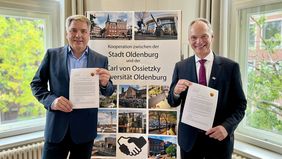
  • Two men stand in front of a display and hold a sheet of paper up to the camera.

    Lord Mayor Jürgen Krogmann (left) and University President Ralph Bruder presented the cooperation agreement. City of Oldenburg

New chapter of cooperation

The city of Oldenburg and the university want to cooperate more closely in future. In an agreement, the city administration and the university have agreed on five strategic priorities.

The city of Oldenburg and the university want to cooperate more closely in future. In an agreement, the city administration and the university have agreed on five strategic priorities.

The cooperation between the city of Oldenburg and the university is a success story. Now both partners are opening a new chapter: Shortly before the celebrations to mark the university's 50th anniversary, which begin on 5 December with a ceremony, the city administration and the university have agreed on joint future priorities as part of a new strategic cooperation agreement. For the first time, cooperation in five core areas will be managed in annual work programmes and regularly evaluated in order to make results visible.

"The University of Oldenburg has been a particular stroke of luck for Oldenburg over the past 50 years. With the new agreement, we are centring our joint activities and aligning them in a results-oriented manner. This is the basis for further growth of the city and the university," said Lord Mayor Jürgen Krogmann at the presentation of the strategy paper in the town hall. University President Prof. Dr Ralph Bruder emphasised: "The University and the City of Oldenburg have been closely linked for many decades, and our partnership is characterised by trust, appreciation and mutual support. Building on this foundation, we want to think even more purposefully about the future of the city and university together and shape it with foresight."

The strategy paper is to be presented to the city council for approval in November. The University Senate of Carl von Ossietzky University has already taken note of the strategy paper and no resolution was required in the Senate. The new strategy paper replaces an initial cooperation agreement from November 2002, which was signed by the then Lord Mayor Dietmar Schütz and the then President of the University, Prof. Dr Siegfried Grubitzsch.

Continuous co-operation

Krogmann and Bruder pointed out that there is already continuous cooperation between the two institutions, including in so-called "annual talks" at top level with all department heads and the Lord Mayor as well as all members of the university's Executive Board. This format, which has been in place since 2016, has led to a close and trusting exchange and concrete project collaboration. The joint commitment to the development of University Medicine Oldenburg was agreed in such annual meetings.

Five core areas

The strategic cooperation agreement outlines five core areas in which cooperation is to be consolidated, strengthened and further developed over the next five years:

  1. Climate neutrality: the university and the city are actively working together to protect the climate and support each other in their ambitious goals, for example in achieving climate neutrality, which the university is aiming for by 2030 and the city by 2035.
  2. Further development of the University of Oldenburg: The university and the city are strengthening their knowledge transfer as well as their cooperation on topics of the future, for example in the qualification of employees and lifelong learning.
  3. Oldenburg campus: The visibility of the university in the city centre will be further increased, for example through joint events organised by the university and the city.
  4. Start-up culture: The city and university are jointly developing their start-up support, for example in the areas of sustainability and energy, digitalisation, health and care.
  5. Internationalisation: Both sides are jointly expanding their international partnerships and are actively recruiting personnel, among other things.

It is the joint goal of the city and the university to build on these core areas in order to shape the cooperation in a measure-oriented and thus concrete manner and to continuously evaluate the respective implementation status as part of annual work programmes. Both Krogmann and Bruder emphasised that cooperation should also be further developed beyond the five core areas in other fields of existing or future co-operation. A coordinating contact person will be appointed on both sides for this as well as for the implementation of the strategy paper.

Lord Mayor: University makes Oldenburg attractive

Lord Mayor Jürgen Krogmann: "The university has had a significant influence on the city's development, when I think of the science axis in the west and the Wechloy district. Institutes and spin-offs such as OFFIS and Computing Science, hearing research, the wind research centre and, of course, university medicine have had a lasting and structural impact on the city. Not forgetting the core competences in education and further education, which make Oldenburg so attractive for students nationwide. The university's expertise in continuing education is of crucial importance for overcoming the shortage of skilled labour nationwide."

University President: Benefiting from each other

University President Bruder: "I am sure that we will benefit from involving each other in projects and sharing expertise in all areas. I would like to thank the city leadership and Lord Mayor Jürgen Krogmann in particular for enabling us to agree on such action-oriented and concrete cooperation."

Historical ties

Krogmann and Bruder emphasised that the university and the city are characterised by historical ties. The decision to establish an academic university was taken by the Oldenburg City Council back in 1959, and in the 50 years of its existence, the university has made a major contribution to social, cultural and economic life in Oldenburg and the entire north-west region. Another example of this is the KIBUM children's and young people's book fair in Oldenburg, which has attracted national and international attention and has been jointly organised by the city and the university since 1975.

Lively co-operation between city and university

Internetkoordinator (Changed: 11 Feb 2026)  Kurz-URL:Shortlink: https://uol.de/p107650en
Zum Seitananfang scrollen Scroll to the top of the page

This page contains automatically translated content.