
Applied Artificial Intelligence

Contact

Group Lead

Prof. Dr.-Ing. Daniel Sonntag

Office

iml-sek@dfki.de

Office hours by appointment

Address

Stiftungsprofessur Künstliche Intelligenz
Marie-Curie Str. 1
D-26129 Oldenburg

See also

Applied Artificial Intelligence

The "Applied AI" research group, which is integrated into the Interactive Machine Learning research area of the German Research Centre for Artificial Intelligence (DFKI), focuses on the application and adaptation of artificial intelligence methods to, for example, industrial and medical applications. The topic of sustainability plays a major role in Oldenburg.

Research-relevant application aspects primarily address the use of learning systems and intelligent user interfaces. Particular areas of focus are multimodal input and output as well as multisensor applications using environment and state recognition, sensor data processing and questions of real-time capability and interactivity when learning from very large or very small amounts of data, through to reliability aspects (including trust in AI and explainable AI).

Regardless of specific subject areas, the overarching research goal is to design guidelines for the practical application of artificial intelligence. In addition, basic research is carried out in the interdisciplinary field of human-machine interaction in combination with machine learning.

Student projects for AI transfer are particularly important to us, a selection can be found here: iml.dfki.de For Bachelor's and Master's theses, please contact Hannes Kath.

News

KI2025: IML presents research on efficient bioacoustics analysis

Hannes Kath from the Chair of Applied Artificial Intelligence at the University of Oldenburg and the Department of Interactive Machine Learning at the German Research Center for Artificial Intelligence (DFKI) presented the research paper „Intermediate-Task Transfer Learning für bioakustische Daten” (engl. "Intermediate-Task Transfer Learning for Bioacoustic Data") at the KI2025 conference in Potsdam.

KI2025 is one of the most important European conferences on artificial intelligence, bringing together researchers, developers, and decision-makers from academia, industry, and public administration. This year's conference took place from September 16 to 19 in conjunction with INFORMATIK 2025.

The research shows that fine-tuning transfer learning models significantly improves the analysis of large bioacoustic datasets. These findings contribute to the development of efficient tools for biodiversity monitoring and thus represent an important step towards practical applications in ecosystem monitoring.
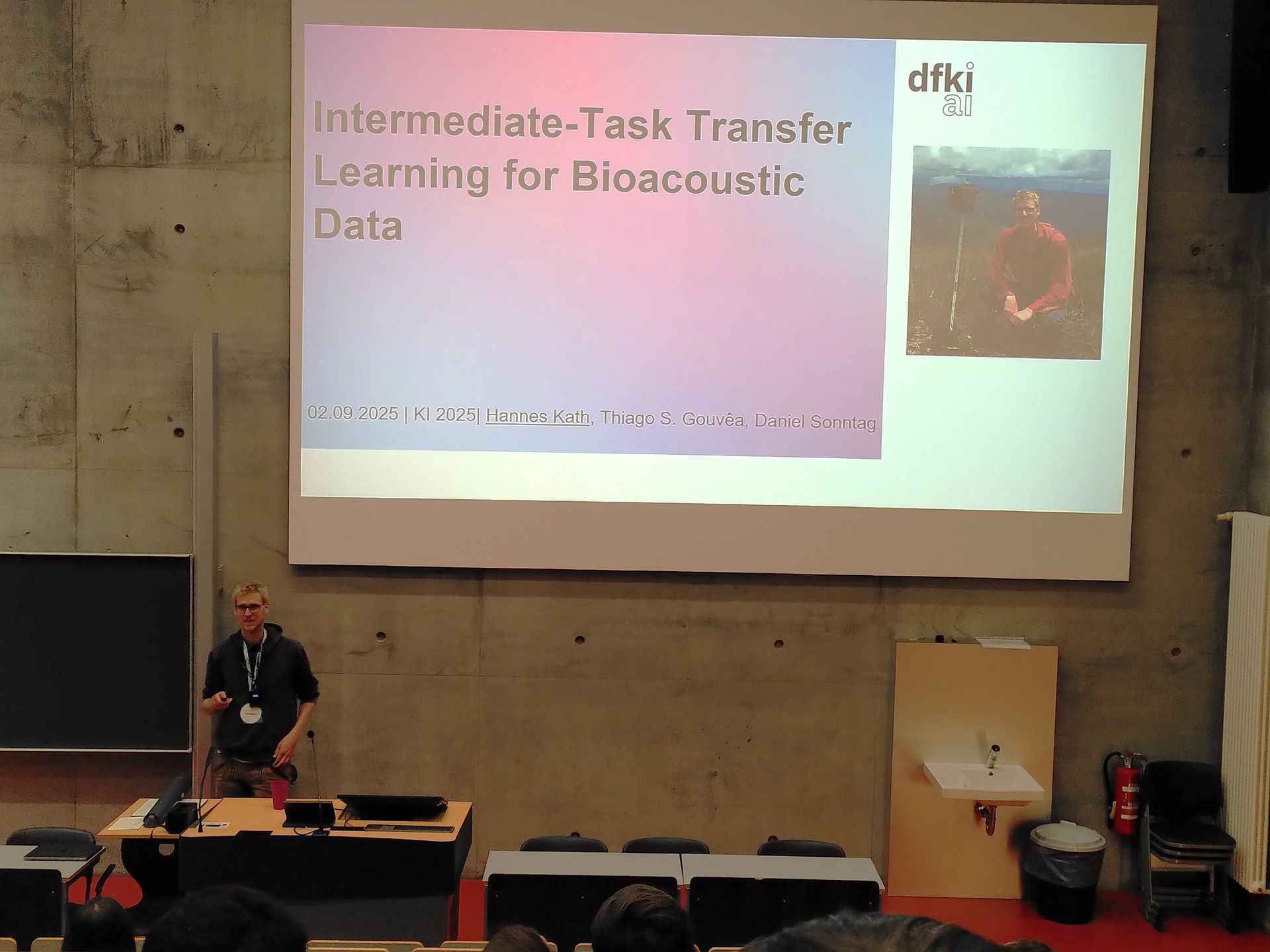
Hannes Kath from the Chair of Applied Artificial Intelligence at the University of Oldenburg and the Department of Interactive Machine Learning at the German Research Center for Artificial Intelligence (DFKI) presented the research paper „Intermediate-Task Transfer Learning für bioakustische Daten” (engl. "Intermediate-Task Transfer Learning for Bioacoustic Data") at the KI2025 conference in Potsdam.

KI2025 is one of the most important European conferences on artificial intelligence, bringing together researchers, developers, and decision-makers from academia, industry, and public administration. This year's conference took place from September 16 to 19 in conjunction with INFORMATIK 2025.

The research shows that fine-tuning transfer learning models significantly improves the analysis of large bioacoustic datasets. These findings contribute to the development of efficient tools for biodiversity monitoring and thus represent an important step towards practical applications in ecosystem monitoring.

Webmaster (Changed: 12 Dec 2025)  Kurz-URL:Shortlink: https://uol.de/p79699n12064en
Zum Seitananfang scrollen Scroll to the top of the page