Mediation - management of environmental conflicts?
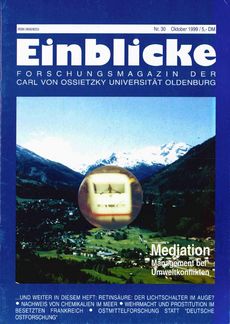
Mediation - management of environmental conflicts?
Mediation - Management of environmental conflicts
by Horst Zilleßen Today, mediation is often used to settle environmental conflicts. The process utilises findings from conflict and participation research as well as decision theory and leads the conflict parties to a joint conflict settlement in a systematic process controlled by a conflict manager. The example of the conflict over the expansion of the Tauern railway in the Gastein Valley illustrates how a mediation process works.
Mediation in Environmental Conflicts
Mediation has become a frequently applied procedure to settle environment-related conflicts. It considers the findings of conflict and participation research and includes basic aspects of the theory of decisionmaking. A mediator moderates the systematically conducted procedure and guides the conflicting parties in reaching a joint settlement of a conflict. The extension of the Tauern railway track in the Gastein valley in Austria will be taken as an example to illustrate a mediation procedure.
Benedikt Lang, the mayor of Bad Hofgastein, is certainly no political revolutionary, but he is prepared to offer more than just political resistance: "If ÖBB builds as planned, we will block the railway tracks with 500 people". He is referring to the environmental conflict that is currently throwing the world-famous Gastein Valley into turmoil: The Austrian Federal Railways (ÖBB) are planning to extend the railway line through the Gastein Valley.
With its decree no. 370 from 1989, the Austrian federal government declared the railway line Salzburg - Schwarzach/St. Veit - Villach - national border a high-capacity line. Furthermore, in the EU Accession Treaty, it also undertook to expand the so-called Tauern railway in the area of the northern ramp, i.e. in the access area to the Tauern Tunnel, through the Gastein Valley as a high-capacity route for passenger and, in particular, freight transport across the Alps. In concrete terms, this means that the currently single-track sections of the Tauern railway in the Gastein Valley will have to be double-tracked and that the capacity of the railway line, on which around 95 to 100 trains per day currently run, would increase to up to 240 trains per day.
What seems sensible from an environmental point of view in terms of relieving the Brenner line and making greater use of the railway for freight transport is a horror scenario from the perspective of the communities of Badgastein and Bad Hofgastein, which are particularly affected: in 10 years' time, trains could thunder through the narrow valley every 6 minutes; they would not only rob people of their peace and quiet, but also the entire valley of its economic basis - tourism.
The conflict constellation that emerges here can be described as typical of environmental policy: Whether railway or motorway route, whether Transrapid or airport construction, whether Emssperrwerk or wind energy parks - wherever such infrastructural measures are planned, they come up against conflicting interests, none of which can say with final authority that one would be less justifiable than the other. Politicians have often tried to do this in the past, but the authority was presumed rather than recognised because it was not clear that the interests involved had really been weighed up fairly.
When Emperor Franz-Joseph himself "most graciously opened" the railway line through the Gastein Valley in 1906, as can still be read on a plaque at Badgastein railway station, his subjects had no opportunity to oppose it, even if they did not agree with the railway construction. German Bahn AG can and does still build to a large extent today as it did in imperial times, applying railway law. The legal situation in which ÖBB finds itself is quite comparable to the German one, but they have recognised that it would be politically unwise and detrimental to their own long-term interests to continue along the traditional path of sovereign decisions. Like the responsible Federal Ministry of Science and Transport (BMWV) in Vienna, they have agreed to seek an amicable solution to the conflict in a mediation process involving representatives of all parties concerned. On the basis of a hearing on 9 March 1999, these representatives unanimously decided to commission the mediators Thomas Flucher, Biberist (Switzerland), and Horst Zilleßen, Oldenburg, to conduct this procedure.
What is mediation?
The idea of mediation is based on three key findings of conflict research:
Conflicts are everyday, unavoidable and recurring results of human activity and reflect actual or apparent incompatibilities between individual and group values, interests and goals. Both individual and social development are based on the open resolution of conflicts. Where this is not done or is suppressed, opportunities for development are wasted and social relationships are impaired or even destroyed. The groups of people affected by or involved in a conflict know best which interests need to be satisfied in order for a conflict settlement to be acceptable to them.
As certain as the productive power of conflicts is, it is also difficult for those involved in a conflict not to get caught up in a fruitless clash of positions in the heat of the dispute. The longer and more intense the disputes, the greater the danger that people will become fixated on asserting their own position instead of looking for a sensible solution to the conflict based on mutual interests. It is obvious: in concrete conflicts, the parties involved think first of all about their own advantage and not about extending the advantages for all those involved.
This is where the idea of mediation comes in, as it was developed primarily in the USA. The English word "mediation" means mediation, and the mediator is ultimately the go-between and conflict mediator who attempts to reach a joint conflict settlement in negotiations with the conflicting parties.
The starting point for mediation is the fact that the underlying interests of a conflict are rarely so straightforward and unambiguous that the possible outcome can only be a yes or no decision, as is the case with the pros and cons of abortion, for example. In environmental policy conflicts, procedural as well as psychological interests usually play a role alongside a wide range of substantive interests. On the one hand, it is certainly primarily about the specific subject of the dispute, e.g. the railway line, but also about whether the parties to the conflict feel that the decision-making process is comprehensible and fair in weighing up the different interests and whether they themselves feel that they have been treated appropriately.
In the resolution of conflicts, the mediator, as an uninvolved third party, has a decisive advantage over the parties directly involved in the conflict: he can control the content, procedural and psychological aspects of the conflict resolution in such a way that the different interests of all parties are covered, one-sided disadvantages are avoided and a settlement that is acceptable or at least acceptable to all is sought.
The question "What is mediation?" can therefore be answered as follows: Mediation is a structured and systematic form of conflict resolution through which a professional conflict manager, the mediator, supports those affected by a conflict and those interested in an amicable solution to reach a jointly responsible outcome specific to the case and problem. The primary aim is not to reach a compromise, but to find new, creative solutions to problems.
For the environmental sector - in contrast to family, school and business mediation - it must be added that mediation is to be understood here as preparation for decision-making; the ultimate responsibility of those with political or administrative responsibility cannot and should not be cancelled by mediation, because otherwise the political or administrative control would come to nothing. At this point, one might object as to how binding the outcome of mediation is if the final decision remains with politicians or the administration. The answer to this is that the binding nature of the outcome is derived from the consensus reached in the process, which the representatives of politics or administration were involved in as parties to the conflict. They will not agree to a result that they do not consider to be realisable.
The following must be regarded as essential prerequisites for mediation: the voluntary willingness of all relevant parties to the conflict to participate in the process; the acceptance of the mediator(s) by all parties to the conflict; the openness of the outcome, i.e. the absence of preliminary decisions on the part of the politically or administratively responsible parties that prejudge the outcome; the confidentiality or non-public nature of the negotiations. The latter does not mean that information about the course and results of the negotiations should be withheld from the public, but only that they themselves take place in private in order to create an atmosphere for dialogue in which the parties involved can understand each other in the full sense of the word.
Mediation as a political innovation
Mediation is not a passe-partout that opens the door to resolving all conflicts. But where, as in environmental policy, distribution conflicts and weighing up the pros and cons of plans, decisions and measures are involved, mediation represents a political innovation for four reasons:
- Mediation takes up the realisation of decision theory, according to which the result of the decision loses clarity with increasing complexity of the subject of the decision and the decision-making conditions - it is no longer self-evident, no longer self-evident. The mediation process takes into account the fact that what is factually or substantively correct no longer necessarily arises from the matter itself, but from an evaluation process in which subjective views of the problem, judgements and interests must be included alongside factual data and facts.
- Participation research shows that those affected by the decision must be involved in this evaluation process. Only through participation does a factually correct decision become "socially correct", i.e. comprehensible and executable. So if mediation assumes that a solution to a problem is not imposed "from above", as in the case of the Tauern railway, but is worked out jointly by those affected, then this pays off in two respects: In terms of decision theory, it improves the decision-making input through the knowledge and problem views, imagination and ideas of those affected; in political terms, it makes those affected participants in the problem-solving process instead of allowing them to become part of the problem in the form of political and legal resistance.
- This approach to mediation is also based on the results of conflict research. A conflict (Latin: confligere = to clash, clash, clash) can never be settled on the factual level alone; conflicts are always about people's emotions, interests and relationships. The structured course of the mediation process gives them space and thus takes account of the fact that conflicts can only be brought to sustainable solutions if all levels of conflict are adequately considered.
- The latter is not usually the case in the traditional political decision-making process, where a rather one-sided, hierarchical procedure is used to decide that a high-capacity railway line should be built. Those affected, e.g. in the Gastein Valley, only receive this information; they learn little or nothing about the legal and political obligations of the Republic of Austria, about the expectations and hopes of ÖBB, about the insights and views of those responsible for the planning, and they themselves feel that their own problems, interests and fears are not taken seriously. Mediation offers a new approach here, based on the findings of communication research: information is a message that conveys not only factual content, but also feelings and expectations, which is why it triggers not only factual reactions, but also emotional and affective ones. Although we know this, it is not always clear what is being conveyed by a message. This requires a process of decoding. This requires direct communication between the sender and receiver of the message and in many cases, such as complex environmental policy decisions, the involvement of an experienced conflict manager, a mediator, who helps the parties involved to make their messages understandable for the addressees, to decode them.
The course of a mediation process
The mediation process in the Gastein Valley, which began in April 1999, will illustrate how the theoretical principles of mediation from various fields of research are put into practice. It should be noted at the outset that although there is a general concept for structuring mediation procedures, each procedure must be planned taking into account the particularities of the case and must also be open to any adjustments that may be necessary as a result of the process.
In order to enable what must be regarded as the essential characteristic of mediation, namely an interaction between the parties to the conflict that is geared towards understanding, the number of participants in the process should not exceed 25. This ensures that the parties involved really get to know and understand each other, because understanding is the prerequisite for being able to develop an appreciation of the different interests involved.
Fortunately, the "Gastein Valley Mediation Forum" as the central body of this process remains below the maximum size. In addition to the mayors of the municipalities of Badgastein, Bad Hofgastein and Dorfgastein, the forum includes the head of the ÖBB planning department, a representative of the Provincial Environmental Ombudsman's Office (LUA), representatives of two citizens' initiatives, a representative of the Austrian Alpine Association (ÖAV) and one representative each of the Badgastein and Bad Hofgastein spa and tourism associations. There is also one representative each from the BMWV, the Office of the Provincial Government of Salzburg and the Salzburg Chamber of Commerce.
We have divided the process into three phases and assigned specific objectives to each. In the preparatory phase, intensive preliminary discussions were held with all parties to the conflict, focussing on the following points: Persons and groups to be involved, analysis of the situation and the development of the conflict as well as clarification of a suitable procedure. The results of these discussions not only provide the necessary background information for assessing how the conflict situation is viewed by the parties involved and how the conflict lines run, but above all allow a comprehensive conflict analysis. The key findings of this analysis were communicated to the participants at the first meeting of the mediation forum on 19 May 1999. The preliminary discussions also served to clarify the organisational issues important for the course of the proceedings (e.g. preparation, location, duration of the meetings and the practical problems of providing the participants with drinks etc. during the meetings). In this first phase, "rules of procedure" were also drafted, which set out the rules for dealing with each other as well as with the press and the general public. They were adopted at the above-mentioned meeting and represent an important first step on the way to solving the problem, insofar as they show the consensus that the participants want to go down this path together and how. The aim of the preparatory phase, i.e. to create a willingness to work together on the problem, has thus been achieved.
The decisive second phase of implementation must prove how far this willingness will go. It will begin with the participants naming the problems to be dealt with on the basis of the conflict analysis. To the extent that the problem description is agreed upon by the participants, it creates a consensus on what is to be achieved in the process. This also achieves the first objective of this phase, namely the mutual recognition of the different interests and needs of the parties involved.
If the participants agree on the problem definition, the next step in the process is the creative search for ideas, which - irrespective of the question of feasibility - should show what the parties involved imagine as an ideal solution to the problem based on their respective interests. This is necessary because usually - as in the present case - the participants have concrete proposals in their pockets that they have committed themselves to and which they see as a manifestation of their particular interests, from which they do not want to deviate. In Badgastein, there are three tunnel variants that, in addition to the ÖBB plans, must first be taken off the table in order to reopen the view of the problem and expand the spectrum of what can be considered rational solutions to the problem by those involved. This is described with the aim of "expanding the capacity to act". (In Bad Hofgastein, the situation is somewhat different; four planning options are under discussion here, which are to be jointly evaluated in order to reach a consensual decision).
Once a creative search for ideas has been successful, the resulting proposals must be operationalised, i.e. checked for feasibility. On the one hand, this requires the participants to agree on the criteria according to which the proposals recognised as feasible are to be evaluated, which in this case is to be prepared by a working group. On the other hand, railway engineering and geological, transport, economic and ecological issues must also be clarified - also prepared by working groups. The joint determination of assessment and feasibility criteria is intended to expand the scope for action and decision-making of all those involved and thus enable a joint solution to the problem.
The path to a consensual solution will be clear if the forum succeeds in agreeing on objective criteria according to which the route options recognised as feasible are to be evaluated. As in other procedures, this will probably lead to a package solution that combines the very different interests of noise protection, economic efficiency, traffic routing in the Gastein Valley, environmental and monument protection, compensation for the reduction in value of land associated with railway construction and many other aspects. The result will be set out in a document that will be signed by all those involved and will then serve as the basis for the planned measures in the Gastein Valley. The outcome of this process will - we hope - establish a long-term willingness to co-operate on the part of all parties to the conflict, as there will be further conflicts and problems to resolve if construction is carried out as recommended by the mediation forum.
The author
Dr Prof. Dr Horst Zilleßen teaches environmental policy/environmental planning at the Institute of Social Sciences. After studying political science at the University of Cologne, Zilleßen was, among other things, head of the Social Science Institute of the EKD before being elected President of the University of Oldenburg in 1980. In his subsequent teaching activities (since 1986), the scientist, who had been actively involved in the environmental protection movement in the 1970s, focussed on environmental policy. He heads the affiliated Institute MEDIATOR (Centre for Environmental Conflict Research and Management), which he founded.