
Detection of chemicals in the sea
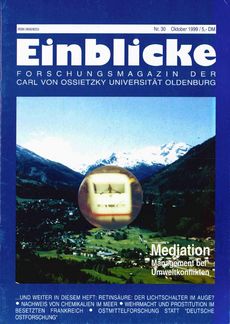
Detection of chemicals in the sea
by Rainer Reuter The German Bight is one of the areas with the highest volume of chemical shipments. After accidental or storm-related losses, such hazardous substances are difficult to find and recover. With new sensors installed on ships operated by the Federal Ministry of Transport, it will be possible in future to sensitively detect chemicals for accident prevention at sea.
Locating chemicals at sea
The German Bight is one of the world's busiest shipping routes. Due to storms or accidents chemical pollutants may come into the sea that cannot be localised with the technical means available today. For this purpose, new sensors are being developed that will be permanently installed onboard of pollution-combating vessels of the Federal Ministry of Transport.
The goods transported by sea also include a considerable amount of chemicals for the needs of the chemical industry. Like crude oil, for example, they are transported in ships specially designed for this purpose, so-called chemical tankers, or in containers or drums for smaller transport volumes. For example, the highly water-polluting substances ethylene dichloride and trichloroethane were handled in German North Sea ports alone in 1984 in quantities of 220,000 and 57,000 tonnes respectively.
In order to minimise the risk of environmental pollution from such sea freight, it is subject to extensive safety regulations, just like the transport of hazardous goods on land. Nevertheless, situations occur time and again in which large quantities of chemicals are released into the sea as a result of collisions between chemical freighters and other ships, for example, causing considerable damage. Ships with chemical cargoes that have sunk and cannot be salvaged are incalculable time bombs for the sea.
Stowed cargo is often damaged by storms, resulting in the release of chemicals that contaminate a ship and pose a considerable risk to the crew and those involved in the salvage operation. If cargo is damaged by heavy seas and is lost overboard, chemicals that have sunk to the seabed can make it too dangerous to deploy divers to recover the cargo. In such cases, it is first necessary to determine the hazard potential using remote-controlled probes equipped with sensors for detecting hazardous substances.
Very considerable consequential damage can already occur if hazardous substances are not released directly into the water, but remain in packaged form and are distributed to larger areas by currents. In December 1993, for example, the container freighter "Sherbro" lost 88 containers in a storm in the English Channel, five of which contained pesticides. One container was damaged, resulting in the release of around twelve tonnes of pesticides packed in 10-gram portions. The prevailing currents in the southern North Sea drove them to the French and Belgian coasts, but larger quantities were also found on the coasts of Lower Saxony and Schleswig-Holstein. Due to the size of the affected area, their removal required a financial outlay of several million marks, which could have been avoided if technical means had been available to detect damaged containers on the seabed.
A new measuring system
Chemicals that do not mix with water and float on the surface due to their low density can be detected from aeroplanes in a similar way to oil stains. It is more difficult to detect water-soluble substances, which usually only pose an immediate threat for a short time due to mixing with seawater. The localisation and identification of insoluble substances such as most chlorinated hydrocarbons, whose density exceeds that of water and which therefore sink to the seabed, is very problematic. Depending on the nature of the seabed, they can collect in depressions to form puddle-like pools, which are transported further by currents, or sink into the sediment. Due to a lack of detection options, it is not possible to recover such released substances.
In order to remedy these deficits in accident prevention at sea, the Federal Ministry of Transport has suggested developing new devices that can be used to identify both dissolved substances in the water column and non-soluble chemicals on the seabed. It should also be possible to analyse the condition of lost cargo containers and detect leaks from which pollutants escape.
Following a phase of fundamental research into various measurement principles that seemed suitable for detecting chemicals in the sea, a joint project was approved by the Environmental Protection Technology Project Management Organisation of the Federal Ministry of Education and Research with the aim of developing a new measurement system for these tasks. It consists of optical, acoustic and chemical sensors which, due to their specific performance characteristics, allow hazardous substances to be detected even in a complex marine area such as the German Bight with its high current speeds and high levels of turbidity that restrict visibility.
Acoustic scanning of the seabed
The first task in the search for chemicals in the sea is to localise the polluted area. This can only be done using remote sensing techniques that allow the nature of the seabed to be characterised over long distances. As sound waves are only slightly attenuated in the sea, acoustic methods are particularly suitable for this purpose. For example, acoustic scanning of the seabed, known as sonar, analyses the backscattering of sound pulses. This provides images that can be used to identify wrecks as well as smaller objects such as lost cargo over a distance of several hundred metres.
However, sonar cannot be used to detect chemicals that spread as sinkers on the seabed. This can be achieved with an acoustic impedance measurement method, on the basis of which an acoustic sensor is being developed in the working group of Prof Dr Volker Mellert at the Department of Physics at the University of Oldenburg. Instead of the backscattering of impulses on objects, acoustic waves are superimposed which propagate through the free water column or as an interface wave at the sediment-water interface. The resulting interference pattern is sensitively influenced by chemicals on the sediment surface.
In addition to the thickness of the chemical film, the acoustic impedance of the substance, which results from the product of density and speed of sound, is decisive for the interference pattern: the more it differs from the impedance of the seawater, the greater the influence on the spectrum of the transfer function.
Laser-based videography and spectrometry
Visible light is the only part of the electromagnetic spectrum that is not strongly absorbed in water and therefore allows optical information to be transmitted over long distances and substances in water to be analysed. While in marine areas characterised by clear water, underwater imaging over distances of up to around 20 metres is possible without any problems, the range in the German Bight is reduced to five metres due to the high content of suspended matter in the water, and often to less than one metre in coastal areas.
Optical images can also be obtained in optically cloudy sea regions if underwater images are taken using the radar principle. A very short flash of light lasting around one nanosecond is used for illumination, as can be generated by pulsed lasers. Due to the speed of light propagation in water, the spatial extent of such a flash of light is only 20 cm long. The scattered light generated by suspended matter in the water column, which is responsible for the low contrast of conventional underwater images, will then reach the camera earlier than the image of the sea floor that is actually of interest. The camera has a comparatively short shutter speed of one nanosecond. It is only activated when the flash of light reflected from the seabed reaches the camera, so that the scattered light from suspended matter in the water column is not registered at all. As a result, the range of underwater images can be improved by a factor of around three compared to conventional images.
By analogy with radar, this method is known as lidar (light detection and ranging). The Marine Physics working group at the Department of Physics has developed such an instrument to obtain underwater images of sunken chemical containers. Its high contrast should also make it possible to recognise cracks in containers from which pollutants can escape. The lidar can also be used to measure the fluorescence spectra of distant objects for more precise detection of chemicals on the seabed. This is useful when searching for transparent chemicals on the seabed that are invisible in underwater images: they can be located using their fluorometric "fingerprint".
Chemical sensors
In addition to the remote sensing sensors described above, which allow the detection of chemicals on the seabed over long distances, methods for detecting water-soluble substances are also required. Two instruments are available for this purpose: the quartz microbalance sensor QCM and the gas chromatograph and mass spectrometer GC/MS.
The quartz microbalance sensor QCM, developed by Prof P. Hauptmann at the Institute of Process Measurement and Electronics at the University of Magdeburg together with the company RST Rostock Raumfahrt und Umweltschutz, consists of an arrangement of eight oscillating quartz crystals coated with films of different polymers and exposed to water. Dissolved chemicals are selectively deposited on the coatings, causing the oscillation frequency of the quartz crystals to change differently and depending on the type of coating. The observed frequency changes of the array are analysed using statistical evaluation methods and a neural network and the dissolved chemicals are determined according to type and concentration. The lower detection limit of this method is approx. 1 ppm.
The gas chromatograph and mass spectrometer GC/MS developed by Prof G. Matz at the Technical University of Hamburg-Harburg serves as a second sensor for dissolved chemicals. Its detection sensitivity is around three orders of magnitude better than that of the QCM - albeit with volume dimensions around 15 times larger - and extends into trace analysis. The first stage of each measurement cycle consists of extracting the pollutants to be measured via a silicone membrane. Highly volatile substances pass through this membrane and low-volatility substances accumulate in it. After the enrichment process, the latter are desorbed again by heating. The extracted substance mixture is fed to the gas chromatograph and separated there into sub-stance groups of similar diffusivity. Finally, the molecular mass distribution of the separated groups is analysed in the mass spectrograph and the substances present are identified by comparison with mass spectra of pollutants stored in a database.
Future utilisation
The instruments developed by the partners in the joint project fulfil very specific and interrelated tasks as part of the system's deployment strategy. With its long range, the acoustic sensor fulfils the function of localising chemicals on the seabed over a large area; this is done after lost ship cargo has been located as the cause of a pollutant discharge using the acoustic sonar of a carrier ship. The condition of these containers, and in particular the leakage of chemicals, is analysed using laser-assisted videography. The chemical sensors detect water-soluble substances or the plumes of poorly soluble chemicals formed by ocean currents.
Other applications that go beyond this task can be found in the investigation of wrecks and the monitoring of submarine cables and pipelines laid on the seabed. The measuring system will also be useful for marine research, for example in analysing the chemical properties of seawater and determining the vegetation on the seabed. After its completion, the system will be permanently installed on the "Neuwerk" pollution control ship, which was commissioned in 1998, but its mobile design will also allow it to be used on other ships of the Federal Ministry of Transport in the North and Baltic Seas.
The author
After studying physics in Kiel,Dr Rainer Reuter was initially a research assistant at the GKSS Research Centre for Geosciences. He initially worked at the GKSS research centre in Geesthacht. He moved to the Department of Physics in 1979. Since 1983 he has headed the Applied Optics/Laser Remote Sensing working group, now Marine Physics. His research focus is on the development of methods for marine monitoring and the measurement and modelling of material cycles in the ocean.