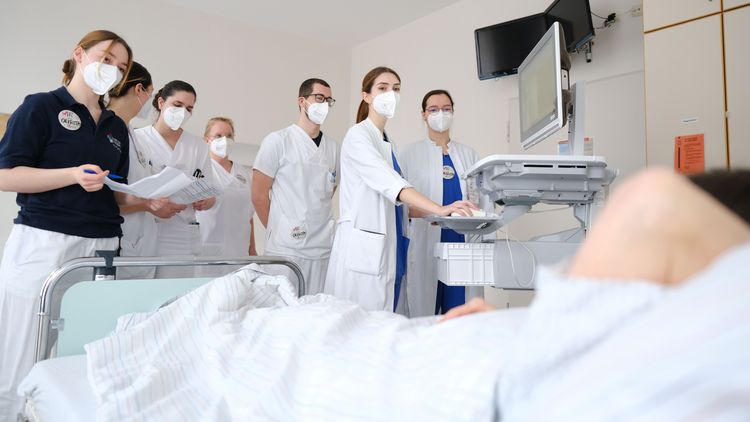
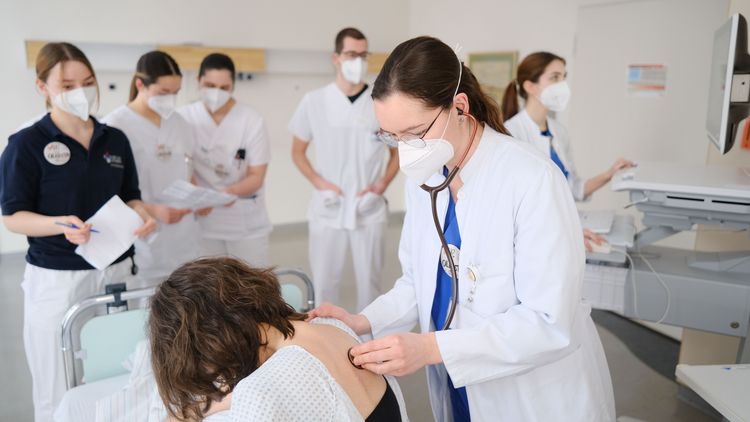
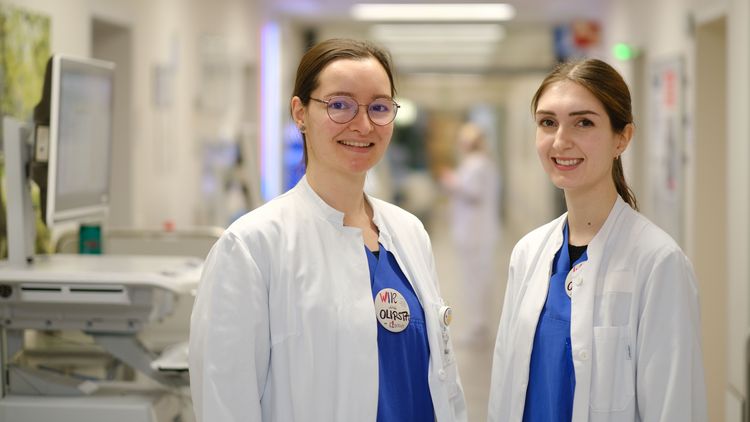
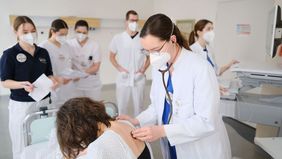
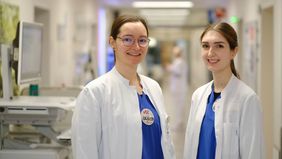
When there is a knock on the doors of two very specific rooms on ward E43 at around 9 a.m. for the morning ward round, the patients know that things are about to get busy. Next to the mobile ward round computer, at least eight people push their way into the two-bed room. Two of them are medical students Antonia Matiszick and Alexandra Horst, who are currently completing the last third of their practical year (PJ) at Oldenburg Hospital. Most of the other participants in the ward round are also remarkably young: two prospective nurses, a physiotherapy trainee and a young woman who is currently completing a voluntary social year.
Together with them, Antonia and Alexandra are responsible for the procedures in two rooms at the University Department of Internal Medicine for three weeks and therefore for the treatment and care of four patients - almost single-handedly. Of course, the junior team will be closely supervised. They are supported by specialists who already work in the academic appointments that the young people are aiming for. They have previously completed practical support training and also accompany the ward rounds.
Concept comes from Scandinavia
Taking over all the processes that need to be organised around these two rooms is part of the programme and philosophy of OLIPSTA, the interprofessional training ward at Oldenburg Hospital. On the one hand, the aim is for apprentices from different healthcare professions to learn with and from each other, and on the other, they experience for the first time how everyday life on the ward changes when they have to organise all the processes themselves.
The training concept has a long-standing tradition in Scandinavia and is already being used at some German locations, explains Sylke Modersitzki, teacher for nursing professions and one of the OLIPSTA organisers. "For us and the region, however, the approach is still new." Twice a year, the hospital would like to offer a junior team the experience of managing a sub-ward independently under supervision.
"In the first few days, our processes were still a bit chaotic. But right from the start, we were all very motivated to get this done together," Antonia recalls of the start a week and a half ago. She is nearing the end of her final year, which also marks the last stage of her medical studies at the University of Oldenburg.
And although the degree programme there is very practice-oriented from the first semester onwards and she has completed numerous internships in practices and clinics over the past few years, working independently on ward E43 is a special experience for the budding doctor. "In internships, you often help out and lend a hand, but here it's important that we do the tasks ourselves," she says.
Everyday hospital life under luxury conditions
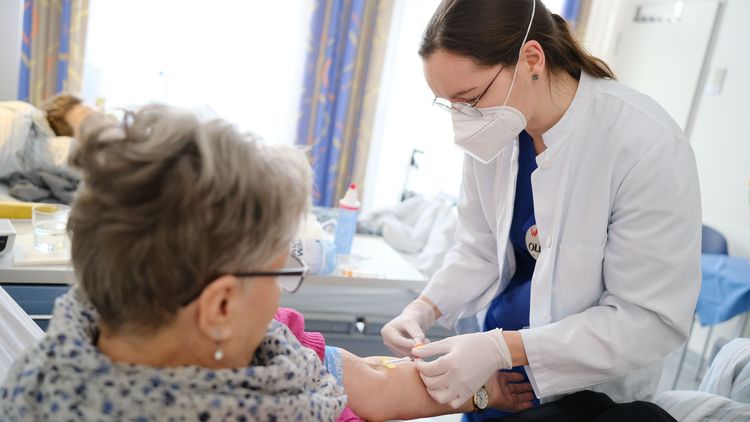
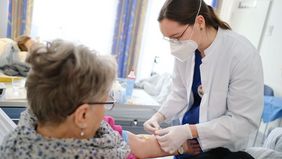
Alexandra Horst is taking blood samples from one of her two patients. "Let's see if my veins are easy to find today," says the elderly lady in bed with a wink, stretching out her left forearm. She has only recently been admitted and thinks it's great to be looked after by a team of young people who are still at the very beginning of their careers. "People who don't think they know and have seen everything yet listen particularly well," she says with conviction.
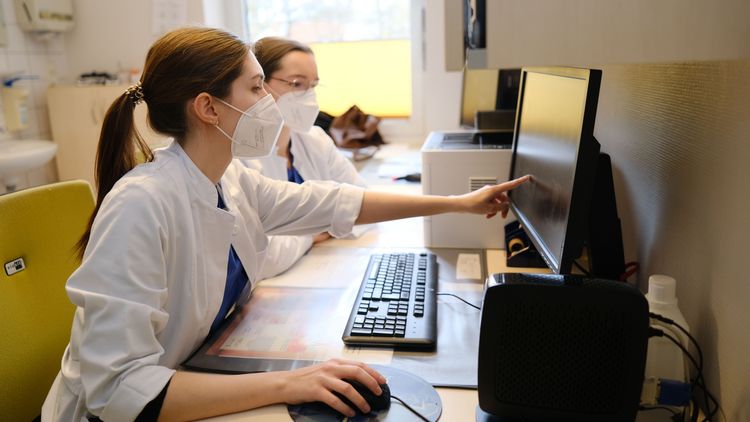
Almost unnoticed, Alexandra has taken two tubes of blood during the short conversation, says goodbye and forwards the samples to the laboratory. The trainee doctor knows, of course, that her responsibility for just two patients is not the same as everyday life on hospital wards - partly because she trained as a healthcare and nursing assistant before starting her studies. "It's a luxury," she says of the time she still has during OLIPSTA to talk to patients, liaise with colleagues and carry out numerous documentation tasks.
Every morning: interprofessional ward round
Learning from and with each other - the daily interprofessional ward round at the patient's bedside is one example of what this can look like. The junior team follows a strict procedure in which all professional groups first share their perspective on the sick person with the others and also with the patient. They discuss the person's current situation, such as their name, age and diagnosis.
In the next step, the junior team gathers background information: What previous illnesses and allergies are present? What is the person's family situation? Do they use a walking frame or other aids? This is followed by an assessment of the current status of treatment. Are there any unusual vital signs? How severe is the pain at the moment? Is the digestion working? Finally, the trainee doctors, nursing staff and physiotherapy trainees make their recommendations for further treatment.
"The fact that not only the medical staff but all employees involved in the patient's recovery take part not only opens up the view for the work of the other team members, but also ensures the flow of information between them," says nursing scientist Nicole Feldmann, who is also part of the OLIPSTA team.
Everyday life as fully trained doctors is just around the corner
For three weeks, medical students Alexandra Host and Antonia Matiszick can slip into their future role as doctors. They will examine their patients, organise appointments in the radiology department, for example, evaluate laboratory reports, make diagnoses, talk to relatives, coordinate with experienced colleagues, document their work and write discharge letters.
It won't be long before the two of them - after their final exam - will actually be doing all of this on their own responsibility and without the watchful eye of the learning supervisors. Perhaps even in the hospital. Both can imagine staying at the centre: Alexandra would prefer to work in general medicine or gastroenterology and Antonia in dermatology.
More information can also be found at: