Latest news
Latest news
Enough. Minimalism in the wardrobe

After a year of work, the students of the Museum and Exhibition Master's programme have created the online interactive exhibition Enough. Minimalism in the wardrobe opened! The Smart House Oldenburg University's Science Communication Centre in Oldenburg was the venue for the exhibition, which had to be moved to the digital space due to the pandemic. It is now accessible online, regardless of location, for years to come.
The exhibition is based on data from the end of project Textile Minimalists: Pioneers of Sustainable Practice? project and introduces the topic of more sustainable everyday practices with clothing through participatory mediation.
Project results
An anthology entitled "The Minimalism Reader" is currently being compiled from the many perspectives we were able to familiarise ourselves with during the project. The interdisciplinary volume combines perspectives from theology, design, art history, psychology, sociology and cultural anthropology/European ethnology on the phenomenon of minimalism.
It includes contributions from Anette Geiger (HfK Bremen) for design history, Michael Plattig (PTH Münster) for theology, Herbert Fitzek (Businness School Berlin) for cultural psychology, Stephan Lorenz (University of Jena) for sociology and Stefanie Mallon (University of Hamburg) for cultural anthropology, Timo Heimerdinger (University of Freiburg) also for cultural anthropology, Wibke Schrape (Museum für Kunst und Gewerbe Hamburg) for East Asian art history and Verena Strebinger and Heike Derwanz for cultural studies and cultural anthropology.
The anthology will be published as an open access publication in the form of an e-book and will therefore be of interest to all cultural studies readers as well as to the minimalism scene itself.
Scientific posters by students researching everyday textile practices
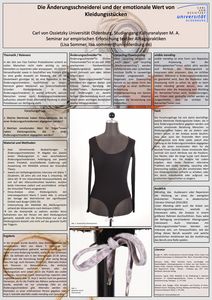
Building on our DFG project, eight academic posters were produced by students during the winter semester 2019/2020 as part of the module ‘Ethnographic Methods of Cultural Analysis’ In the Master’s programme in Cultural Analysis, eight academic posters were produced by students, all of which focus on the empirical study of everyday textile practices. The aim of the module is to provide students with substantive and methodological guidance as they undertake their first independent ethnographic study. As the posters cannot be displayed in public spaces due to the current closure of the university buildings, they are instead being showcased digitally to recognise the students’ efforts and make their findings accessible to interested parties: materiellekultur.de/ethnografische-verfahren-der-kulturanalysen/
Cancellation of the EASA conference in Lisbon

It was to be a highlight of this year for the project: The conference of the European Association of Social Anthropologists (EASA), which was to take place in Lisbon at the end of July. We would have been represented twice, Heike Derwanz with her contribution "Re-defining fast fashion. A Phenomenon from Business Model to Everyday Practice" in the panel "Fashion: uses and practices of clothing in a moving world" and Verena Strebinger with her contribution "From Overflowing Wardrobes to 33 Pieces - Textile Minimalism between Abundance and Scarcity" in the panel "Excess and Absence in Domestic Life". The conference has now had to be cancelled in its previously planned form and converted to an online format. The respective panel organisers have decided to withdraw the entire panel. As a result, we will unfortunately have to do without the interesting encounters and inspiring contributions we had hoped for in this context.
Students prepare minimalism exhibition
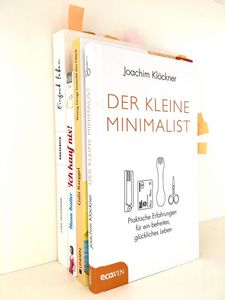
Twelve students from the "Museum and Exhibition" Master's programme are currently discovering and questioning the topic of minimalism - despite online teaching against the background of Covid-19. This is the students' groundwork for their one-year exhibition project: the group is to realise an exhibition on the topic of minimalism by March/April 2021 and can use data material and resources from the "Textile Minimalists" research project. From creating a preliminary concept, defining the target group and venue to financing, design and mediation, the students are responsible for all aspects of the exhibition concept and realisation. We are already looking forward to the results!
Let's wear fair! - Action week for Fashion Revolution Day
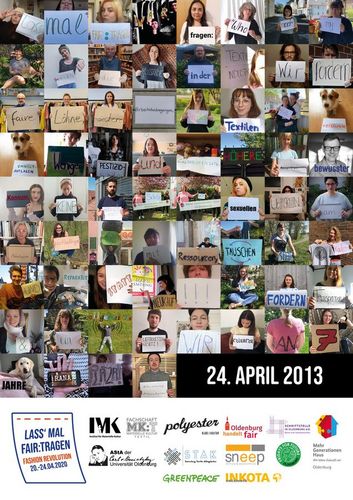
The Institute of Material Culture and the student body Material Culture: Textiles, together with various other Oldenburg groups and organisations, were involved in organising a week of action to mark the 7th anniversary of the collapse of the Rana Plaza textile factory in Bangladesh:
"With the action week from 20 to 24 April 2020, we are dedicating ourselves to addressing and processing various points of contact around the topics of clothing and textiles with a colourful programme. With lectures, workshops and other events, we will be looking at consumption, clothing, fashion, the textile industry, recycling processes, resource use, consumer behaviour and much more, true to the title "Lass' mal fair:tragen!". So why not take a look behind the factory walls with us and ask: "Who made my clothes?"
Unfortunately, the events had to be cancelled due to Covid-19 restrictions. What remains is the memory of the catastrophe, which has not lost its significance even after seven years: Working conditions in the textile industry are still highly problematic in many places, which is in some cases massively exacerbated by the current restrictions. For this reason, Femnet e.V. has set up a corona emergency aid fund to support textile workers: femnet.de/fuer-frauenrechte/kampagnen/solidarityworks-unsere-arbeit-in-produktionslaendern/corona-nothilfefonds.html
Announcement lecture "Minimalism - The right amount of clothing?" on 11.03.2020
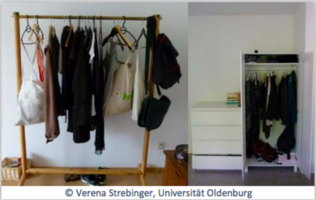
On 11 March 2020, Heike Derwanz will be giving a lecture on minimalism and moderation at the Kulturforum of the Staatliche Museen zu Berlin from 6 - 8 pm:
Numerous tidying guides, internet blogs or videos and not least the Netflix series Tidying Up with Marie Kondo show us that in addition to regularly buying new fashionable clothes, old clothes also need to be sorted out. Minimalists don't just sort things out, they strategically reduce their possessions, e.g. by the number of items or the size of wardrobes. What's more, they go in search of the minimum number of items of clothing with which they can manage their everyday lives. These minimalist textile practices are therefore doubly interesting: on the one hand, they challenge the ideal of having to be correctly dressed for all social occasions. On the other hand, they develop interesting routines for washing, caring for, organising and finally appreciating the few clothes they have.
The lecture presents research results from a research project conducted in Germany, Austria and Switzerland on how minimalists deal with clothing and focuses on the concept of the "capsule wardrobe".
Announcement of expert workshop on 27 November 2019
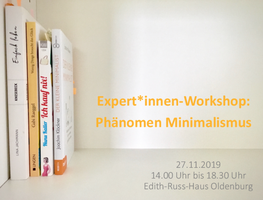
We are organising an expert workshop on the "phenomenon of minimalism" on 27 November 2019. Together with five other experts from the fields of psychology, theology, cultural anthropology, aesthetics and luxury fashion, we want to discuss perspectives on a minimalist lifestyle. The main element of the event will be a group discussion, on the basis of which we want to publish a documentation of the workshop afterwards.
3rd PLATE Conference from 18 - 20 September 2019
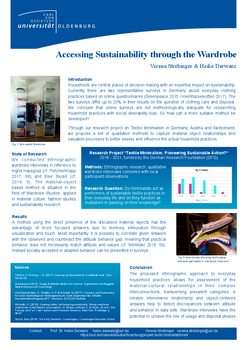
From 18 - 20 September 2019, the 3rd international PLATE conference (Product Lifetimes and the Environment) on the relationship between the life cycle of products and sustainability took place. We contributed to the conference with a scientific poster (see image) on the methodology of the research project entitled "Accessing Sustainabiliy through the Wardrobe". In addition, Heike Derwanz organised one of the keynotes entitled "The end of life of fast fashion", in which she had the audience examine discarded garments and introduced the process of sorting used clothing in the context of clothing collection. The conference brought together sustainability scientists from all over the world, offering valuable encounters and inspiration.
23 Degrees Fashion Revolution Conference
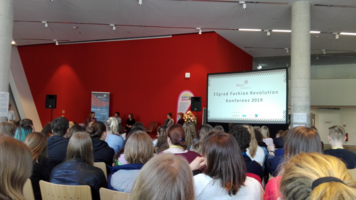
On 24 April, the Fashion Revolution Conference took place in Lüneburg as part of Fashion Revolution Week. The event is one of a number of events which, to commemorate the collapse of the Rana Plaza textile factory six years ago, will address the issue of fair working conditions and responsibility in the fashion industry - and is of course important to us as researchers in the field of clothing. The event was organised by 23 Grad e.V. in co-operation with Leuphana University Lüneburg, TransFair e.V. & Fashion Revolution Germany. On the panel, Thekla Wilkening (Stay Awhile), Laura Drzymalla (Avocadostore), Norian Schneider (fair fashion blog 'fairknallt'), Lena Pudritz (reFashion label Kluntje) and Ariane Piper (country coordinator Fashion Revolution Germany and advisor FEMNET e.V.) discussed steps towards a fairer and more sustainable fashion industry and the role of designers, fashion producers, innovative companies and consumers in this. Following a market of opportunities, where local companies and projects presented themselves, a workshop could be attended. Together with other participants and Norian Schneider, I thought about whether blogging for sustainable clothing consumption is possible or actually a contradiction in terms. You can find more information about Fashion Revolution here: www.fashionrevolution.org
One last trip south: Munich and Vienna
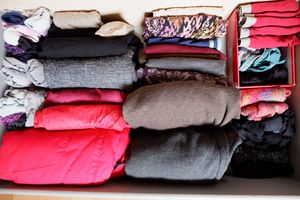
In April 2019, my last field research trip for the time being took me to Munich and Vienna. I was able to meet four exciting and very different minimalists and ask them my questions. In Munich, Lia from Lulalia took a lot of time to answer my questions and showed me her minimalist capsule wardrobe. In the Vienna area, I met Regina Halbauer, a professional organising consultant with the title "The Wardrobe Whisperer", whose insights into wardrobes provided plenty to talk about. As there is currently no regular minimalism get-together in the region, I was unfortunately unable to attend one during this visit. However, the data collection phase - apart from a few interviews that are still planned - has now been completed! Now it's time to process the collected data in the form of data preparation and analysis.
But now for the real thing: the second visit to Frankfurt and Switzerland
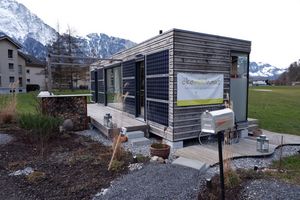
After a winter break over Christmas and New Year, the next field trip was scheduled for the end of January. Once again, I travelled to Frankfurt am Main. The reason was that I was able to meet some minimalists at the regulars' table during my visit in November, but then travelled to Berlin, which left no time for interviews. I wanted to make up for this and was able to attend the Minimalism Stammtisch in Frankfurt again at the same time. In the days that followed, I conducted wardrobe interviews with four Stammtisch visitors, including Kerstin alias KeriChaotic, and met another visitor for a more informal chat. Following these inspiring encounters, I travelled further south to Switzerland, where I was able to meet Barbara Hodel in Bern, who has been working on the topics of simplification, minimalism and sustainability for 20 years. Afterwards, I was also able to visit Tanja Schindler for an interview and take a closer look at her eco-mini house, which she uses to provide information about sustainable construction methods and sustainable everyday practices. Once again, it was a very dense and rich field visit. The material collection phase is slowly coming to an end, but another visit to Munich and Austria is coming up soon.
Across Germany - Frankfurt and Berlin
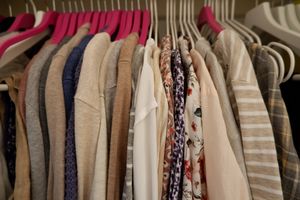
At the end of November, I travelled queerly through Germany: first to the minimalism regulars' table in Frankfurt am Main, where I was able to meet minimalists from the region for four hours and talk to them about clothing and many other topics, and the following day to Berlin. I was invited and announced as an expert on the topic of clothing and minimalism at the Minimalism Regulars' Table there, a completely new situation after the previous regulars' tables, where I was there as a participant without a special role. This had the advantage that we focussed mainly on the topic of clothing and minimalism and an interesting discussion ensued. Over the next few days, some of the participants agreed to take part in a wardrobe interview, and I also took part in a sorting out session. Shortly before I left, I was able to conduct an interview with Karina Papp from Found on the Street, a project in which clothes from the street are presented in the form of fashion shoots: www.instagram.com/found_on_the_street/
It was a very packed research stay: full of appointments, but above all full of exciting new impressions and material for the project!
Start of data interpretation
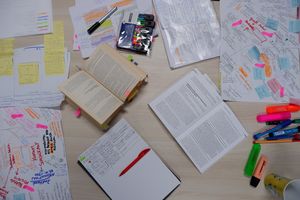
Yesterday we had our second monthly interpretation meeting, where we start analysing data that has already been prepared. Yesterday it was the turn of our two group discussions from MinimalKon and it was a very productive meeting, certainly also because we worked on it with the entire research team and a guest. The photo hopefully shows how colourful and complex such an interpretation process can be. On Saturday, we are already off on our next short field research trip to Frankfurt a.M. and then to Berlin.
Short stay in Cologne
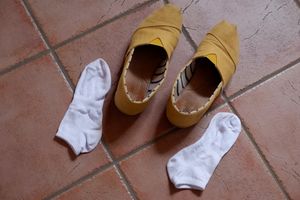
At the end of October, we had the opportunity to talk to three experienced minimalists in Cologne and the surrounding area: Joachim Klöckner, Michael Klumb and Fabian Coenradie. The insights into the clothing of other male socialised minimalists were very informative and inspiring. Joachim and Michael have already appeared several times in print, radio and television, so it was all the nicer to be able to talk to them on site. On 24 November, we will be going to the Minimalism Stammtisch in Frankfurt am Main and the following day to another Stammtisch in Berlin. We have already been able to attend seven other Minimalism Stammtisch events in Germany.
South-west Germany and Switzerland

In September, we were able to explore south-west Germany and visit two minimalism meet-ups in Stuttgart and Tettnang on Lake Constance. We also travelled to Freiburg im Breisgau, Überlingen, Schwäbisch Gmünd and Lucerne for individual interviews, where blogger Zippora Marti took the time to meet us. She has been wearing the same dress for over a year as the centrepiece of her outfits. Bloggers Oliver Domröse and Monica Albrecht were also among the interviewees. Apart from the inspiring encounters with the minimalists, it was also a special experience to live surrounded by rolling hills and real mountains, so very different from the north.
MinimalKon on 22/09/2018
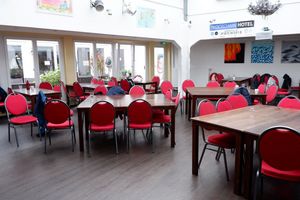
This conference was a highlight of the field research so far, as it enabled us to present our project and hold two group discussions with interested participants, as well as to exchange ideas and network with the approximately 80 participants. The next field research phase can begin! So far, in addition to the group discussions, 20 individual interviews and participant observations of 6 minimalism regulars' tables have already been conducted, and several more interviews and regulars' table visits are planned.
Summer in the Ruhr region
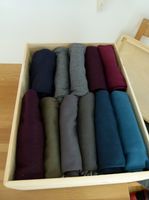
June 2018 was used to gain an insight into the minimalism scene in the Ruhr region and the Cologne/Bonn area. This part of Germany is characterised by a high density of minimalism get-togethers and bloggers on the topic of minimalism. Many interview partners were found via the regulars' tables in Essen and Cologne, including the blogger Gabi Raeggel and Silke Rosenbusch, who runs her own YouTube channel. We are delighted with the great interest in our research, which was reflected in the many completed short questionnaires and the many contacts we made, as well as interesting and inspiring conversations.
Start of field research in Hanover and Münster
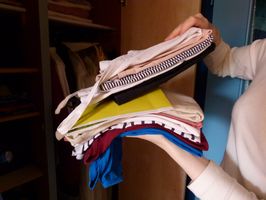
The field research began in April and May 2018 with an introduction in the Nordic region. Minimalism regulars' table participations in Hanover and Münster were followed by some very exciting wardrobe interviews, which already suggested how different individuals' wardrobes and the stories, memories and feelings associated with them can look, even if they are all interested in a minimalist lifestyle. We spoke to them about clothing consumption and care, consumption patterns, materials and the minimalist process. The interviewees used the wardrobe interview partly as an opportunity to sort out their clothes.