Research
Kontakt
Institutsleitung
Geschäftsstelle
Contact
Interim Director
Commissioned in terms of content
Administrative Office
Research
DFG Network “Sharing!”
Project title: "Sharing! (Digital) Sharing in Fields of Material Culture"
A DFG-funded network led by Dr Klara von Lindern and Prof. Dr Stefanie Samida
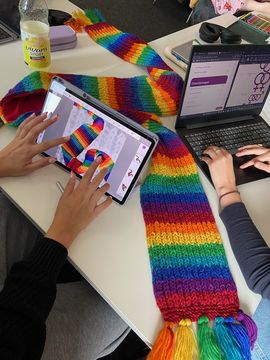
Klara von Lindern and Stefanie Samida have successfully secured DFG funding for an interdisciplinary academic network on the topic of ‘Sharing! (Digital) Sharing in Fields of Material Culture ’. For the first time, it will undertake a systematic investigation of various (digital) practices of sharing – such as dividing, organising, communicating or working with fragments – within thematic and practical fields of material culture, such as collections, cultural heritage or popular cultures.
The kick-off workshop will take place in the winter semester of 2026/27 and will initially focus on exploring the topic from the perspectives of various international experts and guests. Over the course of the three-year project, network meetings will be held at regular intervals, during which we will explore the key thematic areas of material culture and examine various (digital) practices of sharing – for example, through lectures, workshops, excursions or handling sessions. The network is structurally based at the Institute of Material Culture, though the working meetings are intended to take place at various locations and, in some cases, online. Planned outputs include a book bringing together the individual contributions of the network members, as well as a blog that will continuously document the network’s working process and regularly offer insights from different perspectives.
DFG project "The 'tamed' war"
Project title: "The 'tamed' war: Representation-critical perspectives on military history exhibitions"
DFG-funded project carried out by Dr Christopher Sommer
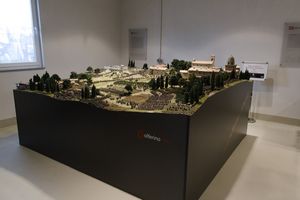
"With the memoralisation of the First World War as a welcome starting point, the military history museum wants to position itself as a forum for discussion and take on current geopolitical challenges through new exhibition strategies. Central to these new strategies is the proverbial scale of war: in an innovative way, a form of representation believed to be outdated - the diorama - is being rediscovered, as in combination with multimedia elements and large exhibits it offers an affective space for experience that favours discussion and reflection, but is no longer aimed solely at reconstructing the experience of war. At the same time, these museums are under political pressure and can only implement a change of paradigm gradually and over the long term. However, how visitors perceive the attempts to update the diorama - especially the use of new technologies - and new exhibition strategies for large exhibits has not yet been the subject of either visitor research or museum studies. [...] The project aims to compare the perception, impact and affective potential of this current form of military history exhibition transnationally through qualitative visitor research. [...] At the same time, curators, designers and modellers will be included in the study (...) [as has] only been pursued in isolated cases to date."
Source: Internal page of the German Research Foundation (DFG) - "The 'tamed' war - On current exhibition strategies and patterns of perception of visitors in military history museums".
Available online at: https: //gepris.dfg.de/gepris/projekt/426340978?context=projekt&task=showDetail&id=426340978& [Accessed: 08/02/2023]
Detailed information on the project can be found here.
Project Northwest: ‘Steampunk’ Initiative
Project title: "Making History in Steampunk: Actors, Objects and Appropriations"
Project funded by the Northwest Impuls funding programme, carried out by Stefanie Samida (University of Oldenburg) and Thekla Keuck (University of Bremen)
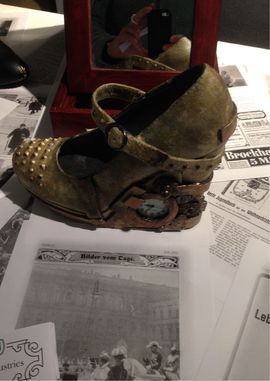
The project combines public history and its focus on historical and cultural transformations with material culture studies and popular culture research. The aim is to interweave these fields of research conceptually and to bring them together on a practical research level. The subject of investigation is steampunk, a movement originating from a literary genre that links modern and futuristic technology with the Victorian era: how and under what conditions is cultural heritage dealt with in steampunk, how is history constructed, and what image of an era is created? What role do materiality, authenticity and performativity play in this? What new bodies of knowledge and cultures are being created? The final question is of particular interest, as it can be assumed that processes of education, communication and mediation take place through whatever form of appropriation of the Victorian heritage may be involved. – Project period: 08/2026 to 07/2027.
Teaching project "Research-based learning" - "On the material culture of football"
Project title: “On the material culture of football: exploring cultural glocalisation through ethno- and object-biographical research”
Teaching project funded by‘forschen@studium’ (Summer Semester 2026), proposed by Prof. Dr Stefanie Samida and tutor Lisa Johann Kersten
In June/July, the FIFA Men’s World Cup will take place in Mexico, Canada and the USA. This media event, which is also a global phenomenon, provides an opportunity to take a closer look at the material culture of football. However, the focus here is deliberately on local manifestations, and thus on the question of how the material culture of football – or, more specifically, the World Cup – manifests itself in Oldenburg and the surrounding area. In football, processes and (material) manifestations of cultural glocalisation are emerging, which are reflected, for example, in fan culture and the presentation of (fan) bodies – e.g. clothing/outfits, which are also an expression of questions of identity – in merchandising products and in the staging of urban space; yet these are also frequently expressed through nationalism and gender-stereotypical manifestations (keyword: ‘masculinity’).
The teaching project is funded by forschen@studium and approaches the material and sartorial dimension of football from a practical, everyday perspective, a theoretical and reflective perspective, and an ethno- or object-biographical perspective. The applicants are Prof. Dr Stefanie Samida and tutor Lisa Johann Kersten.
You can find the Nordwest-Zeitung article about the project here.
SQM project "Wearing the Prize Papers"
Project title: "Wearing the Prize Papers. Analogue and digital (re-)staging of historical clothing"
SQM-funded project applied for by Prof Dr Dagmar Freist, Dr Sarah Thompson, Dr Christopher Sommer and Dr Klara von Lindern
From the summer semester of 2026, the ‘Textile Everyday Culture’ collection will be a partner in the project ‘Wearing the Prize Papers: Analogue and Digital (Re-)Staging of Historical Clothing’. The aim of the project is to undertake a critical (re)staging and a critical (re)reading based on specific materials and descriptions of historical clothing found in the Prize Papers. What do descriptions of 18th-century men’s* clothing reveal about contemporary notions of masculinity*? What global interconnections between materials, production and consumption can be identified in relation to textiles, both then and now? How can marginalised perspectives be made visible, for example through an examination of the clothing of enslaved people?
The project addresses these and other questions as part of an international series of lectures and an interdisciplinary project seminar. Drawing on historical materials and descriptions, students will produce contemporary interpretations of historical clothing and develop a virtual exhibition incorporating VR elements, in which the designs can be digitally explored alongside the historical sources and contextualised in relation to one another. The project is funded by the Study Quality Fund (SQM) and is being carried out in collaboration with the ‘Prize Papers’ academy project (School4/Institute of History); the applicants are Prof. Dr Dagmar Freist, Dr Sarah Thompson, Dr Christopher Sommer and Dr Klara von Lindern.
DFG project "Textile Minimalists"
'Textile minimalists'. Pioneers of sustainable practice?
Project team
Prof. Dr Heike Derwanz (Project Leader)
Niklas Reinken (Research Assistant, Editorial Work – Final Publication)
Verena Strebinger (Research Assistant, Field Research)
Hannah Evers (Research Intern)
Project description
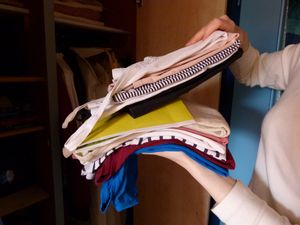
In this DFG-funded study, Prof. Dr Heike Derwanz and Verena Strebinger are using the example of minimalists to investigate how sustainable household management and economic practices are implemented and morally reflected upon. To answer the question of how textile minimalism is practised in everyday life, they are conducting wardrobe interviews and participant observation with people in Germany, Austria and Switzerland who describe themselves as being interested in minimalism or as minimalists. Short questionnaires, textile diaries and group discussions also form part of the project’s methodological repertoire.
From a cultural studies perspective, the study focuses primarily on the value placed on textiles, care and repair routines, and the role of sustainability in the everyday life of textile minimalists. It provides fundamental insights into the nature and consumption of clothing in the age of fast fashion.
Results/Publications
Verena Strebinger (2019): On colour palettes and standard combinations. Everyday practices within the context of the capsule wardrobe.
Heike Derwanz and Verena Strebinger (2019): Assessing sustainability through the wardrobe.
→ Download link
Heike Derwanz (ed.) (2022): Minimalism – A Reader (Bielefeld 2022).
→ Download link
In addition, there were various teaching projects, including:
- Students on the Master’s programme in Museum and Exhibition Studies organised the online interactive exhibition: Enough. Minimalism in the Wardrobe . Originally planned to take place at the University of Oldenburg’s Science Communication Centre, ‘The Smart House Oldenburg’, the exhibition had to be moved online due to the pandemic. The exhibition is based on data from the project and uses participatory learning to introduce the topic of more sustainable everyday practices relating to clothing.
→ Visit the digital exhibition
- During the 2019/2020winter semester , as part of the module ‘Ethnographic Methods of Cultural Analysis’ in the Master’s programme in Cultural Analysis, eight academic posters were produced by students, all of which focus on the empirical study of everyday textile practices.
→ Project results
Detailed information on the project can be found here.
New Local History Museums" project, funded by the Volkswagen Foundation
New local history museums as institutions of knowledge production
Project team
Prof. Dr Karen Ellwanger(project leader)
Dr Beate Bollmann (participatory accompanying research)
Dr Smilla Ebeling (senior scientist)
Sebastian Bollmann M.A., Dennis Herrmann M.A., Antje Vogt M.A.
(research assistants/doctoral candidates)
Gabriele Speckels M.A. (senior researcher, co-applicant/museum side)
Bastian Guong B.A. (research assistant)
Project description
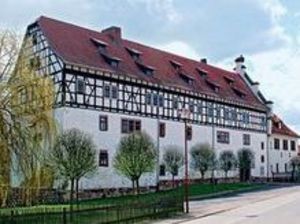
Five museums, the Nationalpark-Haus Museum Fedderwardersiel (Lower Saxony), the Handwerksmuseum Ovelgönne (Lower Saxony), the Lötschentaler Museum (Kippel, Switzerland), the Landschaftsmuseum Angeln/Unewatt (Schleswig-Holstein) and the Werratalmuseum Gerstungen (Thuringia), have joined forces with the Institute of Material Culture at the University of Oldenburg to form a research network. What the selected museums have in common is that they see themselves as "new local history museums" and have a special relationship to landscape and its representation in these museums. Over a period of three years, the project aims to investigate specific types of knowledge production that characterise local history museums. Of particular interest are the nature, timing and intention of knowledge production and the associated forms and processes of collection formation.
The specific research objective of the project is to identify and analyse object collections specific to the New Heritage Museums and the associated forms of presentation through which statements on nature, region, homeland, gender and ethnicity are implicitly and explicitly conveyed.
Results/publications
Ellwanger, Karen (ed.): Neue Heimatmuseen. Volume 4: Beate Bollmann (2017): Qualities of small (local history) museums. A guide. Münster: Waxmann, 2017.
→ download link
Ellwanger, Karen (ed.): New local history museums: Volume 3: Smilla Ebeling (2016): Durch die Blume - Geschlechternarrationen in musealen Naturdarstellungen. Münster: Waxmann, 2016.
→ download link
Ellwanger, Karen (ed.): New local history museums. Volume 2 Smilla Ebeling (2016): Museum & Gender. A guide. Münster: Waxmann, 2016.
→ Download link
The symposium "Neue Heimatmuseen als Institutionen der Wissensproduktion" took place from 26-28 June 2014.
Detailed information on the project can be found here.
Trachten" project, sponsored by the Pro*Niedersachsen foundation
'Trachten' in the Lüneburg Heath and Wendland. Dress behaviour of rural classes and forms of its representation since the end of the 18th century
Project team
Prof. Dr Karen Ellwanger (Project Leader)
Dr Andrea Hauser (Principal Investigator)
Gerda Engelbracht
Laura Schnibbe (doctoral candidate)
Project description
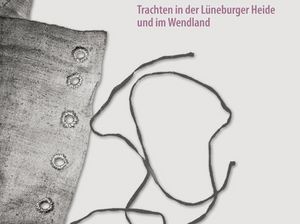
The project, run by the Institute of Material Culture in co-operation with four regional museums (the Bomann Museum in Celle, the Museum of the Principality of Lüneburg, the Hösseringen Open-Air Museum and the Wendlandhof Lübeln Rundling Museum), conducted fundamental research into a classic topic in the study of material culture. Under the working title ‘Traditional Costumes in the Lüneburg Heath and the Wendland. Clothing Practices of Peasant Classes and Forms of their Representation since the Late 18th Century’, the extensive and valuable collections of traditional costumes held by the participating museums were examined from multiple perspectives and in an interdisciplinary manner. Some items of traditional costume were documented, in some cases for the very first time. The project was made possible by funding from the ProNiedersachsen Foundation (2009–2011/12).
Results/Publications
Ellwanger, Karen; Hauser, Andrea; Meiners, Jochen (2015): Traditional Costumes in the Lüneburg Heath and the Wendland. Münster: Waxmann
→ Link to Waxmann Verlag
In connection with this, the symposium ‘Traditional Costumes in the Lüneburg Heath and the Wendland’ took place from 6–8 October 2011.
Detailed information on the project can be found here.
Research colloquium summer semester 2026
Wednesday, 12-14 h, sewing room (A02 3-321)
22 April 2026
Jan Watzlawik (TU Dortmund)
Museum fashions. Dress and accessories in exhibitions
6 May 2026
Simone Egger (Saarland University)
Dressing up. The dirndl as a complex phenomenon of the late modern present
20 May 2026
Klara von Lindern (University of Oldenburg)
From Anti-Ageing to Magazine: On (digital) work with object biographies in scientific collections
3 June 2026
Nina Hennig (Ostfriesische Landschaft)
Networked museum work in the East Frisian region
17 June 2026
Christopher Sommer (University of Oldenburg)
The continuation of war by digital means - immersive media and the military history museum
1 July 2026
Anamaria Depner (University of Frankfurt)
From handbags to blast furnaces. Everyday materialities in changing contexts
Q+ Digital Literacy" project
Quality Plus - Digital Literacy at the "Material Culture" site
Project team
Prof. Dr Karen Ellwanger (project leader)
Dr Christopher Sommer, Vanessa Barbagiovanni Bugiacca M.A. (project coordination)
Glenn Arthur Ricci, M.A., Tabea Meret Stracke B.A.(research assistants)
Chayenne Lauterbach, Christoph Wollesen, Sabrina Alber (media tutors)
Project description
With the project "Research-based learning as a study programme profile" (Q+FL), the University of Oldenburg has committed itself to the visible and sustainable implementation of research-based learning as a contribution to a change in learning culture. The Institute of Material Culture is one of the research-intensive "small subjects" in School III and favours research-based teaching and learning. However, as an ethnographic cultural studies department with a university collection, it faces particular challenges with regard to a digital infrastructure for teaching and learning.
This applies in particular to the polyvalent BA in Material Culture: Textiles. In the three-year project "Digital Literacy in Material Culture" (01.2019 - 03.2022), the degree programme was further developed and the collection was increasingly incorporated. Research-based approaches were systematically expanded throughout the programme and supported by low-threshold formats.
An important learning objective here is "digital literacy", which is sustainably anchored using tools such as introductions to applications like Photoshop or After Effects or an event format for the digitalisation of knowledge production.
Results/publications
Sommer, C., Barbagiovanni Bugiacca, V., Lauterbach, C., Wollesen, C, Alber, S., & Ellwanger, K. (2021). "Wat mutt, dat mutt" - Teachers' perspectives on ad hoc digitisation in the course of the Covid-19 pandemic at the small subject of Material Culture at the University of Oldenburg. In: Bolten-Bühler, R., Dertinger, A., Ellinger, D., Thielsch, A., Vanvinkenroye, J., & Zender, R. (2021). "Brave new (digital) world?!" Proceedings of the Young Forum Media and Higher Education Development 2019. Young Forum Media and Higher Education Development 2019 (JFMH), Weingarten. Zenodo , pp. 49-61.
→ To the publication
Sommer, Christopher, Barbagiovanni Bugiacca, Vanessa, Alber, Sabrina, Wollesen, Christoph, Ellwanger, Karen: Game on! Enhancing Tertiary Student Engagement Through Co-development of Interactive Treasure Hunts. In: Fotaris, Panagiotis (ed.), Proceedings of the 14th International Conference on Game Based Learning ECGBL 2020. Supported by University of Brighton, UK, 24-25 September 2020. Reading: Academic Conferences International Limited 2020, 824-827.
Sommer, Christopher, Barbagiovanni Bugiacca, Vanessa, Ellwanger, Karen: X Marks the Spot: A Student-Developed Treasure-Hunt on the Digitisation of Knowledge Production. In: Elbæk, Lars, Majgaard, Gunver, Valente, Andrea, Khalid, Md. Saifuddin (eds.): The Proceedings of the 13th International Conference on Game Based Learning ECGBL 2019. Hosted by University of Southern Denmark Odense, Denmark
3-4 October 2019. Reading: Academic Conferences International Limited 2019, 1038-1041.
→ To the learning platform Q+FL
Detailed information on the project can be found here.
Uni Action" project
Uni Action - Digitalisation of knowledge production
Project leader and coordination
Vanessa Barbagiovanni Bugiacca M.A.
Project description
Despite socialisation in a digitalised environment, young people often lack a balanced ability to reflect on the knowledge they have acquired. The digitalisation of knowledge production often means that the standards of academic work in a digital environment are not followed. Unintentional plagiarism or inadequate citation of sources are well-known phenomena, but there is a lack of prevention programmes.
School III - School of Linguistics and Cultural Studies at the CvO Oldenburg is tackling these challenges on an interdisciplinary basis: A new type of two-semester course has been developed and trialled that combines exercise and workshop formats with the development of an interactive scavenger hunt (via the "Achtionbound" app) including audiovisual content (explanatory videos).
Actionbound is intended to educate first-year students about institutions of knowledge production and at the same time teach the basics of ethical scientific work. The results/products will be published on the state's OER portal.
→ To the OER portal
Detailed information on the project can be found here.