
That's it!
That's it!
The Textile Everyday Culture Collection comprises around 5,000 objects in four sub-collections: 'Clothes and Stories', 'Textile Objects', 'Writings' and 'Colouring Drugs'. Under the heading 'Dings Da!', an object from this wealth is regularly presented in more detail by students or employees of the collection. The authors ask about the biographies or material properties of the objects or take a cultural studies approach, focussing, for example, on wearing and usage practices. In this way, a first impression of the objects can be gained independently of a visit to the collection - as well as of the research that is carried out with them at the Institute.
Peaked cap with Union Jack motif

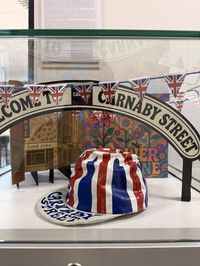
Object description: Peaked cap
Inventory number: KG778
Date: ca. 1972
Holidays are seen as a special opportunity to distance oneself from the routine and stress of everyday life, to get away from it all and recharge one's batteries. Travelling not only offers the chance to relax, but also enables people to get involved with new destinations and cultures and to have experiences that can leave a lasting impression. The memories created in such contexts can be intangible and therefore intangible, for example through discovering new flavours, through the excitement of visiting a place for the first time or through the impact of viewing a favourite work of art in situ. But tangible mementos such as photographs, postcards, key rings or fridge magnets also play an important role. In a way, they become evidence of the trip and allow you to take a piece of the place home with you. They are referred to as souvenirs because, by definition, they are "small objects that are [acquired] [...] as a memento of a journey[...]" [1] or are given as a gift.
Souvenirs often refer to something typical of a place, be it a flag, a well-known building or a historical personality. They therefore not only convey an image of the place, but also appeal to a personal, emotional level, especially when they are given as a gift. From ancient times, it is said that friends broke a small clay disc as a farewell gift and kept one half each [2]. Every era has produced its own souvenirs that evoke different memories. The peaked cap, which came into the collection of the Institute of Material Culture in 2002 and was originally intended as a souvenir, can also be categorised against this background. [3]
After a trip to London in 1972, a traveller selected the object as a souvenir for the children. The design combines several cultural references. The top depicts the Union Jack, the shade clearly reads Carnaby Street in a font reminiscent of the graphic style of the 1960s, and inside there is a fabric label with the inscription Lord Kitchener's London, Carnaby St. & Kings Rd. These elements directly refer to the famous Swinging London andin particular to Carnaby Street, which at the time was considered a meeting place for important designers, musicians and fashion. [4] The boutique I Was Lord Kitchener's Valet was located there, known for transforming military uniforms into fashion items and counting musicians such as Jimi Hendrix and Mick Jagger among its customers. [5]
Although it cannot be confirmed whether the peaked cap actually comes from this shop, important stylistic features can be recognised. The psychedelic lettering, as popularised by Alan Aldridge and others, whose graphic work shaped the aesthetic of those years [6], as well as the Union Jack, which became a well-known emblem and a symbol of a vibrant English identity [7], point to the cultural dynamics of the era. The souvenir thus becomes a time capsule that takes us back to the Swinging Sixties and at the same time fulfils the task ascribed to all souvenirs: To evoke memories of a certain place or moment even after a long time.
Author: Jimena Luna Zárate
Sources:
[1] "Souvenir spelling, meaning, definition, origin | Duden https://www.duden.de/rechtschreibung/Souvenir(accessed: 12.01.2026).
[2] Cf. Deutschlandfunk.de. "A short cultural history of the souvenir": https://www.deutschlandfunk.de/eine-kleine-kulturgeschichte-des-souvenirs-100.html (accessed: 12.01.2026).
[3] Cf. "Peaked cap (KG778) | Sammlung materielle Kultur Oldenburg": http://wisski-stak01.virt.uni-oldenburg.de/wisski/navigate/1111/view (accessed: 12.01.2026).
[4] Cf. London Museum: "Music icons, Soho fashion streets & the Swinging 60s": https://www.londonmuseum.org.uk/blog/music-icons-soho-fashion-streets-the-swinging-60s/ (accessed: 12.01.2026).
[5] See Pixelstorm: "1960s - I Was Lord Kitchener's Valet - Kings Road - DNU": https://winstonchurchill.org/churchill-central/image/1960s-i-was-lord-kitcheners-valet-kings-road/ (accessed: 12/01/2026).
[6] Cf. Design Week: "Remembering Alan Aridge: the graphic designer of the 'swinging sixties '": https://www.designweek.co.uk/issues/20-26-february-2017/remembering-alan-aldridge-revolutionary-graphic-designer-swinging-sixties/ (accessed: 12 January 2026).
[7] Cf. Enter Gallery: "The Iconic Artistic History of the Union Flag": https://www.designweek.co.uk/issues/20-26-february-2017/remembering-alan-aldridge-revolutionary-graphic-designer-swinging-sixties/ (accessed: 12 January 2026).
Storage device for underwear

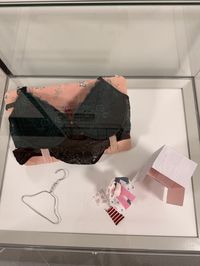
Object description: Storage device for underwear
Inventory number: KG2080
Date: not specified (ca. 1950 - 1970)
Organised and hidden - where underwear lives
Almost everyone knows it: the so-called "laundry chair". A chair in the bedroom where clothes that are not dirty but not completely clean end up. It grows in layers day after day, sometimes even over weeks. Underwear, on the other hand, usually remains invisible. Bras and pants disappear in the laundry basket, on the floor or in the drawer. They are not only hidden under clothing, but are often neatly organised behind drawer fronts, in boxes or organisers. The correct storage of underwear is a science in itself, as blog articles show. Underwear should not come into direct contact with wood to avoid splinters, bra hooks should be closed and not be placed in a drawer when worn [1]. Quite a lot of requirements for items of clothing that most people don't actually give much thought to.
The object from the STAK analysed here, the storage device for underwear, makes this care particularly visible. It consists of a fabric-covered plate on which two elasticated straps are attached to hold the bra and briefs in place [2]. Such storage units were used either in the wardrobe to create structure or when travelling to keep everything together in the suitcase. The colourful, flowery fabric shows that it's not just about functionality, but also about aesthetics. The previous owner used several of these storage units, sorting her underwear by set or colour and paying particular attention to the care of these intimate items of clothing. The object thus shows that organisation is more than just practical storage. In the interview with the daughter, it became clear that such storage devices were sometimes even supplied with high-quality underwear sets [3]. The device also looks homemade, possibly due to its age.
The place where we store clothes is also important. Storing clothes has played an important role for centuries. Even before wardrobes, for example, there were clothes chests [4]. Kerstin Kraft describes the wardrobe as a kind of place of worship. In addition to its main function of storing clothes, it is also associated with important experiences and personal memories [5]. Underwear is one of the most intimate items of clothing, as it is worn directly on the body and at the same time concealed. The storage device for underwear can be seen as a kind of miniature organisation: It structures an area that is otherwise easily overlooked. The practice of not simply placing underwear loosely in a drawer, but consciously organising it, can also be understood in terms of Pierre Bourdieu's habitus theory [6]. Tidiness is not just a personal preference, but is also characterised by upbringing and habits. The storage device for underwear examined here refers to a habitus in which care, aesthetics and structure are important values. The fact that the previous owner sorted her bras and panties by set and colour is therefore not only a personal preference, but also an expression of a socially learned approach to clothing.
Overall, it is clear that storing underwear is more than just practical. It is also about closeness to the body, material and memories. This makes it clear that even inconspicuous things can have a special meaning. By consciously organising and caring for things, you can not only create structure, but also express personal values and attitudes. If you take a closer look at the "Dings Da!", you can draw conclusions about the previous owner's love of order and perhaps be inspired to think about your own underwear, its organisation and how you deal with it. It might even inspire you to reorganise a drawer or two.
Author: Jana Neiweiser
Sources:
[1] See Fräulein Ordnung (n.d.): Storing beautiful underwear properly: fraeulein-ordnung.de/schoene-unterwaesche-richtig-aufbewahren (last accessed on 22/09/2025)
[2] University of Oldenburg (n.d.): WissKI - STAK object view ://wisski-stak01.virt.uni-oldenburg.de/wisski/navigate/28194/view (last accessed on 22/09/2025).
[3] Interview with the donor Prof Dr Cornelia Hamann. The interview was conducted on 11.04.2024 between the donor and Dr Klara von Lindern and Veronika Dawydow.
[4] See Haller, Melanie (2019): Wardrobe. In: Hasse, Jürgen/ Schreiber, Verena: Spaces of childhood. Bielefeld. S. 198-203, here p. 198.
[5] Cf. Kraft, Kerstin (2015): "Textile memory". In: Braun, Karl/ Claus-Marco Dieterich/ Angela Treiber: Materialisation of Culture: Discourses, Things, Practices, Würzburg. S. 174.
[6] Cf. Krais, Beate/ Gebauer, Gunter (2014): Habitus. 6th edition, Bielefeld. S. 61.
Artificial fingernails
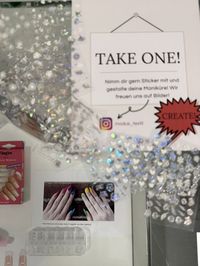
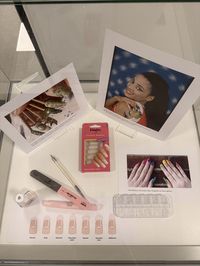
Object description: Artificial fingernails
Inventory number: TO922
Date: early 2000s
Nail design is subject to trends in length, shape and colour. Whereas at the beginning of the 20th century there were only a few nail polish colours on the market, there are now a multitude of ways to design your fingernails according to your own ideas. These include not only nail polish in different colours and finishes, but also the option of artificially lengthening and shaping the nails.
For a long time, nail art received little attention in art and research. This is partly due to the trivialisation of interests with female connotations and partly due to racism and classism. For a long time, conspicuous nail art was seen as a sign of low social status. Black women* in particular were stigmatised as unprofessional for having long artificial nails. This only changed when white women*, inspired by Black stars, also began to wear long and elaborately designed nails. Nail art in the form of artificial fingernails is now exhibited in museums, for example at the Museum of Modern Art in New York or in the "Glitter" exhibition at the Museum für Kunst und Gewerbe in Hamburg. [1]
The artificial fingernails from the Fing'rs brand shown in the display case were available to buy in the cosmetics departments of drugstores and supermarkets in the 2000s. The set contains 24 artificial fingernails in different sizes, a small disposable nail file and a cleaning pad to remove oils and grease from the natural nail. Not included, but necessary for use, are nail glue and nail remover. The artificial nails are curved, their tips are 'square' (rectangular) in shape. They are single-coloured in pearl white and have no other designs or decorations.
For a long time, long fingernails were a distinguishing feature of the upper classes: they were not suitable for physical labour and were therefore a sign of the wearer's wealth. This applied to both natural nails and nail modelling. The latter first emerged in the 1950s in the USA as a method of repairing torn or broken natural nails and were usually applied in such a way that they could not be recognised as artificial nails. [2] From the 1970s onwards, women* of colour began to wear long acrylic nails with elaborate colourful designs as an expression of autonomy and to distinguish themselves from Eurocentric ideals of beauty. [3] Nail art is also used in queer communities as an expression of one's own queer identity, for example through the so-called "lesbian manicure", in which the fingernails of the index and middle fingers are worn shorter. [4]
Press-on nails have been available for home use since the 1980s. While initially only single-coloured nails or nails with a French manicure design were available to buy, more and more different designs and shapes came onto the market in the 1990s and 2000s. [5] In addition to the classic plastic press-on nails, there are now also reusable nails made from gel or synthetic resin, recyclable nails and removable nail rings to which artificial fingernails can be attached.
The development of press-on nails represents a democratisation of artificial fingernails: This type of manicure is less expensive than a visit to the nail salon and application is quick and easy to learn. Designs can be changed after a short time, whereas acrylic or gel nail modelling requires time-consuming filing or removal with acetone. Artificial fingernails are a perfect example of how an inconspicuous-looking accessory can become a means of visualising political and cultural identity.
Author: Miriam Rupprecht
Sources:
[1] https://www.theguardian.com/fashion/2021/jan/27/from-ancient-egypt-to-cardi-b-a-cultural-history-of-the-manicure, accessed 11/09/2025.
[2] https://www.shopqaq.com/en-de/blogs/blog/the-history-and-evolution-of-press-on-nails-from-simple-beauty-fixes-to-creative-artretrieved on 11/09/2025.
[3] https://nmaahc.si.edu/explore/stories/nail-art, retrieved on 11/09/2025.
[4] https://www.allure.com/story/nail-length-queer-identity, retrieved on 11/09/2025.
[5] https://oxalisbliss.com/blogs/bliss-blog/the-history-of-press-on-nails-from-the-1980s-to-now#:~:text=The%20Birth%20of%20Press%2DOn,a%20quick%20beauty%20fix%E2%80%8Bretrieved on 11/09/2025.
Shoulder pads


Object description: Shoulder pads
Inventory number: KG1118
In the collection since: 21/04/2004
Date: 1988/89
In times when new fashion trends appear in our social media feeds on a weekly or almost daily basis, one particular accessory is celebrating its comeback. It is known for being worn under blouses or blazers, giving wearers an oversized silhouette [1]. We are talking about no less an accessory than shoulder pads. Even though they are mainly associated with 80s fashion, they had already made their way into the world of clothing a few decades earlier. Shoulder pads actually have their origins in football clothing. Developed in 1877, they were used to protect players. Elsa Schiaparelli's women's ready-to-wear fashion for the autumn/winter collection in 1931 marked the debut of shoulder pads on the catwalk. In the 1940s, the Second World War changed the proportion of working women, with women taking over vacant jobs from men. With this change, the clothes that women wore in everyday life also changed. Clothing was adapted to work on machines and was therefore sewn differently from the previous everyday clothing, which was designed for domestic activities. Shoulder pads, usually made of cotton, wool or sometimes sawdust, were worn under work clothes. The padding under the clothing also changed the silhouette of the body, creating a dominant silhouette. [2]
The women's movement of the 1980s brought shoulder pads back into fashion. The powersuits presented on the catwalks usually consisted of a double-breasted jacket combined with a skirt or trousers. The jacket was characterised by its exaggerated shoulder shape created by shoulder pads, usually made of foam. The oversized silhouette hid the actual shape of the (female) body and turned against the male gaze. So-called power dressing was also used by women* specifically in the workplace. Women*'s work clothes resembled those of their male* colleagues. This form of clothing also found its way into politics and made British Prime Minister Margaret Thatcher one of the most famous wearers of shoulder pads.
Contrary to the shoulder pad trend, there were also some critical voices that questioned the empowering effect of power dressing. The criticism is based on feminist theories about the construction of gender and its social significance. According to these theories, femininity in a patriarchal culture is constructed as a deviation from the male norm and is therefore not seen as equal. With regard to power dressing, created by textile elements such as shoulder pads or suits, it can hardly be fundamentally emancipating to have to dress like a man* in order to be taken seriously by men*. [3]
However, shoulder pads were not only used for power dressing, but were also worn for other occasions. The questionnaire on the donation of a pair of shoulder pads from the collection provides an example of other reasons for wearing them. At the time, the pair of shoulder pads in the collection primarily gave the wearer the feeling of having a well-groomed appearance. The shoulder pads could be used in a variety of ways, as they were simply stuck to the skin and could therefore be worn under any clothing. Due to their self-adhesive properties and proximity to the skin, the shoulder pads required special personal care and handling. For this reason, they were rarely worn on special occasions. [4]
Today, shoulder pads can once again be found on the catwalks in combination with dramatic oversize silhouettes. However, they are being used less for the purpose of empowerment and more to create drama. It remains to be seen whether this trend will also become established in everyday fashion.
Author: Katharina Bünte
Sources:
[1] See Dang, Kim. CORPORATE CORE: Hello, shoulder pads, welcome back! 13 Nov. 2024 https://bellevue.nzz.ch/stil-design/mode/schulterpolster-in-der-mode-uebergrosse-silhouetten-sind-jetzt-wieder-angesagt-ld.1856891 (last accessed: 13/10/2025).
[2] Cf. Freestone, Camille. Our Favourite Throwback Trend Has a History of Female Empowerment. 04 Apr. 2019 https://coveteur.com/2019/04/04/empowering-history-shoulder-pads-trend/ (last accessed: 13.10.2025).
[3] Cf. Evans, Caroline and Minna Thornton. "Fashion, Representation, Femininity". Feminist Review 38 (1991), 48-66.
[4] Cf. n.d. Questionnaire on clothing donation inventory number 1118. n.d./Collection of Everyday Textile Culture
Jewellery made from silver wire and beads


Object description: Jewellery made of silver wire and beads
Inventory number: TO150a-c
In the collection since: 03/06/2000 (permanent loan)
Date: 1955-1965
Homemade jewellery is not just an accessory, but a reflection of the soul. Every bead, every twist of wire carries the warmth of hands, love and a personal story. Such pieces of jewellery are unique: there is no exact copy in a shop. They make it possible to express individuality, emphasise the style and mood of the owner. By creating a piece of jewellery with your own hands, you can make it as suitable as possible for a particular person or make it comfortable to wear, you can put special meanings in it or give the piece special functions. People tend to express themselves through clothing, and things made with their own hands are best suited for this. [1]
Handmade fashion is trending, and more and more consumers are opting for handmade clothing as opposed to mass-produced clothing made in large factories. This is being actively utilised by companies and advertisers. As a result, many of them are trying to label their products as "handmade" in order to potentially achieve greater reach and good sales figures. [2] However, people do not only create handmade jewellery for self-expression. When a person does something with their own hands, they may feel proud of the result, their self-confidence increases and they realise their previously unknown skills. [3] People associate handmade products more strongly with the symbolic love embedded in the product and therefore often buy handmade jewellery as gifts for loved ones or even make it themselves. [4]
The exhibited object with the inventory number TO150a-c comes from the STAK and was also handmade. It is probably a necklace made of wire links on which amber-coloured beads are strung. These links are connected to each other with wire rings. Some of the rings have lost their shape. The jewellery consists of three parts - each without a clasp. [5] In its current state, it is difficult to determine in which order the links of this piece of jewellery were originally connected and how it was worn. At the same time, this is what makes this piece of jewellery so unique.
Wire and glass beads are among the most popular and affordable materials for making handmade jewellery. What's more, these materials can be used in many different ways. Beads can have different shapes or colours, but in this imperfection lies the charm of such accessories. Even supposed imperfections emphasise the uniqueness of the object and the individuality of the wearer. This also applies to the necklace on display here: it consists of glass beads of different sizes and shapes and has various connections of wires, etc.
Take a close look at the object. How long do you think it took to make the necklace? What meanings could the person who made it have attached to the object? What clothing could this jewellery be worn with? Are you able to find two identical details in this piece of jewellery?
Author: Bogdan Rogachev
Note: In addition to the Dings da! there is a hands-on station where you can make your own jewellery. Photos of the results can then be hung up on the clips provided!
Sources:
[1] Cf. Barthes, Roland, 2004 (French 1967), The Language of Fashion, translated by Horst Brühmann, Frankfurt am Main: Suhrkamp, 2004 (French original 1967) pp. 219 - 227.
[2] Cf. van der Westhuizen, Liezl-Marié / Kuhn, Stefanie Wilhelmina, Handmade clothing consumption as a means of self-expression, in: Journal of fashion marketing and management, 28 (4), 2024, pp. 759-774, here p. 760.
[3] Cf. Birau, Mia M., Handmaking a better future: A scoping review on the role of handmade activities in advancing individual and societal well-being, in: Psychology & marketing, 42 (1), 2024, pp. 44-63, here p. 51.
[4] Cf. Fuchs, Christoph / Schreier, Martin / van Osselaer, Stijn M. J., The Handmade Effect: What's Love Got to Do with It?, in: Journal of marketing, 79 (2), 2015, pp. 98-110, here p. 105.
[5] http://wisski-stak01.virt.uni-oldenburg.de/wisski/navigate/1268/view (Last accessed: 09/09/2025).
Bow tie
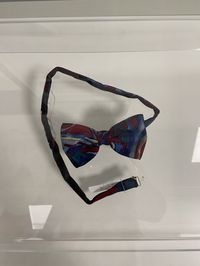
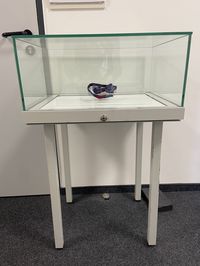
Object name: Fly
Inventory number: KG2102
In the collection since: May 2025
Date: 20th/21st century
A bow tie is an accessory that many of us recognise from different contexts. In muted colours such as black or anthracite, it appears as part of a festive wardrobe or official (academic) clothing - often in combination with suits. Colourful and with large, soft and often patterned ribbon ends, they are part of clown outfits. For a long time, however, it was seen as an exclusively male* accessory. In the context of pop culture, this interpretation has long been broken up by celebrities who consciously contradict such attributions and the supposed norms associated with them by integrating a bow tie into their wardrobe or wearing it as part of an overall outfit with a masculine* connotation. One example is Ellen Degeneres, who showed up at the Oscars in 2014 wearing a full black tie look: "Tuxedo, a white shirt [...], patent Oxford flats and a black bow tie." [1] Musician and producer Janelle Monáe wears bow ties in a different way. Monáe goes one step further than Degeneres and specifically combines her outfits by "bringing together stereotypically masculine and feminine elements". [2] While heteronormative categories ultimately remain in place when a stereotypically masculine wardrobe is appropriated by a female* person (and vice versa), in Janelle Monáe's case the bow tie breaks down these boundaries in its materiality, but also on an immaterial-symbolic level - and thus becomes a queer accessory.
As a queer accessory, the patterned bow tie shown here was also donated to STAK by its previous owner. It can be described as a key object for the donor's queer clothing practice, because after she acquired the bow tie in a second-hand shop, the accessory became the starting point for her increasing joy in experimenting with and combining the aforementioned masculine and feminine fashion elements. While the bow tie was initially worn 'classically' with the top purchased as a men's shirt, feminine* connotations were later added with colour-matching nail polish and a drinking bottle in lilac tones. Today, the donor consciously combines masculine and feminine elements in almost every outfit every day in order to create a balance, as she reports in the interview: A loosely tied tie is accompanied by multi-strand pearl necklaces, earrings with heavy earrings are paired with rough low shoes and braces with a silk blouse. [3] The changing clothing practice, which can also be described as queer dressing [4], is interrelated with the changing self-perception of the donor - and thus becomes a vestimentary mirror of an identity perceived as queer.
Queer objects have played a minor role in the STAK to date. When donations were received, they were often categorised as either male or female, and the category 'diverse/unisex' was rarely used. In future, queer objects are to become more visible in the STAK as an important but still underrepresented and invisible component of everyday textile culture in (museum) collections. A first step is the intervention exhibition Queer objects@STAK, curated by Denise Neumann (MA Museum and Exhibition), which has been on display in the showcase of the textile objects archive since September 2024. It also focuses on collection objects that are sometimes only retrospectively read as queer in the exhibition. In a further step, objects explicitly read as queer by the donors will be specifically included in the future. This bow tie is a first example of this - but certainly only the beginning of the queerisation and diversification of the STAK, which should thus become an adequate mirror of the surrounding society!
Author: Klara von Lindern
Sources:
[1] Katharina Rost: Women with bow ties. The pop singer Janelle Monáe and her ambivalent accessory, in: Gertrud Lehnert/Maria Weilandt (eds.): Ist Mode queer? New Perspectives on Fashion Research, Bielefeld 2016, pp. 93-108, here p. 93.
[2] Ibid, p. 95.
[3] The interview was conducted on 9 April 2025 between the donor and Klara von Lindern and Lüder Tietz.
[4] Cf. https://en.wikipedia.org/wiki/Queer_fashion (last accessed: 24/04/2025)
Spencer with floral embroidery
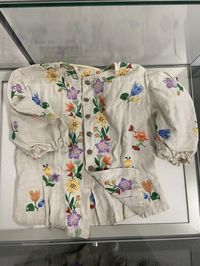
Object description: Spencer with embroidered appliqués
Inventory number: KG1826
In the collection since: November 2018
Date: 1929/1980
The days are getting longer, the birds are chirping, trees are budding and tulips and snowdrops are sprouting everywhere. Spring is just around the corner. As soon as the first warm rays of sunshine appear, it is noticeable how people swap their winter clothes for lighter spring clothing. In addition, colourful decorative eggs adorn the trees outside front doors. This is a sure sign that Easter is approaching and summer is not far away. In keeping with the occasion, I am presenting an exciting object from our collection: This is a hand-stitched and hand-embroidered linen spencer. The embroidery shows floral appliqués with floral patterns.
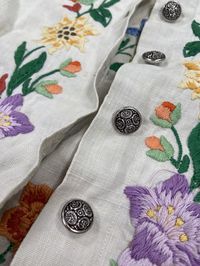
The spencer has a fitted, symmetrical and close-fitting cut. It is embroidered on the front and back as well as on the sleeves. The background is in the colour ecru (a muted natural white) and the floral embroidery is in the colours blue, purple, red, yellow, green and orange. The embroidery runs vertically along the neckline and the silver-coloured row of buttons. [1] According to the donor, the flowers are alpine flowers: gentian and alpine roses [2]. The neckline is round, the sleeves are short and puffed with gathered sleeve ends. The Spencer has peplums at the back. There are darned holes and mould stains on the sleeves and back and it is slightly yellowed. [3]
The donor's mother probably sewed this spencer in the late 1920s or early 1930s and the donor's older sister embroidered it. [4] You can tell that the embroidery is handmade because the bobbin thread is the same colour as the upper thread. [5] This is a satin stitch and a stem stitch. In satin stitch, the needle is inserted from the bottom upwards, while the thread runs downwards on the reverse side. This creates dense, adjacent stitches that form an even surface. With a stem stitch, a stitch can run to the left or right. Curves look more harmonious if they are stitched in the opposite direction. The stem stitch produces an evenly wide line. [6]
During the National Socialist era, the donor's mother always wore it in combination with a standing skirt for standing receptions. Standing skirts were suitable for particularly formal occasions at that time. The donor herself wore the spencer, usually in summer, combined with trousers in the 1970/80s. The buttons on the spencer were probably replaced in the late 1960s or early 1970s. They came from a collection of buttons belonging to the mother, which were later donated to an organisation for people with disabilities. The spencer was hand washed with great care so as not to damage the embroidery. [7]
The spencer is a good example of traditional craftsmanship and textile design. It clearly shows how fashion has changed over the years in terms of manufacture, combination and use€ and how carefully clothing was handled and passed on in the past.
Author: Joanna Kanthak
Sources:
[1] http://wisski-stak01.virt.uni-oldenburg.de/wisski/navigate/30030/view (last accessed on 13/03/2025)
[2] Eller,P. & Müller J. ( 14 December 2015). Interview with donor, part 1 [transcript]. Clothing Archive of the Institute of Material Culture, Carl von Ossietzky University p. 21
[3] http://wisski-stak01.virt.uni-oldenburg.de/wisski/navigate/30030/view (last accessed on 13/03/2025)
[4] Eller,P. & Müller J. ( 14 December 2015). Interview with donor, part 1 [transcript]. Clothing Archive of the Institute of Material Culture, Carl von Ossietzky University p. 24
[5] https://de.yutaitextiles.com/info/what-is-the-difference-between-hand-embroidery-85948986.html?utm_source=chatgpt.com(last accessed on 13/03/2025)
[6] Employers' organisation Gesamttextil. (1994). Jewellery textiles, machine embroidery (Training resources, teaching aids, 33). Eschborn: Arbeitgeberkreis Gesamttextil.
[7] Eller,P. & Müller J. ( 14 December 2015). Interview with donor, part 1 [Transcript]. Clothing Archive of the Institute of Material Culture, Carl von Ossietzky University p. 21 - p. 25
Doll's house
Object description: Doll's house 'Fashion shop'
Inventory number: TO965
In the collection since: April 2021
Date: 20th/21st century (1990-2010)
Educational toy for girls or socio-historical depiction of domestic spheres? Doll's houses have often received ambivalent categorisations in research, which often reduce them to a single aspect [1]. However, they are multi-layered objects that must be viewed from all sides and from very different perspectives in order to approach a categorisation. Evidence of doll's houses in Europe from the 15th century onwards tells different stories of domestic spheres over the centuries. They offer insights as toys or art objects, but above all as representations of a cultural-historical ideal in which intersectional discourses such as gender, class and ethnicity always play a role [2]. As miniature houses, they generally replicate hegemonic norms of what is considered a desirable way of life, 'normalised', in the respective context of origin [3]. In early 20th century Europe, for example, doll's houses are usually two storeys high and inhabited by mainly white, female-coded dolls positioned in the kitchens and laundry rooms.
Doll's houses pose a particular challenge for reconstructions of an original state, for example in (museum) collections, because while the wall-fixed furnishings of the rooms determine their basic function (e.g. as a kitchen or living room), movable furnishings and figures must first be assigned to the room [4]. The basically infinite dynamics of the microcosm of the doll's house without a fixed status quo thus makes an unequivocal reconstruction impossible [5]. The key to approaching a reconstruction is the material: this is also the case with the doll's house fashion shop from the Textile Everyday Culture Collection. This handmade doll's house made of wood and cork consists of four rooms of roughly the same size, which can be decoded as a historical fashion shop with fixed wall furnishings (pastel blue wallpaper, electric wall lighting) and dynamic furnishings. In addition to the seven mannequins, all of which are coded as female, the dynamic furnishings include individual textile items - shoes, handbags, felt hats, women's underwear, gloves; some on coat hooks, others stored in fine paper boxes. These detailed individual pieces are not only associated with attributions of meaning, but also make it clear that the doll's house as an object as a whole consists of many individual object biographies [6].
This becomes particularly clear through the documentation medium of video. Firstly, the doll's house is a large object, filled with many initially blurred details. In order to make the object digitally tangible, macro shots can be used in addition to close-ups to produce a high magnification, which can reveal not only individual objects, but also details of their composition, material and manufacture (weaving and knitting structure, adhesive residues) that would otherwise remain invisible. The medium of video is particularly suitable for visualising damaged areas and remaining evidence of the manufacturing processes. The dynamics of the moving individual pieces, which can be viewed both inside and outside the context of the doll's house, are also taken up in the dynamics of the video and made comprehensible - at the same time as a reference to their staging. In this way, the video approaches a supposedly authentic documentation of the object, but through the presentation technique and its focussed gaze, the viewer is given a certain way of seeing it: By filming and editing, a perspective is pre-selected and enforced. The selection of the details shown, as well as the reconstruction of the object itself, inevitably manipulates the viewer.
In museum and collection-related contexts, video as an audiovisual medium is not only an effective way of communicating and engaging with objects and content at a low threshold. On the one hand, the visual material works on its own, even if voice-over and picture titles are omitted. In addition, the audio layer offers a simple way of adapting the video for a new target group by slightly changing the sound for other languages or simplifying the language. If such a documentation process is created with an awareness of the unavoidable transfer of one's own perspective, effective new questions and presentation techniques can also arise in museum spaces. Especially in view of the need for digitalisation and digitality at different levels of museum work, which has intensified during the Corona pandemic, an experimental approach to digital media and their integration into collection and mediation work is worthwhile, as this project aims to show by way of example.
NOTE: The doll's house itself can be visited by arrangement with can be visited.
Text & Video: Marie Schmohel
[1] Cf. Cremer, Annette: Mon Plaisir. Die Puppenstadt der Auguste Dorothea von Schwarzburg (1666-1751), Cologne/Weimar/Vienna: Böhlau Verlag, 2015, esp. pp. 49-69.
[2] Cf. ibid.
[3] Cf. Millhauser, Steven: The Fascination of the Miniature, in: Grand Street 2.4 (1983), pp. 128-135.
[4] Cf. Cremer 2015.
[5] Cf. ibid.
[6] Cf. Kopytoff, Igor: The cultural biography of things: commoditisation as process, in: Arjun Appadurai (ed.): The Social Life of Things. Commodities in Cultural Perspective, Cambridge: Cambridge University Press, 1986, pp. 64-92.
Lace top


Object description: Lace top
Inventory number: KG119
In the collection since: January 1998
Dating: 1970
"Trick or treat, or you'll get trick or treat!" The shop shelves are filled with spooky masks, pumpkin faces and spider webs. Zombies, witches and all kinds of fantasy creatures become the faces of various brands for a short time and even find their way into advertising slogans. Anyone who combines these signs knows immediately: Halloween is just around the corner! But where does Halloween actually come from? Its origins can probably be traced back around 2000 years to the Celts. In pre-Christian times, they settled in what is now Ireland, Scotland, Wales, England and the north of France and celebrated Samhain, one of their most important festivals, on 31 October. It was named after the god of the dead of the same name. The festival was both a harvest festival and a New Year's celebration. The Celts believed that the boundaries between the world of the living and the dead were opened on this day. It is believed that the provision of food served to appease or invite the spirits and that dressing up in masks served to protect the spirits[1].
Before Halloween took on its current - commercialised - form, however, the Celtic festival was subject to numerous influences and changes. In the USA, the 'traditions' that now characterise the 31st of October nationwide finally developed from the 19th century onwards.[1] While a majority of the German population state in surveys that they do not attach any particular importance to Halloween itself, a surprising majority nevertheless state that they increasingly watch spooky series or films in October.[2] In 2023, the series "Wednesday" joined the genre and became an unexpected record streaming favourite on Netflix.[3] The series is an homage to the Addams Family known from cartoons and earlier films, which aims to show a time in the characters' lives that has not yet been addressed. It mainly refers to the everyday school life of the daughter Wednesday Addams at boarding school, Nevermore Academy.[4] In keeping with the earlier films, Wednesday also dresses mainly in black and white in the Netflix series and contrasts with the rest of her environment, which is shown in a much more colourful way. The clothing style draws on elements from the gothic scene, which costume designer Colleen Atwood wanted to translate into our modern times in order to appeal to a wider audience[5].
Our item of the month, a black sleeveless top made of openwork lace, is not a prop from the set, but it is reminiscent of the (dress) aesthetic of the series. Together with an orange-coloured cocktail dress, over which it was worn, it forms an ensemble. The cut and fabric of the black top is reminiscent of the evening dress Wednesday wore to the Nevermore Academy ball, which went viral on social media. It proves that certain trends are timeless in a certain sense - and that Halloween as we know it today is not going out of fashion, but on the contrary is having a style-defining effect!
Author: Jennifer Kynast
[1] Höhn, Marco: Dead but happy. Halloween - the night of the living dead as an event mix, in: Andreas Hepp, Marco Höhn, Waldemar Vogelsang (eds.): Populäre Events. Medienevents, Spielevents, Spaßevents, 2nd revised edition, 2010, Wiesbaden, pp. 269-297, here pp. 271-272, p. 277.
[2] NDR Info: Halloween. What's behind the popular custom, https://www.ndr.de/ratgeber/verbraucher/Halloween-Was-steckt-hinter-dem-Brauch,halloween10.html, as of 31/10/2023, accessed: 15/10/2024.
[3] Cf. IMDB entry for the series Wednesday (Director: Alfred Gough, Miles Miller), https://www.imdb.com/title/tt13443470/, accessed: 12/11/2024
[4] The Hollywood Reporter: How Wednesday brought Tim Burton to TV, https://www.hollywoodreporter.com/tv/tv-features/making-of-wednesday-series-tim-burton-tv-1235509693/, accessed: 07/06/2023, accessed: 16/10/2024.
[5] Variety: Wednesday Costume Designer Colleen Atwood on Finding the Addams Family Look at Zara and what's next for Season 2, https://variety.com/video/wednesday-costume-designer-colleen-atwood/, accessed: 16.10.2024.
Traditional hat

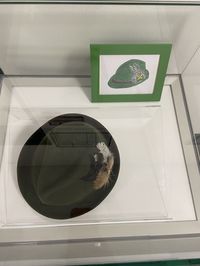
Object description: Traditional hat
Inventory number: KG1407
In the collection since: July 2006
Date: 1984–1988
Autumn is here! It brings not only colourful leaves and cooler weather, but also the Oktoberfest, the world’s largest folk festival. A highlight of the Oktoberfest is the traditional costume and marksmen’s parade, which has traditionally taken place on the first Sunday of the festival since 1950, winding its way through Munich city centre to the Theresienwiese. Around 9,500 participants, including traditional costume groups, shooting clubs and marching bands from Bavaria and across Europe, take part and proudly display their traditional costumes and historical attire. The Schützenzug offers an impressive variety of traditional dress, ranging from classic dirndls and lederhosen to historical costumes such as Biedermeier fashion and even knights’ armour. [1]
For the numerous visitors, too, their choice of attire plays a central role. They come not only to admire the diverse traditional costumes, but also to present themselves in traditional dress. For many, the Oktoberfest is the perfect occasion to wear a dirndl, which was originally designed as workwear and only came into its own in 1930. [2] Lederhosen are also a popular choice. In the past, these were worn by men as a way of flouting church norms. [3] Nowadays, lederhosen are worn at Oktoberfest by people of all genders. They are often paired with a traditional shirt or blouse, frequently in subtle colours such as white or light blue. A buttoned waistcoat, colour-coordinated with the embroidery on the lederhosen, a Janker and chunky knitted socks complete the outfit. [4]
Of course, no traditional costume is complete without accessories, such as traditional hats. Our example, a dark green traditional hat from the 1980s, is in the style of a Tyrolean hat [5]. This traditional felt hat, originally from the Zillertal valley, is characterised by its pointed shape and a brim as wide as a hand. The Tyrolean hat became famous thanks to Edward VIII, who made it popular in Styria. [6] The traditional hat from our collection stands out in particular thanks to an animal-fur rosette and a feather appliqué. A cord around the edge of the crown serves as a border and adds further decorative touches to the hat. This hat was part of the uniform of the shooting club in Leer and was worn at public events and during performances by the marching band. The owner wore it mainly in summer and kept it for around 13 years before leaving the marching band. [7]
By the way: during the winter semester, the Institute is hosting the seminar ‘Tracht on Display!’, which will explore historical and contemporary perspectives as well as strategies for the preservation and exhibition of traditional costume. Our traditional hat is sure to feature in the seminar too!
Author: Joanna Kanthak
[1] City of Munich (2024): The Traditional Costume and Riflemen’s Procession: Oktoberfest highlight: traditional costume groups parade through the city centre. https://www.oktoberfest.de/informationen/termine/trachten-und-schuetzenzug (last accessed: 4 September 2024).
[2] City of Munich (2024): The History of the Dirndl: The long history of a special traditional costume. https://www.oktoberfest.de/dirndl-tracht/dirndl-geschichte-so-begann-der-hype-ums-trachtenkleid (last accessed: 4 September 2024).
[3] City of Munich (2024): Lederhosen: from a scandal at church to a must-have. A brief history of the lederhosen. https://www.oktoberfest.de/dirndl-tracht/lederhosen-vom-skandal-beim-gottesdienst-zum-must-have (last accessed: 11 September 2024).
[4] Fuchs, K., & Goldbach, M. (21 September 2023): Oktoberfest attire: Everything you need to know about dirndls, lederhosen and more, Vogue. https://www.vogue.de/mode/artikel/oktoberfest-kleidung-wiesn (last accessed: 8 October 2024).[5] Yip, S., Penter, A. (2018): Fashionpedia: The visual dictionary of fashion design, Fashionary Verlag, p. 166.
[6] Stöcker, C. (2003): Reisebilder II. 1828–1831. Commentary , Heine , p. 232.
[7] http://wisski-stak01.virt.uni-oldenburg.de/wisski/navigate/327/view (last accessed: 4 September 2024).
VOGUE September Issue


- Item description: VOGUE US/September Issue (09/2002)
- Inventory number: None (holdings of the typeface archive)
- In the collection since: September 2002
- Date: September 2002
In keeping with September, the current Dings da! is an object that is directly related to the month: The September 2002 issue of the US magazine VOGUE. A quick glance at the magazine shows that it is an extensive publication - exactly 750 pages long, if we flip to the back. One of the large teaser headlines on the cover promises readers: "750 pages of fall fashion's all-out glamour". Although a closer read reveals that a good 60% of the 750 pages consist of adverts for high fashion and luxury lifestyle products, other teaser headlines on the cover reveal illustrious names from the world of (fashion) photography such as Helmut Newton and Annie Leibovitz. So what is this fashion heavyweight all about in a double sense?
(The September issue of fashion magazines is a veritable institution worldwide, and not just for fashion enthusiasts. In this eagerly awaited annual publication, everything that will characterise the coming fashion seasons manifests itself - predicted with unerring instinct by the experts in the editorial offices and photographically staged by the industry's best-known photographers. [1] A documentary film was even dedicated to the September issue: The September Issue, created in 2007 and published in 2009, which is exhibited here together with the magazine. The film documents the creation of the September issue of the US magazine VOGUE 2007 with a special focus on the work of editor-in-chief Anna Wintour and the then creative director Grace Coddington. It is easy to see that it is about much more than just forecasting upcoming trends. Every year, the aim is to surpass the previous September editions in terms of effort and scope. As shown in the film, for example, various shoots are realised with high-ranking fashion photographers, whereby a large part of the material never makes it into the sometimes 20-page editorials and individual themed shoots even have to be repeated. [2] The effort and costs are therefore seemingly disproportionate to the benefits. However, if one considers the function of such a magazine in the context of the global VOGUE brand, it can be described as proof of a successful race against itself. Jasmin Assadsolimani has vividly illustrated how such special editions of VOGUE acquire a legitimising status. Because the look ahead always takes place with reference to what has already been achieved: VOGUE quotes and references itself directly or indirectly and thus simultaneously stages itself as an archive of fashion history and as an authority that predicts or even determines future fashions. [3]
Much has changed in the fashion world since the film was released - not least in terms of the (print) media landscape. Numerous magazines have discontinued their print edition in favour of a digital edition or have ceased publication altogether. Although VOGUE still holds its own as probably the best-known publication in the fashion sector and as a global brand, the days of 750-page September issues are over. While the former publishing director at Condé Nast Tom Florio proudly claimed in the film that the first question journalists ask after the publication of a September issue of VOGUE is how much it weighs, Taylor Bryant wrote back in 2019 that such publications are now irrelevant - because due to the increased information speed of digital media and the newly added professional group of influencers, nobody waits for the September issue anymore. In addition, the previously thick issues are no longer feasible for environmental reasons and not least due to a lack of financing. [4] Whether September issues have really lost their status completely is not something I would like to answer here, but rather put up for debate - in any case, the object of the month is an impressive reminder of the history of this once so important publication and invites you to take a look at VOGUE from a media-historical perspective.
Author: Klara von Lindern
[1] Viviana Harris: A History of the September Issue, available online at https://www.highsnobiety.com/p/september-issue-history/ (last accessed: 04/09/2024).
[2] Cf. Jasmin Assadsolimani: 30 years of Vogue - looking back as a staging strategy for modernity, in: nmt Jahrbuch Netzwerk mode textil, 2022, pp. 24-35.
[3] Cf. The September Issue (2009), cf. www. imdb.com/title/tt1331025/?ref_=ttvg_ov (last accessed: 04/09/2024).
[4] Cf. Taylor Bryant: Are the september issues still relevant? (29 August 2019), available online at: https://fashionista.com/2019/08/september-issues-magazines-media-landscape (last accessed: 04/09/2024).
Pearl bracelet


- Object description: Pearl bracelet
- Inventory number: TO751j
- In the collection since: 31/10/2002
- Date: 20th century
The summer of 2024 was all about big concerts. Pop stars such as Adele, Coldplay and Taylor Swift filled entire stadiums around the world. Hundreds of thousands of fans never tired of sharing photos and videos of the performances on Instagram. The question of the right outfit for a concert was particularly prominent in the context of Taylor Swift's concerts: a real dress code developed among the 'Swifties', as the fan community calls itself. But what do pearl bracelets have to do with it? I would like to shed some light on this, starting with the object of the month, a bracelet made of glass beads.
Taylor Swift's tour is entitled The Eras Tour. 'Eras', in German 'Ära' or 'Epoche', refers to the different phases within her career. These are not only characterised by different musical styles, but also go hand in hand with Taylor Swift's specific, dress-related appearance. A concert on the tour comprises 44 songs and lasts over three hours, as the different eras of the albums(Lover, Fearless, Red, Speak Now, Reputation, Folklore/Evermore, 1989, The Tortured Poets Department and Midnights) are run through in the course of the show. Not only will individual songs from the respective albums be played, but instruments and costumes will also be changed to adequately reflect the style and mood of the eras. For the Eras Tour performances, Taylor Swift worked with well-known designers (such as Versace, Etro and Zuhair Murad) who created stage outfits for the costume changes during the concert, which allude stylistically to outfits worn at previous performances or in music videos. [1]
In the run-up to a concert, the Swifties don't just get in the mood by listening to their favourite album. Much more important is the question of the outfit, specifically: "Which era are you?", according to which they then dress to match their favourite era. International fashion magazines such as Glamour UK have put together their own guides for such outfits to match each era in the context of the Eras Tour, so that even concertgoers less familiar with the styles can easily put together something suitable. [2] One item that should not be missing from any outfit are beaded bracelets that contain song titles or words from lyrics and are colour-coordinated with albums or eras . The bracelets are made or purchased in advance of the concert and then exchanged with each other at the venue. [3] The practice has its origins in a line from the song You're on your own, Kid(Mignights): "Make the friendship bracelets, take the moment and taste it." [4] There are now even special craft kits for making the bracelets on sale, containing beads in different colours, with motifs and letters.
The Dings da! is not a Swiftie bracelet, but a much older example that has been in the collection since 2002. However, this bracelet was also made from coloured glass beads - not using a knotting or threading technique, but a weaving technique (presumably with a bead weaving frame). As the bracelet is part of the textile objects archive, there is no donation interview and only little information about the object's biography. Nevertheless, it shows that even objects about which we know little can always be viewed in new contexts, for example in the context of everyday life or pop culture. A single line of a song leads to a practice whose results become part of a material culture of music history, but are also linked to the much older practice of bead and friendship bracelets, of which the bracelet from the STAK is an example. Of course, the STAK now also has a 'real' Swiftie bracelet, which was exchanged and worn by the donor at one of the Hamburg concerts in June 2024 and will be shown here shortly.
AUTHOR: Klara von Lindern
SOURCES:
[1] Christian Allaire: Taylor Swift Kicks Off Her Eras Tour in Fully Bejeweled Fashion, VOGUE US (19.03.2023), available online at https://www.vogue.com/slideshow/taylor-swift-eras-tour-best-fashion-moments (last accessed: 08.08.2024).
[2] Sophie Cockett/Hattie Cotmore: Taylor Swift's Eras Tour has reached Europe, so here's what to wear to the concert, Glamour UK (25.07.2024), available online at https://www.glamourmagazine.co.uk/article/what-to-wear-taylor-swift-concert-eras-tour (last accessed: 08.08.2024)
[3] Gala (26/10/2023): That's why all Swifties wear colourful bracelets, available online at https://www.gala.de/beauty-fashion/fashion/taylor-swift--darum-tragen-alle-swifties-bunte-armbaender-23937110.html (last access: 08.08.2024).
[4] Lyrics from You're on your own, Kid, available online at https://www.musixmatch.com/lyrics/Taylor-Swift/You-re-On-Your-Own-Kid (last accessed: 08/08/2024).
Potholder


- Object description: Pot holder
- Inventory number: TO137, TO366, TO372, TO398, TO411, TO415, TO416, TO766, TO811
- In the collection since: 2000-2004
- Dating: 1967-1997
Studying everyday culture often requires, paradoxically, an ability to expand one's perspective. In doing so we need to start out by noticing things that we previously took for granted or saw as naturally ordained. This is not always an easy feat, so it is important to sometimes look at the things around us from a different perspective. A boon to the study of textile culture is that this process is made much easier by the material aspect of the field. This is a strength of the STAK, in that it contains material details which by being entered in a university collection are much easier to pay attention to. It is still not simple to focus on everyday things, as both personal interests and public funding often skew towards "special" fields, topics and objects.
So, let me tell you about my favourite everyday objects in the STAK, the pot holders. Contrary to what one might think, the textile pot holder is a fairly modern invention, the earliest attested examples being less than 300 years old. One of the few in-depth analyses of the history of the textile pot holder, conducted by Rachel Maines, shows that most premodern illustrations of people handling presumably hot cookware do not include any form of pot holder. When there is a tool being depicted, it is made of wood or metal in the form of a handle or hook. [1]
The earliest extant textile pot holders seem to be from the18th century. [2] These are almost universally very fine and decorated objects, and were mostly intended for tea pots. During the course of the19th century, pot holders grew more popular, while still not being as ubiquitous as they would later become. An interesting example of this is the propagandistic use of pot holders by the American abolitionist movement, in the lead up to and during the American Civil War. A slogan often featured on abolitionist pot holders was "Any holder but a slaveholder". [3] These were sold at abolitionist fairs, intended to raise funds for the movement, and later the Union army during the civil war. Many homemade objects were sold at these fairs, [4] and the inclusion of pot holders indicates they were becoming a more mainstream item, as well as a popular object to make at home.
Around 1900, the pot holder became ever more common, but this was a mostly working- and middle-class phenomenon. It is worth noting though, that from 1880 onward more and more handicraft magazines started to feature instructions for making needlework pot holders. Maines posits that this is connected to the increased cost of household labour during the period, which meant that more affluent women started to cook, and thus needed pot holders which could represent their aesthetic and material needs. Even though the needlework pot holder became more common, most instructions for creating pot holders were still published in cheaper handicraft magazines until well after 1930. These were most often knitted, and more practical rather than decorative. [5]
This history of pot holders is thus interwoven with several concurrent social and economic historical developments. Their aesthetic and functional development seems to be connected in a quite clear manner, as most household objects can be adjusted to serve a supplemental decorative purpose. Since pot holders became so common during the first half of the20th century, it seems almost natural that they would be made in a myriad of ways. Their role as a basic home-made item is also boosted by the fact that they are quite easy to make, and can be produced cheaply at home. These factors make the pot holder an exemplar of an everyday item, which connects well with the large numbers available in the STAK. They are fascinating not because they are special and rare, but precisely because they are not. In an academic world where unique items are often valued the highest and afforded the most attention and funding, it is important to sometimes take a serious look at the common objects that so often make up everyday life.
AUTHOR: Edwin Mårtensson
SOURCES:
[1] Maines, Rachel. Evolution of the Potholder: From Technology to Popular Art. In Journal of Popular Culture, 1985-06, Vol.19 (1), p.3.
[2] Many of these are in the collections of the Winterthur Museum in Delaware, USA. The Museum's catalogue is available online at museumcollection.winterthur.org.
[3] There are many examples of this in American museums and university collections. These include the Chicago History Museum, catalogue entry available at collections.carli.illinois.edu/digital/collection/chm_museum/id/1981/ (accessed 08.05.2024).
[4] Maines. Evolution of the Potholder: From Technology to Popular Art. p. 13.
[5] Goddu, Theresa A. Selling Antislavery. Abolition and Mass Media in Antebellum America. Philadelphia, University of Pennsylvania Press, 2020, pp. 85-88.
Kente cloth

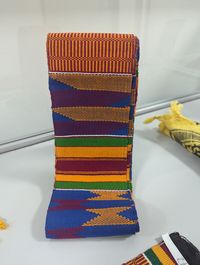
- Object description: Kente cloth
- Inventory number: TO842
- In the collection since: 2003
- Date: ca. 1989
There are many possible approaches to writing about kente cloth. One could write about its long history, its traditional symbology, or its role as a political marker. Since the fabric has its origins in 17th century west Africa (in the Ashanti Empire, located in what is now Ghana and Togo), a discussion of slavery and colonialism is central when writing about kente. It has also been used as a symbol of heritage and pride by African Americans, [1] and has subsequently been worn by white Americans to symbolise solidarity. [2] These multifaceted meanings, uses and contexts mean that this text cannot possibly cover it in anything even resembling its full context. Of course, every object in the STAK requires specialised knowledge to fully understand it, but this is especially true in the case of the kente cloth.
So, what can we say about the kente in the STAK? Firstly, there is one larger piece of cloth, and 4 kente strips. This illustrates the production and structure of kente, since it is woven in long narrow strips, which are then sown together to create a larger piece of fabric. The cloth is multicoloured with geometric shapes in several different patterns. Both the colours and the patterns carry traditional meaning. Patterns have names, associated with proverbs and thus associated with specific messages. [3] It is sadly unclear which message the pattern of the kente in the STAK was made to express, since no other example of the exact pattern has been found.
Kente clearly demonstrates an example of how material culture is created and recreated through active human interpretation. In this perspective, the exact history of West African weaving tradition is not as relevant as understanding kente's use, interpretation and reinterpretation. Having a sample of kente in the STAK can help with adding a material bent to this perspective. Kente started out as a fabric solely intended for royal use, and was made from locally sourced cotton or silk and cotton from unravelled imported textiles. Today it is not uncommon for kente to be made from synthetic yarn, although cotton is still the most common material and is also featured in the STAK's kente. It might not be surprising to hear that kente, always being viewed as an African symbol, has been considered as an early use of commercially produced African silk. [4]
Furthermore, kente has a somewhat tenuous connection with Germany. The Ewe people of modern-day Togo and Ghana makes a distinct type of kente, and were one of the peoples living in the German colony Togoland. The kente cloth in the STAK was purchased in 1989 as part of a charity project with focus on helping people in Ghana. The STAK's background material contains a booklet about kente published by the Norddeutsche Mission. The Norddeutsche Mission has been active in both missionary and charity work in Ghana and Togo since 1847, before the colony Togoland was established. [5] Colonialism was an important factor in the development of kente, as is shown by both the early use of foreign silk in the cloth and by the post-colonial use of kente as an African symbol of pride and heritage. Germany's role in colonising west Africa can thus be used to create a new perspective for viewing kente. As it could be argued that this problematic and still prevailing colonial narrative and history played a role in bringing the kente cloth to the STAK, the colonial perspective is also central to understanding its specific circumstances.
It is clear that kente is a good example of how material culture can be incredibly complex and the product of entangled of entangled histories. Kente can be used as a starting point for understanding colonialism, racial politics and textile developments while also being a very interesting object of study in itself. With its many meanings, kente is a relatively straightforward example of how textiles can be used for display of wealth, solidarity and traditional values, among many other examples. Any of the perspectives given in this text would be excellent starting point for further research and projects.
AUTHOR: Edwin Mårtensson
SOURCES:
[1] It should be noted that the use of kente as a symbol of African or black pride is not universally accepted among African Americans. Padilioni, James, Jr. The History and Significance of Kente Cloth in the Black Diaspora. The African American Intellectual History Society, 22.05.2017, www.aaihs.org/the-history-and-significance-of-kente-cloth-in-the-black-diaspora/ (accessed 10.04.2024).
[2] Which has been criticized as cultural appropriation and using kente as a "political prop". Lee, Alicia. Congressional Democrats criticised for wearing Kente cloth at event honoring George Floyd. CNN, 08.06.2020, https://edition.cnn.com/2020/06/08/politics/democrats-criticized-kente-cloth-trnd/index.html (accessed 10.04.2024).
[3] Padilioni. 2017.
[4] Okwae Fening, Ken. History of kente cloth and its value addition through design integration with African wild silk for export market in Ghana. Conference Paper, Development of Sericulture and Apiculture Products for the Poor in Fragile Ecosystems Using the Value Chain Approach, Session 2. 2006, pp. 62-64.
[5] Evangelische Mission Weltweit. North German Mission. mission-weltweit.de/de/ueber-uns/mitglieder/regulaere-mitglieder/norddeutsche-mission.html (accessed 10.04.2024).
Handkerchief Olympic Games
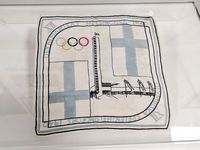
- Object description: Olympic Games handkerchief
- Inventory number: TO611
- In the collection since: 2001
- Date: 1938-1939
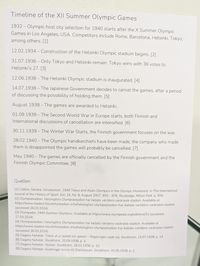
In recognition of the upcoming Summer Olympic Games in Paris, this month's object has been chosen to have an Olympic theme. It is a handkerchief, made for the XII Olympiad in Helsinki, planned to be held in 1940. The handkerchief features the Finnish flag, Olympic rings, the Roman numeral XII and a depiction of the Olympic stadium in Helsinki. The games were originally planned to be held in Tokyo, but were instead assigned to Finland because of Japan's involvement in the Second Sino-Japanese War (1937-1945). Japan's Olympic committee was reluctant to cancel the games, even though the international Olympic committee grew ever more sceptical of the feasibility of arranging the games in Tokyo. [1] But on the 14th of July, 1938, the Japanese government decided that they could not spare the resources required to arrange the games and thus cancelled them. [2] Since Finland had been the clear runner-up in the selection of host country, they were assigned the games during the next month. Preparations for hosting the games started quickly, and construction of the Olympic stadium had already been finished, as the Finnish government had built it in preparation for holding the games before Tokyo had been given preference over Helsinki. [3] After having been awarded the games, specific preparations were started and it is during this time that the handkerchief was most probably produced.
This did not mean the games were ever viewed as a certainty. Because of international tensions during the lead up to the Second World War in Europe, the cancellation of the games was discussed early on. When the war broke out, criticism of the games was amplified further, but the games were not formally cancelled until May of 1940. Like Japan, Finland seemed to have been displeased with giving up the games, but once the Wehrmacht broke into France and Norway the games were deemed impossible. [4] On the other hand, the Winter War (November 1939-March 1940) between Finland and Russia probably meant that the Olympic games had been a very low priority for the Finnish government for some time. The late cancellation could then also be seen as an official confirmation of a well-known fact.
As for the handkerchief, there is definitive proof of a company in Finland producing handkerchiefs decorated with the Olympic stadium, as well as handkerchiefs with all participating countries' flags. In February 1940, the company was publicly lamenting their investment as it was unlikely the games would be held. [5] The Riksidrottsmuseum in Stockholm, Sweden, has examples of both handkerchiefs, [6] one of which heavily resembles the handkerchief presented here. Interesting to note is that the two handkerchiefs have different corner decorations, the STAK's having the Roman numeral XII and the Riksidrottsmuseum's having an Olympic logo. Despite this, the similarities between the two handkerchiefs means that they were almost certainly made by the same company.
For the purposes of the STAK, the exact dating of the handkerchief is not all that important, but it is interesting to note that it was part of a longer process of creating and negotiating the XII Olympic games. There are many material traces of the lead up to the cancelled games, both in Japan and Finland, including everything from stadiums to memorabilia. Noting that there is definitive proof of several different iterations of an Olympic handkerchief points to both the design and production processes of hosting the games during this period. The Olympics have been used as propaganda events by the host countries ever since they started, and Finland was looking for international attention as well. A relatively small and neutral country like Finland could not directly compete with the propaganda capabilities of Japan or Germany, which hosted the games in 1936. But Finland was still reluctant to give up the opportunity presented to them.
To finish the saga of the XII Olympics, Finland was given the 1952 Olympics, partly to compensate for the cancellation of the 1940 games. By then, the Olympic cycle was returning to its normal routine, and the Olympic stadium could finally serve its intended purpose. And yes, a range of handkerchiefs was produced, [7] and this time they could be sold to international spectators, like intended.
AUTHOR: Edwin Mårtensson
SOURCES:
[1] Dagens Nyheter. En halv miljon unga svenskar mot Japan-spelen. Stockholm, 03.07.1938, p. 1.
[2] Dagens Nyheter. Tokyo ut ur spelet om spelen - Regeringen sade nej. Stockholm, 15 July 1938, p. 14.
[3] Olympiastadion. Helsingfors Olympiastadion har kallats världens vackraste stadion. Available at www.stadion.fi/sv/info/stadion-info/helsingfors-olympiastadion-har-kallats-varldens-vackraste-stadion (accessed 26.03.2024).
[4] Dagens Nyheter. Guldringar tonvis till Statskassan. Stockholm, 20 May 1938, p. 1.
[5] Dagens Nyheter. Notiser. Stockholm, 28/02/1938, p. 10.
[6] Riksidrottsmuseums Samlingar. RIM RMF 3268 - Näsduk, RIM RMF 4324 - Näsduk . Can be seen at samlingar.riksidrottsmuseum.se/objects/c25-4121/, samlingar.riksidrottsmuseum.se/objects/c25-5565/ (accessed 27.03.2024).
[7] As can be seen on Bukowskis, Olympic memorabilia from the summergames of Helsinki 1952: Four Scarves and five handkerchiefs Available at www.bukowskis.com/en/lots/1383214-olympic-memorabilia-from-the-summergames-of-helsinki-1952-four-scarves-and-five-handkerchiefs (accessed 28.03.2024)
BDM buttons and patterns
- Object description: BDM buttons and patterns
- Inventory number: TO421, TO182
- In the collection since: 2001, 2000
- Dating: 1933-1945, 1934-1941
There are two objects being featured this month, which both relate to clothing used within the NSDAP. This is an inherently political subject that is able to demonstrate how textile culture and history is often entangled with symbolism and power structures. The objects in focus are interesting because they were originally intended to be used by the same group of people, and closely materially connected. Despite this, they can show us two very different aspects of NS ideology, as well as how an inherent tension within an industrialised totalitarian society can be expressed in textile production and practices.
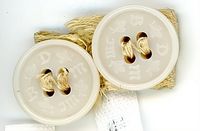
The first object (convolute) is a collection of four buttons, intended for use on Bund Deutscher Mädel (BDM) uniforms. The BDM was the female section of the Hitlerjugend, created and formalized in 1930. All young female organizations within the NSDAP were unified under the banner of the BDM in 1932, and membership was made mandatory for female "Aryans" with German citizenship over 14 in 1936. The Jungmädel (JM), a branch organisation for girls between the ages of 10 and 13, was also formalized and made mandatory during this period. [1] The buttons are emblazoned with "BDM JM", which would seem to indicate that they were also, or mainly, intended for the JM. The backsides of the buttons are emblazoned with the Reichszeugmeisterei (RZM) logo and identification number. The RZM was the organisation responsible for control of all uniforms and other official party equipment, and was headquartered in Munich. The RZM identification numbers were used to indicate what factory or company produced the items, and was present on all official party equipment. After 1933 the RZM, like many other NSDAP organisations, expanded quickly. [2]
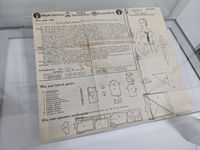
The wide use of systematised identification for even the smallest of objects indicates a high level of control, which is a central aspect of NSDAP ideology. The other object highlighted here, an instruction for creating a BDM blouse at home, is an example of a different and even contrary idea of control. The instruction is printed by Otto Beyer Verlag, a publisher who specialised in textile crafts and women's magazines. [3] The fact that a private company would publish an instruction on how to create a part of an NSDAP-organization's uniform seems, at a first glance, to be contrary to the idea of the RZM's centralised control. But when the instructions are analysed in light of the NSDAP's view of women, the fact that BDM members were expected to make their own blouses can also be viewed as a form of control. Textile crafts were supposed to be a woman's duty, both to preserve traditional gender roles and to save industrial resources for other uses.
These two versions of control and conformity, both illustrated by the practices surrounding BDM-uniforms, form one possible perspective for studying the NSDAP's view of society. The two objects illustrate how different aspects of a totalitarian state can seem contrasting at a first glance, but symbiotic after further analysis. While the BDM-buttons are an example of centrally produced objects that carry their history in straight forward symbols, a home-made BDM-blouse is a distinctly personal item that carries a personal history. Of course, these are not two completely different categories, as objects can form a personal history as part of their object biography even if they are industrially made, and home-made objects can lose their individual context. But the objects presented here can still represent two sides of what is expected of the citizens of a totalitarian state, and more specifically the NSDAP's multifaceted systems of control. A BDM uniform was both an example of the individual woman's personal qualities, as well as a symbol of the uniformity of the German people.
AUTHOR: Edwin Mårtensson
SOURCES:
[1] Krentz, Natalie. The League of German Girls (BDM). German Historical Museum, Berlin, 2014. Available at www.dhm.de/lemo/kapitel/ns-regime/ns-organisationen/bund-deutscher-maedel.html (accessed 04.03.2024)
[2] Weyerer, Benedikt. Reichszeugmeisterei. In Nerdinger, Winfried (ed.). Place and memory. National Socialism in Munich. Salzburg, Pustet, 2006, pp. 53-56.
[3] Sächsisches Staatsarchiv. Verlag für die Frau, Leipzig. Available at www.archivportal-d.de/item/YYF4XKIZSUURLYOKYSFCJJTABKHOFWJQ (accessed 05.03.2024)
Feed bag
- Object description: Feed bag
- Inventory number: TO830
- In the collection since: 2003
- Date: ca. 1920-1960
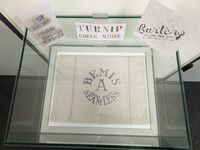
There are many examples of transportation textiles at the STAK, including Geldkatzen, cloth sausage casing and a myriad of different bags. These range from the handbags that have served a mainly aesthetic purpose, to more utilitarian post and shopping bags. The item presented here certainly falls in the more utilitarian category at a first glance. It is a linen canvas sack, that was used for storing chicken feed before coming into the collection. It is important to note that this is only the most recent of its uses, as it is stamped with labels indicating different uses throughout its life. On the front of the sack is the stamp of the manufacturer, Bemis Brothers Bag Company. Bemis was one of the largest US producers of packaging in the late19th and early20th century. The rest of the logo on the front, "A Heavy Duty Seamless", indicates the quality of the sack, and the fact that it was made from a cylindrically woven fabric. [1] Because this structure limits the necessary seams to the bottom and top of the sack, it makes it sturdier and less prone to spillage.
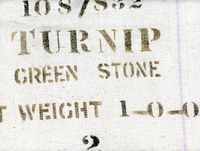
The other side of the sack has shipping stamps on it, indicating that it at some point was filled with alfalfa or alfalfa seeds, and sent from Idaho to London. It is of interest to note that the inside of the bag has been stamped as well, which indicates that it was turned inside out and reused for a different purpose. The stamps on the inside are the logo of Carters Tested Seeds Ltd. and information on the bag's contents and size. Carters, a London based company, published gardening and agricultural magazines and reference books. Carters also sold high quality seeds, and their clients included the British Royal family. [2]
The sack is not only interesting in connection with international uses of transport textiles. It also represents an interesting part of textile history, and how textiles can be repurposed. When the textile sack became the most common method of storing dry goods, substituting the wooden barrel in the middle of the19th century, it also provided an easy and readily available source of cloth. Because of this, sack fabric became an often-used material for making homemade textile objects. This, in turn, was noticed by the companies selling the sacks, who began to print the fabric in colourful patterns. By doing so they gave consumers a reason to choose their product over a rival's. The consumer was at the same time on the lookout for different patterns while buying goods packaged in sacks. The ubiquitous nature of these sack prints led to a tradition of sowing quilts and clothing from many different patterns. [3]
The cloth of the sack in the collection is of course neither printed or repurposed, but it still gives a valuable resource for studying this type of 'multipurpose' fabric. Having an original sack at hand also shows that they could be reused even if they were not transformed into another textile object, for example by being used for storage and shipping several different times in its lifetime. The fact that it ended its active life storing chicken feed is also interesting, as it shows the fact that older storage and transportation textiles can serve an active similar purpose for a very long time, while most packaging produced today is only used one time before being discarded.
AUTHOR: Edwin Mårtensson
SOURCES:
[1] Terry, Dickson. They've Made Bags by Billions in 100 Years, St. Louis Post-Dispatch, St. Louis, Missouri, 20.05.1958, available online at www.newspapers.com/paper/st-louis-post-dispatch/4064/ (accessed 22.02.2024).
[2] The Museum of English Rural Life. Carters Tested Seeds Ltd. merl.reading.ac.uk/collections/carters-tested-seeds-ltd/ (accessed 22/02/2024)
[3] Print Pattern Archive. Fabulous Feedsacks. www.printpatternarchive.com/post/fabulous-feedsacks, (accessed 22/02/2024)
Toilet roll cover
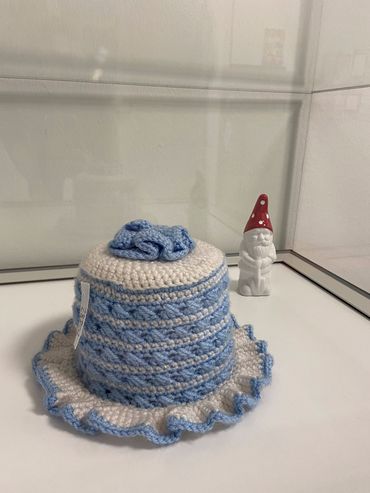
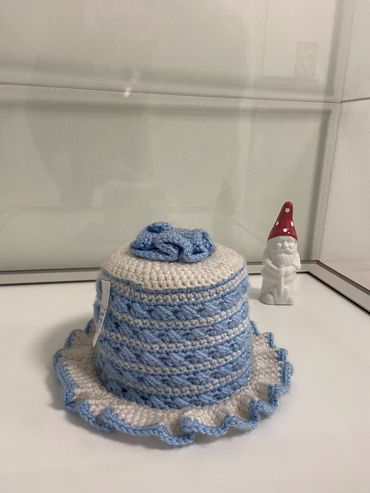
- Object description: Toilet roll cover
- Inventory number: TO882
- In the collection since: 2004
- Date: 1950-1970
The object in focus this month is a crocheted blue and white toilet rollcover[1]. Toilet roll covers are a traditional form of decoration, often used in cars. The idea of covering up toilet paper in order to make it more pleasing to the eye may seem like a natural impulse. There is an argument to be made that this simple description of the object and its intended purpose and role misses the deeper idea toilet roll covers might potentially illustrate. This text suggests that this idea is the concept of (German) kitsch.
To call the Toilettenrollenhaube kitsch is a fairly non-controversial statement. Kitsch as a concept is very hard to define, but many instances of kitsch, or at least "kitschiness", are easy to find. The traditional garden gnome, hotel art and snow globes quickly come to mind, among many other motifs and forms. The original German word described paintings in specific, but the meaning of the term later expanded to describe many different forms of expression. Thomas Kulka, in his book Kitsch and Art, admits that the term is hard to define, but gives a couple of very useful guidelines. For works of art, Kulka defines kitsch as an artistic piece whose "appeal is not generated by the artistic merit of the work itself but by the emotional appeal of the depicted object". [2] This definition outlines the inherently simple nature of kitsch, as a form which neither challenges nor requires complex analysis.
For the case of art, this is of course a highly disparaging definition, as it implies that kitsch is inherently less interesting than a non-kitsch work of art. Viewing kitsch in this way also means it is a highly subjective phenomenon, which can be used to belittle forms of art and expression one does not like. The negative implication can also be extended to many everyday decorative items. One might very well say that this in many cases is a fair, if pointless, point of view. The garden gnome, indeed, does not try to challenge the viewer, but is there to decorate the lawn. This form of decoration is thus there for the viewer to enjoy in a simple and non-critical way. This view is, of course, highly simplistic and ignores central aspects of the material history of kitsch objects. To actually understand the toilet roll cover as an aspect of material culture, we must discuss and analyse its creation, use and continuing role in how culture has been performed and produced. This text is arguing that a discussion of kitsch can help with this goal, as long as it is only one of many framings.
One way that kitsch can help with understanding the Toilettenrollenhaube starts with noting that it serves a more directly obscuring purpose, that of hiding, or beautifying, toilet paper. An often-mentioned author when discussing kitsch is Milan Kundera, who spends some time discussing and defining kitsch in the novel The Unbearable Lightness of Being. One of Kundera's definitions of kitsch focuses on a phenomenon deeply connected with the toilet roll cap: "Either/or: either shit is acceptable [...] or we are created in an unacceptable manner. It follows, then, that the aesthetic ideal of the categorical agreement with being is a world in which shit is denied and everyone acts as though it did not exist. This aesthetic ideal is called kitsch." [3]
With this in mind, we can add a layer of understanding to how and why the toilet roll cover can be seen as kitsch. It is not only kitsch in the simplicity of making its environment more pleasant, but also in the fact that it covers up the evidence of an undesirable, or even non-kitsch, phenomenon. By covering and decorating toilet paper, the toilet roll cover is kitsch not only in form, but inherently also in function. If kitsch is the simplifying, flattening and idealising of a complex and sometimes ugly reality, then what can be more kitsch than covering up the evidence of undesirable basic human functions.
AUTHOR: Edwin Mårtensson
SOURCES:
[1] Because of the quintessentially German nature of the object, the German word will be used in this text.
[2] Kulka, Thomas. Kitsch and Art. Penn State University Press, University Park (PA). 1996, p. 42.
[3] Kundera, Milan. The Unbearable Lightness of Being. Harper Perennial, New York (NY). 1991, p. 248.
Bobbin Lace Pillow and Bobbin Lace Lace (1916) by Gussy von Reden
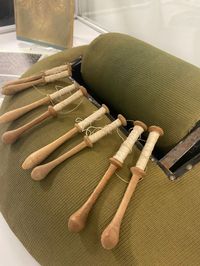
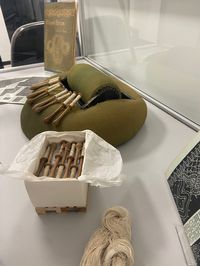
- Object description: Bobbin lace pillow and bobbin lace lace (1916) by Gussy von Reden
- Inventory number: TO461
- In the collection since: 2001
- Date: 1900-1920, 1916
This month's object is a pillow for making bobbin lace, sometimes also called pillow lace. Bobbin lace is named after the use of bobbins(Klöppeln in German), to which thread is attached. This enables the lace maker to manipulate and control many threads at the same time and thus weave complex extended patterns of lace. There are further categories within the group of bobbin lace, and there are many different styles of bobbin lace pillows. [1] The pillow being presented here has a rolling centre pillow, on which the lace is made. The outer pillow is used for attaching and controlling the bobbins which is most often done with the same pins used for attaching the lace pattern.
The pillow in the collection was donated by a former teacher of handicrafts. The donation included 34 bobbins, some thread used for lace making and a book on bobbin lace. The book is part of the series Beyers Handarbeitsbücher der Deutschen Moden-Zeitung. It includes an introduction to bobbin lace, detailed descriptions of methods and four sheets with different lace patterns. The author of the book, Gussy von Reden, seems to have been an expert on bobbin lace, and published many other books on the subject during the first decades of the20th century. [2] It is worth noting that the book advertises six sheets of lace patterns, and it seems this copy lacks sheets No. one and five, which have most probably been used for their intended purpose: the step by step production of a piece of lace. The patterns available to the collection vary quite a lot in complexity. Some are showcasing simple techniques, more suited for beginners or as parts of larger pieces of lace. Others are larger or much more complex, demonstrating the intricacy of more refined pieces of lace. There is also, of course, a difference in intended use of different patterns, meaning one has to choose patterns based on the required size and delicacy of the final piece of lace.
The book is the third edition of the work, published in 1916. In the introduction to the third edition von Reden opens with: "Spitzenklöppeln ist eine im Erzgebirge uralte Volkskunst, deren Erfindung der Barbara Uttmann, Annaberg, im Jahre 1561 zugeschrieben wird." This statement establishes two things. First, von Reden argues that lace making is a very old form of handicraft. Second, they bring forth the at the same time German and female origins of bobbin lace in the figure of Barbara Uttmann. In fact, Uttmann did establish the lacemaking industry in Annaberg in the 16th century and it is written on Uttman's tombstone that she invented the bobbin lace technique. [3] Annaberg and the region of Erzgebirge was of central importance for lace making in the 18th and 19th centuries. [4]
In the end of the preface to the book, von Reden urges her intended readers, "Jede deutsche Frau", to make sure to only purchase German lace. The stated reason for this is to support female home workers, who would be considered part of the historical cottage industry. The home workers are presented as poor and threatened by the spread of machine lace, and von Reden thus indirectly paints a picture of how traditional handicrafts are being threatened by industrialisation. Within the third edition's specific chronological context this interpretation can be extended to include the ongoing national struggle of the First World War. It might be argued that von Reden is portraying bobbin lace as a German handicraft in an effort to distance it from its image as a Belgian and French style. These two national adversaries constituted a threat not only to the male-coded military, but also to the female-coded textile handicrafts. Von Reden is thus giving the female population of Germany a chance to support the national cause, the bourgeoisie by buying German handmade lace and the working class by continuing the production of the lace.
Von Reden's presentation of bobbin-lace-making as a simultaneously ancient, cultural, German and female activity is further strengthening the argument that the audience should support and practice bobbin lace making. This aspect of how bobbin lace was viewed and communicated gives a very interesting background for the pillow present in the collection. It raises many questions on how bobbin lace was on one hand practiced, but on the other hand politicised, both during the early 20th century and further back in history.
AUTHOR: Edwin Mårtensson
SOURCES:
[1] Leader, Jean. Introduction. Bobbin Lace. Lace Types. A Historical Guide to European Laces. available at https://www.lacetypes.com/bobbin.html (accessed 02.01.2024)
[2] I have been unable to find any source on von Reden, but a simple search gives many examples on books by the author. For example https://www.booklooker.de/B%C3%BCcher/Angebote/autor=von+Reden+Gussi (accessed 02.01.2024)
[3] Brooklyn Museum. Barbara Uttmann. available at https://www.brooklynmuseum.org/eascfa/dinner_party/heritage_floor/barbara_uttman (accessed 02.01.2023)
[4] Leader, Jean. Other Countries. Bobbin Lace. Lace Types. A Historical Guide to European Laces. available at www.lacetypes.com/othercountries.html (accessed 02.01.2024)
Bicycle transport rope
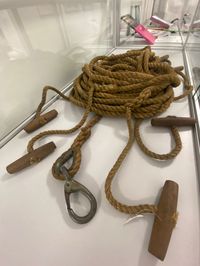
- Object designation: Bicycle transport rope
- Inventory number: TO87
- In the collection since: 1999
- Date: 1949-1990
This month's object is an eighteen-metre rope, with eight attached handles. It was made for the Swedish military, to ease the transportation of soldiers on bicycles. The rope was attached to the back of a motor vehicle, and the troops could hold on to the handles, and thus would not have to exert themselves too much over long distances. Several of the ropes could be linked, so that more than eight soldiers could be pulled at the same time. In a handbook published by the Swedish military there are detailed instructions of how to deploy the rope. [1] The handbook details how the soldiers have to make sure the rope is taut, except in curves where some slack is needed to avoid being pulled into the curve. Exactly how to let go of the rope, both when ordered to and in case of an accident, is also shown and explained in detail. [2]
The rope was purchased at a flea market in Sweden in the 1990: s. Since the rope, in Swedish called a tolklina, [3] stopped being used in 1990 when the bicycle shooting companies where disbanded it is likely that a lot of them were available for purchase during this period. According to a rough calculation made by a representative of the Military Museum in Stockholm around 10 000 ropes would have been produced. They were first deployed in 1949 and it is thus quite challenging to get an exact dating of this particular rope.
The rope has been treated with what seems to be pine-tar. Pine-tar is common in Sweden, and although mainly used for the treating of wood it is not uncommon to find older heavy-duty ropes treated with it. [4] Pine-tar can vary quite a lot in both colour and smell, but most often gives the treated material a darker brown colour, unlike the black and often foul-smelling coal tar. Pine-tar, on the other hand, is considered pleasant enough that it was an ingredient in the dessert served at the Nobel banquet this year. [5] Since pine-tar can also easily be blended with other organic compounds, it is possible that the tolklina has also been treated by other chemicals, mixed to fit the needs of the military and properties of the fibre. [6]
The rope presents us with an interesting textile, both in use, history and form. It is one of the objects in the collection whose use requires a bit of research to understand, and as such it also poses further historical and material questions. On a basic level it immediately poses practical questions of how to use it, which are in part answered by the handbook. It also poses terminological questions, as the direct translation of tolklina would be translation-line. As the term is both very specialised and archaic it is not directly evident what the such a line was used for. With the internet these are, of course, much simpler problems than they used to be. When the collection's background material on the object was collected more than 20 years ago, information was not as readily available. Objects do of course speak for themselves, but in some, if not all, cases it is vital to do further research on both origins and use. The tolklina illustrates this quite well by being obscure enough to warrant further research but well defined enough to have a strict, and regulated, use. Not all objects have a manual that illustrates how to use them.
AUTHOR: Edwin Mårtensson
SOURCES:
[1] Cykel Instruktionsbok. Försvarets Materialverk, M7786 003520 (F201:1A), 1977, pp. 16-17.
[2] Soldaten i fält: SoldF 1. Allmänna förlaget, Stockholm, 1972, pp. 72-73.
[3] The current use of such lines is nowadays largely confined to sporting events, and are called joring-lines in English(https://nahak.ca/en/sporting-activities/bikejoring/) Since joring is a direct loan word from Norwegian, and the military practice is different from the sport in many ways, I have chosen to here use the Swedish loan word to illustrate the unique qualities of the object.
[4] Bolin, I., Santesson, C. G.. Trätjära. In Westrin Th. (ed.). Nordisk Familjebok, vol. 30. Nordisk familjeboks förlags aktiebolag, Stockholm, 1920, pp. 195-196. Available at https://runeberg.org/nfcj/.
[5] Hüll, Justina, Hedberg, Sofia. Svensk-norsk matfest på nobelmenyn: "Nästan som citronjuice!" SVT Nyheter, 10.12.2023, available at https://www.svt.se/nyheter/inrikes/svensk-norsk-matfest-pa-nobelmenyn-nastan-som-citronjuice--kez4c1 (accessed 12.12.2023)
[6] Swedish paint trade. Data sheets DALBRÄND TRÄTJÄRA 773 (Kiln fired pine wood tar. 18.02.2019, available at schwedischer-farbenhandel.de/Datenblaetter/td_de_Dalbraend_Traetjaera_773.pdf (accessed 01.12.2023). Example of rope treated with pine wood tar being produced and sold: www.repbutiken.se/naturfiber/tjarat-hamparep
Suit, peplum blouse and etui skirt
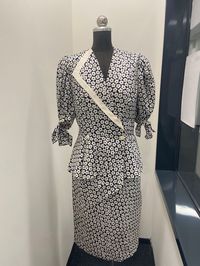
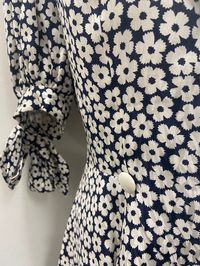
- Object description: Suit, peplum blouse and etui skirt
- Inventory number: KG1564a+b
- In the collection since: 2008
- Date: 1980s?
The clothing of women in public roles is often regarded as important, and can garner a lot of interest. Such interest may either amount to a seemingly hagiographic depiction in the form of a stylish icon, or on the other hand result in criticism of a lack of style. Examples of both views are abundant, and are not limited to any specific area of public life. Vogue's profile on the first lady of Syria, published in March of 2011 (the same month that the protests leading to the still on-going civil war began) [1] is an interesting example of how a positively intended depiction of style can become highly problematic. On the other hand, we have the enduring criticism of Angela Merkel's fashion choices, which was, predictably, compared to the lack of scrutiny afforded male politicians. [2] Questions of power, clothing and politics have previously been discussed within this Institute by Professor Karen Ellwanger, and will no doubt be a continuing subject of research. [3]
This month's object can illustrate another layer of this debate. It simultaneously showcases how the focus on and communication around female clothing can become materialised. The object is a skirt suit, consisting of a peplum blouse and an etui skirt. Both are made from the same dark blue fabric that shows a floral white pattern. One of the most distinguishing features of the blouse is its asymmetrical lapel, consisting of a layered white and textured contrast fabric, with two matching buttons, covered with the same fabric. Only one of these buttons serve the purpose of holding the dress together, while the other has a decorative function. In addition, the blouse is held together with several snap buttons and a hook which attaches to a loop directly underneath the ornamental button. This is, as one might imagine, a rather complex way of fastening a blouse, and indicates that it is a tailored (rather than industrial) piece. The skirt has an inner lining only attached to the waist, with a lower trim of torchon lace.
As can be found out from background material available in the collection, and a previous project concerning the suit, it was custom tailored based on a suit worn by Queen Silvia of Sweden. The woman who ordered the suit had seen a picture of it in a magazine and ordered it from her tailor. [4] This shows how the examination of public women can participate in the circulation of styles in a practical material sense. There are many other examples of this of course, like fashion brands inspired or run by public figures, and articles and websites providing tips for how to dress like a specific famous woman. [5] But I would argue that with this object in particular, the collection possesses a more individual and thus unique example of direct material inspiration. This leads to further questions of how widespread the bespoke tailoring of clothing directly influenced by public figures has been historically, and is today. There is, as one might suspect, very little information to find on this subject. Most of what is available in the fashion and lifestyle press focuses on how styles are shared within the public sphere, which is of course also an important subject for the understanding of the circulation of styles.
Despite there being some focus on the copying and inspiration of style between public figures, this month's object arouses interesting questions. The question of how widespread the small-scale reproduction of clothing is remains unanswered, and adds a distinctly material twist on the subject of fashion circulation and creation. If there are more objects like this one, in public and private collections, where does the research focus lie? What sort of public figure inspires what form of emulation? These questions show that much further research on the topic remains to be done!
- Edwin Mårtensson
SOURCES:
[1] Khaleeli, Homa, Asma al-Assad and that Vogue piece: take two!, The Guardian, 2012, https://www.theguardian.com/world/shortcuts/2012/jul/31/asma-alassad-vogue-blame-game,(accessed 28.09.2023). Original Vogue article has been removed from Vogue's website but the text is still available at https://www.gawker.com/asma-al-assad-a-rose-in-the-desert-1265002284.
[2] Mischke, Judith, Merkel: Clothing criticism reveals double standards, Politico, 2019, https://www.politico.eu/article/german-chancellor-angela-merkel-clothing-criticism-reveals-double-standards/ (accessed 28.09.2023).
[3] Ellwanger, Karen, A Change of Clothes in Politics? - On the Vestimentary Staging of Gender in Political Space, (Translation by Uhlaner, J.) Studien zur Materiellen Kultur, Vol. 12, Institute of Material Culture, University of Oldenburg, 2014 (originally published 2000).
[4] "Königin Silvia Kostüm", Material Culture, http://materiellekultur.de/koenigin-silvia-kostuem/ accessed (accessed 05.10.2023). This project is based on an interview with the tailor, Mr Seidel, but was mainly focused on the more general history of female suits. As I deem the background of this particular suit to be of much of interest, a further analysis of it is beneficial.
[5] A good example of this are the numerous articles on how to dress like Princess Diana (Diana, Princess of Wales, née Spencer), for example Pucket-Pope, Lauren, Where to Shop Princess Diana's Most Iconic Outfits, Elle, 2021, https://www.elle.com/culture/movies-tv/a38148989/shop-princess-diana-outfits-fashion-the-crown-spencer/ (accessed 29.09.2023).
spindle whorl
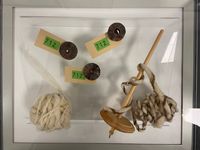
- Object description: Spinning whorl
- Inventory number: TO712 a-c
- In the collection since: 2002
- Date: 20th century
Interesting, I thought, spindle whorls in the STAK - how did they get there? Well, on reflection, it's not so far-fetched. These objects certainly fit into a collection of everyday textile culture, even if the focus is on the 20th century. But let's start at the beginning.
Spinning whorls have been around for a very long time. The first evidence of them in Europe dates back to the 6th millennium BC [1] They belong to a very widespread archaeological find type that occurs both in settlements and in graves. The archaeologist Heinrich Schliemann (1822-1890), for example, recovered several thousand specimens during his excavation campaigns between 1870 and 1890 on the ruined hill of Hisarlık - where he surmised the site of ancient Troy -[2] which are now scattered in numerous university collections and museums (see the comparative illustration on display). Spinning whorls are usually round, can have a disc or lentil shape, be flat or steeply conical (i.e. pointed), spherical or cap-shaped and (usually on one side) decorated or undecorated. The objects therefore vary greatly in terms of size, material (e.g. clay, glass, amber, bone, metal), shape and decoration. However, they do have a certain recognition value - at least if you have seen them before and know what they are: They all have a perforation.
So what is the story behind these objects, which were in use from the Neolithic period until well into the Middle Ages - and even into the modern era? Spinning whorls are part of hand spindles and thus refer to textile processing. Together with the spinning rod, which was mostly made of perishable material and has therefore not usually survived, they form a whole, with the spindle whorl acting as a flywheel/weight and performing an important function in spinning fibres into yarn. Depictions of the spinning process can be found on numerous ancient Greek vases, for example, where the motif of spinning women was repeatedly taken up as a standardised role model and was part of a fixed pictorial symbolism. [3]
The spinning whorls in the STAK do not differ from those from prehistoric and early historical times in terms of size, material, shape and decoration. However, the three whorls made of fired clay and decorated in different ways are relatively light and show little or no signs of wear. This is not surprising, as these are not antique objects, but rather modern objects from the 20th century, which have probably never been used. They were added to the Oldenburg collection in 2002 and come from the estate of Ingrid Köller (1935-2002), who specialised in textile didactics at the Institute of Material Culture from 1984 to 2000. [4] It is not clear whether they were perhaps purchased by her or whether she produced them herself. Unfortunately, the sources are rather poor. The index card merely states: "A spinning cube [sic!] bears the signet: 'I' ". This may indicate the owner, perhaps even that this whorl was moulded by Ingrid Köller - who knows. There is no doubt, however, that the three objects, which at first glance may seem inconspicuous and may not appeal to some, are a vivid example of an (old) textile technique that has a long history and is still practised today. The objects reveal a depth of cultural history that is highly relevant for understanding everyday textile culture and practices. Good that they are in the STAK.
- Stefanie Samida
Sources:
1 Cf. Rudolf Albrecht Maier, Neolithic clay spindle whorls from shore settlements on Lake Constance. In: Germania 37, 1959, 35-52.
2 Cf. Heinrich Schliemann, Atlas trojanischer Altertümer (Leipzig 1874); Rainer Hilse, Troianische Spinnwirtel. In: Mitteilungen aus dem Heinrich-Schliemann-Museum Ankershagen 7, 2001, 135-150.
3 For an example, see https://upload.wikimedia.org/wikipedia/commons/b/bf/Woman_spinning_BM_VaseD13.jpg,(last accessed: 25 August 2023); see also Daniela Ziegler, Hausfrau, Ehefrau, Lebensgefährtin, Mutter. Die sozialen Rollenbilder der Frau auf attischen Vasen klassischer Zeit (dissertation University of Erlangen-Nuremberg 2007), URN: urn :nbn:de:bvb:29-opus-23910 (last accessed: 25 August 2023).
4 For Ingrid Köller, see Heike Derwanz/Patricia Mühr (eds.), Geldkatzenwäsche: Kommentierte Neuheraushabe der Schriften Ingrid Köllers zur Didaktik textiler Sachkultur (Oldenburg 2020), available here: https://uol.de/f/3/inst/materiellekultur/Forschung/Schriftenreihe_Studien_zur_Materiellen_Kultur/Publikationen/Studien_Mat_Kult_Band_31-40/Band39_Geldkatzenwaesche_Derwanz_Muehr_2020_01.pdf?v=1610374549 (last accessed: 25 August 2023).
Doll clothing
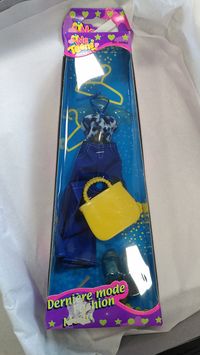
- Object description: Doll's clothing
- Inventory number: TO898
- In the collection since: unknown, inclusion in the inventory book 2023
- Dating: 2000 to 2010s
Barbie! In the cinema, on the radio and in advertisements for the "I am Kenough" hoodie. [1] The film "Barbie" by Greta Gerwig hit like a pink bomb in July 2023. [2] The film and the combination of themes around dolls, fashion and feminism were also a topic of conversation in my circle for weeks. Friends and I kept coming back to childhood memories. How many Barbie films did you watch? Which dolls did you have? What were your favourite outfits? Did you also give your dolls a radical short hairstyle?
We can only speculate how and whether the previous owner of object TO898 had a similarly formative relationship with dolls. This is because the present doll's clothing was found in a cardboard box without any contextual material or inventory number during the current conservation-related reburial.
The trapezoidal packaging is particularly striking with its high-contrast colour scheme of purple, yellow, blue and pink. The yellow lettering on almost all sides reads "We Teens" and "Dernière mode Fashion Moda". The front is labelled with the item number "38062". The back is labelled in French, English, Portuguese, Spanish and German with instructions for safe handling of the product contents, distribution and manufacturer information. The product was therefore manufactured in China and imported by a shop based in France. We also find stylised illustrations of four female figures. They are wearing garish make-up, long loose hair, mini skirts, crop tops and platform shoes. The actual product, an outfit with four components, is presented in the window: ankle-length blue flared trousers; a patterned blue velvet halterneck top; a large yellow bag with a handle; blue, slightly transparent platform sandals with glitter elements.
When I search the Internet for the aforementioned lettering, I find only rudimentary information in addition to product auctions [4]. According to the Russian-language doll wiki "Kuklopedia", "We Teens" is supposed to be part of one of five doll lines from the Chinese company "Wilco Products Ltd", founded in 1999. [5] Furthermore, screenshots from the online service "Wayback Machine" provide us with information that the website "wilcogirls.de", which no longer exists, and the product line "We Teens" existed from at least 2003 to 2014. Although the Flash file format can no longer be played here, the YouTube channel "Lookin' Bratz" has fortunately preserved the website content in video format. [7] The four characters on the back of the packaging are therefore called Katie, Emily, Kimmy and Stephanie. In their individually designed character profiles, great importance was apparently attached to precisely describing aspects such as age (15-16 years), hobbies or favourite music. Furthermore, we see trapezoidal packaging with "outfit-only" products in the "Product Showroom" under item number "38031" [ibid]. It is possible that our object is a later modification of this product series or a version adapted to the European market.
Finally, the YouTube comments provide us with examples of personal stories. One person from the "Doll Customisation Community" is delighted that it is easy to buy "We Teens" dolls in Germany. And another person euphorically recalls a childhood obsession with this toy [ibid.]
- Veronika Davydov
Sources:
[1] cf. Colónjul, Ana: Of Course Mattel Is Selling That I Am Kenough Hoodie, in: Fashionista, 24.05.2023, fashionista.com/2023/07/i-am-kenough-hoodie-barbie-movie, accessed: 06.09.2023.
[2] cf. cinema.com: Barbie, www.kino.de/film/barbie-2023/, accessed: 06/09/2023.
[3] cf. e.g. Mercari: search query for Wico Fashion Dolls, www.mercari.com/us/brand/10913/1620/, accessed: and Worthpoint: search query for wilco we teens, www.worthpoint.com/inventory/search= , accessed: 06/09/2023.
[4] cf. Куклопедия: Wilco, wiki.kuklopedia.ru/doll/Wilco, accessed: 06/09/2023.
[5] cf. Internet Archive Wayback Machine: Screenshot calendar of the search query, web.archive.org/web/20230000000000*/http://www.wilcogirls.com/index.htm , accessed: 06/09/2023.
[6] cf. Lookin' Bratz, Wilco's We Teens Website Tour. Product Showroom, Character Profiles, Songs, and More!, in: YouTube, 14.03.2023, youtu.be/tcXtjUuIhi8, accessed: 06.09.2023.
Dance lesson subjects
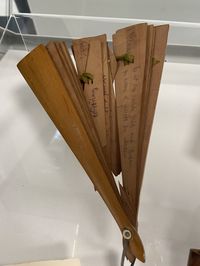
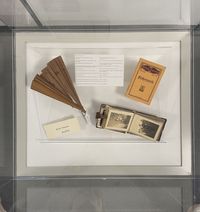
- Object description: Dance lesson fans
- Inventory number: KG2040
- In the collection since: June 2023
- Date: 1940s
Poetry albums and love letters are used to exchange poems and messages (sometimes in secret) between friends or lovers. The current Dings da! is somewhat reminiscent of both. The so-called dance lesson fan belonged to the donor's mother and probably dates from the late 1920s. It is a brisé fan made of wood. This means that the individual sticks have identical shapes and dimensions. [1] At the lower end there is a metal pin with an eyelet, and in the upper third they are additionally held together by a textile band.
When closed, the object appears inconspicuous. The subject only reveals its secret when it is opened and the rods are pushed apart. Lines written in pencil are then revealed. Different handwriting and names quickly reveal that each stick was written on by a different person - sometimes even on both sides. Deciphering is not easy, as some of the sticks are written in Sütterlin script, a variant of Kurrent script. This alphabet was increasingly taught in schools from 1916, but was banned again in 1941 and replaced by the cursive script still in use today. [2] The dating of the subject given by the donor to the late 1920s therefore seems plausible, as some of the admirers were apparently already familiar with the Sütterlin script.
The handwritten lines are verses that revolve around the theme of 'love'. Some of them are humorous, others rhyme. They are reminiscent of the short sayings in poetry albums, for which separate collections of verses were even published, in which you could leaf through and find inspiration for an entry. Such collections also existed specifically for labelling dance lesson subjects, as the book "Fächerverse" from 1914 on display here shows. [3] Due to its handy format, it could be carried in a pocket and may have proved to be a useful source of inspiration for dance partners who were asked to make entries on subjects. Some dance lesson fans even had their own small pencils attached to the eyelets. [4] Their predecessors are so-called autograph fans from the 19th century, whose owners collected the signatures of famous personalities on the sticks. [5] Although the STAK's copy no longer has a pencil, it does have the owner's business cards, which were handed over in exchange for the entry (KG 2042), as well as an album containing photographs of some of the dance partners (KG 2041). Both objects are exhibited here together with the subject.
Even though dance lesson fans have now been forgotten, these objects were not uncommon in the past. They can also be found in the collections of other museums. [6] The specimen from the STAK is unfortunately badly damaged due to frequent use. Individual rods are only held together by the textile band, and several broken parts have already been lost. Handling as part of preventive conservation, regular photographic documentation of the condition, transcription of the preserved writing and recording in the database can help to slow down the ageing process, at least in digital form. In this way, the dance lesson fan will hopefully be preserved for a long time to come and inspire the writing of many stories!
Author: Klara von Lindern
Sources:
[1] Cf. the entry on the typology of subjects on the website of the German Fan Museum, https://www.faechermuseum.de/typology (last accessed: 15/09/2023)
[2] Cf. de. wikipedia.org/wiki/Sütterlinschrift (last accessed: 15/09/2023)
[3] Cf. Gustav W. Ewerlein: Fächerverse, Leipzig 1914
[4] Cf. Ute Marquardt: Tanzstundenfächer, http://tanzstundenfaecher.de/?page_id=37 (last accessed: 15/09/2023)
[5] Cf. for example the copies in the Wien Museum and the Victoria and Albert Museum, https://sammlung.wienmuseum.at/objekt/584109-autographenfaecherfaltfaecher/ and https://collections.vam.ac.uk/item/O1114043/autographed-wooden-fan-belonging-to-fan-unknown/ (last accessed: 15/09/2023)
[6] See, for example, the Dessau-Wörlitz Cultural Foundation and the Herrnhut Local History Museum, https://nat.museum-digital.de/object/31173 and https://www.saechsische.de/plus/liebesbotschaft-auf-dem-faecher-1730372.html (last accessed: 15/09/2023)
Older contributions
Hair clips
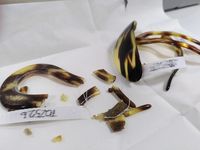
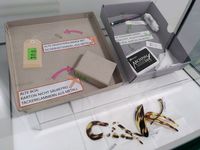
- Object description: Hair clips
- Inventory number: TO252a-c
- In the collection since: before 2000
- Dating: 1928-1932
The collection items from the Textile Objects sub-collection have been stored in flat, beige-brown boxes for many years. This storage option has proven to be practical. The narrow boxes can be easily stacked on top of each other on the shelves in the collection rooms, clearly organised and easy to handle in a research and teaching context. The inventory numbers are clearly visible - on the outside of the box, but also in the form of cardboard labels with safety pins directly on the objects.
Anyone who has been visiting the collection for about a year will quickly notice that the shelves are now only half full of the original boxes. Some of them have been replaced by sturdier, grey cardboard boxes. The new boxes differ not only in terms of their colour: unlike the boxes used previously, they are made of acid-free cardboard, which does not produce any potentially harmful vapours for the objects inside. The objects were wrapped in packing silk for protection. In addition, the inventory numbers are now attached to sections of textile tape instead of cardboard labels and are no longer attached to the objects with safety pins but with white polyester thread.
These changes are currently being made by collection staff as part of a so-called reburial programme. The main reason for this is conservation measures to protect the objects. While the old boxes appear harmless from the outside, things may look very different on the inside. This is shown by the sad example of the plastic hair clips. They date back to around 1930, originate from the collection and were inventoried in 2000 and stored in accordance with the procedure followed at the time. In May 2021, Veronika Dawydow, a member of the collection staff, discovered that the plastic had suffered considerable damage due to the storage conditions. In this case, the safety pins with the inventory numbers had been stuck directly to the clasps with transparent adhesive tape. As can be seen from the images in the damage report, this had led to severe corrosion in some cases. A blue-green patina, possibly verdigris (copper(II) acetate), was visible under the adhesive tape. The TO252b clasp was broken into several individual pieces; further micro-fractures were also visible within the individual pieces. The packing silk was heavily yellowed at the contact points. [1]
Based on their dating, it can be assumed that the hair clips were made of Bakelite. Developed in 1905 by chemist Leo Hendrik Baekeland, this material was the first plastic from which a wide range of objects were produced until the 1960s: From light switches to hairdryers and telephones to jewellery. [2] Although the material is characterised by its extreme durability, it was obviously not resistant to damage caused by metal corrosion, which in turn was caused by reactions between the safety pins and the adhesive tape.
In order to prevent future storage-related damage, the old boxes and the inventory numbers attached with safety pins are now being replaced as described. A look at this part of the collection's history shows that conservation concepts also change over time. Storage conditions are constantly scrutinised, updated and adapted to new findings. Whether a definitive status has been achieved in the collection seems doubtful - constant observation, self-criticism and reflection on one's own approach, on the other hand, are all the more important.
- Klara von Lindern
Sources:
[1] Veronika Dawydow: Damage report for objects in the collection of the Institute of Material Culture at the University of Oldenburg, 25 May 2021 https://uol.de/f/3/inst/materiellekultur/Die_Sammlung/Dings_Da_/2023/TO252a-c/Schadensprotokoll_TO252_0.pdf?v=1689767614 and http://wisski-stak01.virt.uni-oldenburg.de/wisski/navigate/1327/view (last accessed: 15 May 2023)
[2] For the history of Bakelite, see the website of the Bakelite Museum in Kierspe: https://www.kierspe.de/de/verein/heimatverein/bakelitmuseum/bakelitmuseum.php (last accessed: 15/05/2023)
Sjödén catalogue
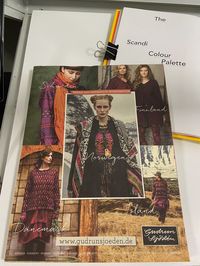
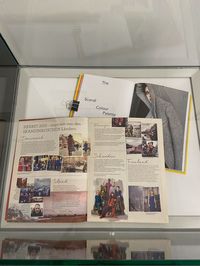
- Object description: Gudrun Sjödén catalogue 'Fascination Scandinavia'
- Date: Autumn 2015
The 'Fascination of Scandinavia' has been booming for years. This can be seen, for example, in tourism: Iceland, the North Cape and the Lofoten Islands are becoming increasingly popular holiday destinations. Many online shops - for example in the furniture sector - offer the categories "Scandinavian Style" or "Scandinavian" as a search and filter option. This (mostly undefined) buzzword is used to give objects predicates such as 'modern, 'high quality' or 'stylish' [1]. This fascination has also had an impact on the fashion sector in the Nordic countries [2]. Pieces from the Swedish label Acne Studios, for example, which was founded in 1996, now have international cult status [3]. Copenhagen has had its own fashion week since 2006, which is attracting increasing international attention. Since 2021, Vogue Scandinavia has been the 27th country edition of the fashion magazine Vogue , published by Condé Nast [4]. Bloggers from the Nordic countries - for example Pernille Teisbæk or Kenza Zouiten Subosic - have millions of international followers who are inspired by posts, videos or guides such as Teisbæk's book Dress Scandinavian, which is also on display here.
A common idea of this so-called Scandinavian style can be described with the keywords 'simple', 'timeless', 'elegant', whereby clear cuts and muted colours (shades of grey, cream or dark blue as well as black and white), described by Teisbæk as a "Scandi Colour Palette" [5], dominate. The exact contrast is presented in the autumn 2015 catalogue of the Swedish clothing company Gudrun Sjödén entitled Inspiration Scandinavia. The catalogue in the holdings of the STAK's partial collection Schriftenarchiv complements the collection's focus on catalogues of sustainably and/or ecologically produced fashion. Founded by the designer of the same name in 1974, the label stands for colourful, richly patterned pieces with playful cuts that are aimed at women* of all sizes and ages. Sjödén draws her inspiration from her "place as a human being in nature" [6]. For this catalogue, the landscape of the countries subsumed under the title 'Scandinavia' - Sweden, Finland, Norway, Denmark and Iceland - is the stage for the models photographed on location. The garments presented in the individual country chapters differ from one another in terms of their patterns and colour palette, as they were each inspired by 'typical' elements of the region. The sources of inspiration are presented in short texts - for example, shimmering sunlight on Finnish lakes or frozen glaciers in the twilight of wintry Iceland. In the case of the Norwegian collection in particular, traditional handicraft techniques and folkloric costumes are invoked, forming a historically traditional antithesis to the minimalist 'Scandi style' of the 2010s and 2020s. Hand-woven rag rugs, knitted jumpers or hats, gloves and socks made of thick sheep's wool - often labelled with the term 'Norwegian pattern' - have represented a Nordic style for much longer. Interestingly, they have also (re)entered popular culture, as can be seen in the costumes and textile objects in Disney's hit films Frozen and Frozen II.
Two different versions of a 'Nordic style' are juxtaposed here - or rather side by side. For perhaps it is precisely this coexistence, which is quite naturally accepted in the Nordic countries, that never becomes boring in its mixture of colourful, patterned, monochrome and minimalist, traditional and new elements, and draws its topicality from this without abandoning its historical roots.
- Klara von Lindern
Sources:
[1] Since the 1950s at the latest, Danish and Finnish furniture in particular has been regarded as 'design classics' (Arne Jacobsen, Poul Henningsen and Alvar Aalto are just a few examples), to which exhibitions are dedicated time and again and which are constantly being reissued.
[2] At a geographical level, the term 'Scandinavia' only covers Norway, Sweden and parts of Finland. In this respect, the term 'Nordic countries' is more precise, as it includes Norway, Sweden, Denmark, Finland, Iceland and also Greenland, the Faroe Islands and Åland: https://www.nordischebotschaften.org/die-nordischen-laender (last accessed: 05/05/2023).
[3] https://www.elle.de/designer/acne-studios (last accessed: 05/05/2023). The leather jackets, jeans, scarves and beanies with the characteristic smiley patch are considered particularly iconic.
[4] https://www.voguescandinavia.com/store/magazine (last accessed: 05/05/2023). Vogue Scandinavia sees itself as a representative of Sweden, Denmark, Norway, Finland and Iceland and is published primarily as a digital magazine as part of the sustainability strategy; the printed editions are available separately as collector's editions.
[5] Pernille Teisbæk: Dress Scandinavian. Style your Life and Wardrobe the Danish Way, New York 2017, pp. 60-61.
[6] https://gsw.gudrunsjoden.com/de/gudruns-world/gudruns-inspiration (last accessed: 05/05/2023).
Leather mini skirt
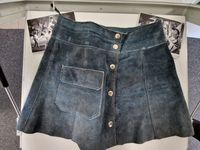
- Object description: Mini skirt
- Inventory number: KG315
- In the collection since: 18/05/1999
- Date: 1974
The miniskirt, as we know it in everyday fashion, first became popular in the 1960s. Since then, it has developed into a fashion classic and has become an integral part of the westernised fashion world. For many women, it symbolised freedom, self-confidence and independence [1].
The recently deceased designer Mary Quant is often referred to as the 'inventor' of the miniskirt. However, precursors or pieces comparable in form can be found not only outside the 'western' fashion world, but also in the area of stage costumes, for example. For example, in the performance "I am as I am - Women for Golden Hill" [2].
Mary Quant designed skirts that ended just a few centimetres above the knee and therefore showed a lot of leg. They were a sensation at the time and caused a real revolution in the fashion world.
The 1960s were an eventful decade and are still regarded as a time of upheaval and protests today. On a vestimentary level, the miniskirt can be seen as an expression of this desired change and as a sign that women wanted to show their bodies and their sexuality in a self-determined way [3].
From then on, it was not only seen as an integral part of everyday Western fashion, but also as a symbol of the feminist movement. Women no longer wanted to be dictated to by male ideas and social norms about what they should wear. The miniskirt was a statement against the double standards of society at the time.
Feminist movements were also present in society in the 1970s. Women's movements were still addressing persistent problems of education, partnership and sexuality [4].
This suede mini skirt also dates from this period. It was purchased in size 38 from C&A in West Berlin by the donor in 1974 and worn until 1993. The donor herself owned the skirt until she became a member of the STAK in 1999. We do not know exactly how the skirt changed hands. What is certain is that it was worn a lot. The clear signs of wear bear witness to this. The relatively firm and stiff leather is slightly scuffed. There are cracks in the material at the lower press stud and we can see clear deformations in the waistband.
The long period of time over which the suede mini skirt was worn by different people is further evidence of the firm place that this type of clothing has managed to secure despite changing fashions. In high fashion, too, mini skirts have been reinterpreted by various designers for decades and shown in collections, for example by Stella McCartney, Isabel Marant and Saint Laurent [5] . It was not until 2022 that Miu Miu's mini skirt was shown on the catwalks in an ultra-short, low-waist version as a reference to Y2k fashion.
Today, the mini skirt is no longer just a symbol of emancipation and freedom, but also an item of clothing that can radiate self-confidence and femininity [3]. Women wear them to emphasise their legs and show off their figure. At the same time, it polarises as an often criticised item of clothing that can be read as an expression of sexism and an objectification of the wearer.
- Elisa Geisler
Sources:
[1] WDR, 2014. 29 August 1964 - The miniskirt conquers Germany. [Online] https://www1.wdr.de/stichtag/stichtag8550.html [Accessed on 25 April 2023].
[2] Kirsten Heiberg - Ich bin wie ich bin - Frauen für Golden Hill 1938. [Online]
Kirsten Heiberg - Ich bin wie ich bin - Frauen für Golden Hill 1938 - YouTube [Accessed 25 April 2023].
[3] Jebens, C. O., 2023. on the death of Mary Quandt - What the miniskirt meant. [Online] https://www.faz.net/aktuell/stil/mode-design/zum-tod-von-mary-quant-was-der-minirock-bedeutete-18821207.html [Accessed 25 April 2023].
[4] Farin, K., 2010. New social movements. [Online]
https://www.bpb.de/themen/zeit-kulturgeschichte/jugendkulturen-in-deutschland/36197/neue-soziale-bewegungen/ [Accessed 11 May 2023].
[5] Besser, R., 2022. From Mini to Micro, Skirts Are Getting Short-Short. [Online] https://www.vogue.com/slideshow/mini-skirts [Accessed 26 April 2023].
Short-sleeved shirt in a checked pattern
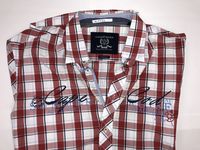
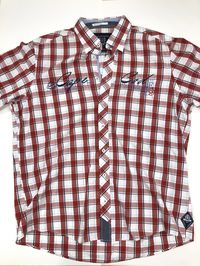
- Object description: Shirt
- Inventory number: KG1732
- In the collection since: 26/06/2018
- Dating: 2011/2012
In view of the short lifespan of clothing today, this object proves to have a long life. As a result of the relocation of clothing production to low-cost manufacturing countries, we as consumers are able to acquire catwalk trends quickly and at a favourable purchase price. The rapid changes in trends and cheap products in turn lead to overconsumption of clothing, which has an enormous impact on people and nature.
Despite being aware of the consequences, German citizens purchase an average of 60 new items of clothing per year, while at the same time discarding an average of 16 items of clothing per year and disposing of the majority in used clothing collections.[1] However, the well-intentioned intention of consumers to pass on old clothing to third parties is turning out to be a challenge for used clothing sorting companies. This is because the increasingly poor quality of the sorted goods means that they are often no longer usable and have to be disposed of directly as waste by the companies.
In contrast to the use and consumption of clothing is this object and its biography. The short-sleeved shirt in a checked pattern with eye-catching lettering comes from the "Heritage Collection", as the donor's family humorously calls it. She and her family use this term to describe items of clothing that are passed down within the family. The shirt originally came from her father's wardrobe. It was acquired around 2011/12. After a few years, the garment was passed on to the donor's spouse. The reason for this was that her father no longer favoured the shirt, which also had a poor fit due to weight gain. The donor describes it as a common practice to pass on clothes within the family. Usually from her parents to her and her husband, rarely the other way round.
By acquiring clothes in this way and thus extending their lifespan, the donor's family demonstrates that new clothes do not have to be bought new, but can also fulfil their purpose second-hand. Every year, 80 billion items of clothing are produced worldwide, while 1.1 million items of clothing are thrown away in Germany alone.[2]
In addition to the sustainability aspect, the object also reveals another characteristic of clothing: Clothing and fashion fulfil a role as a symbolic and cultural carrier of meaning. On the one hand, textile objects always communicate the personal identity and affiliation of the owner and, on the other hand, they can also represent the emotional relationship to another person.[3] This is the case with the chequered shirt. The donor describes it as "typical" of her father. Above all, it is emotionally charged by its association with a special day in the donor's life. At a family celebration on Whit Monday 2014 to mark the donor's wedding and her father's 60th birthday, he took the opportunity to wear the shirt.
"It is not the objects as such that create this bond, but the story through which object and subject are connected."[4]
Photos taken that day and kept in a photo album ever since are a constant reminder to the donor and her husband of the bond between the (garment/object) and their father. However, this connection triggered a feeling of alienation in two respects: the donor found the shirt inappropriate on her husband, and her husband also felt uncomfortable in his father-in-law's shirt.
The donor emphasises that in her household, clothes are rarely discarded early and are normally used until they are worn out. The item is therefore a special case of the "Heritage Collection" and thus found its way into the STAK at an early stage. In this place, the shirt can now serve as a representative object of the theme of sustainability through inheritance and as a symbol of remembrance.
- Stella Schnakenberg
Sources:
[1] Ci-romero (undated): Fast Fashion - Disaster for people and the environment, ci-romero.de [online] https://www.ci-romero.de/kritischer-konsum/kleidung/fast-fashion/ [accessed 05/10/2022].
[2] NDR (2020): Wegwerfware: Was passiert mit Altkleidern, ndr.de [online] https://www.ndr.de/ratgeber/verbraucher/Wegwerfmode-Was-passiert-mit-Altkleidern,kleidung170.html [retrieved on 05/10/2022].
[3] Mentges, Gabriele (2010): Kleidung als Technik und Strategie am Körper - Eine Kulturanthropologie von Körper, Geschlecht und Kleidung in: Holenstein et. al. (eds.) Zweite Haut: Zur Kulturgeschichte der Kleidung. 1st edition, main publisher.
[4] Hahn, Hans Peter (2014): Material Culture: An Introduction. 2nd edition, Berlin: Reimer, p.32.
Light blue children's jumper with embroidered daisies
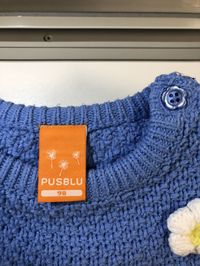
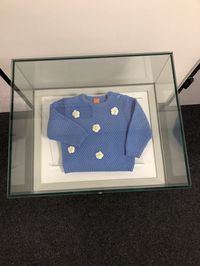
- Object description: Sweater
- Inventory number: KG2019
- In the collection since: 14.09.2022
- Date: Summer/spring 2020
Shopping for children's clothes is a joyful endeavour. Parents buy clothes for their children that they or the children themselves like. Their own taste, the functionality or even the handling of the item in terms of washing and care decide whether or not to buy the garment. But what happens when the purchase decision becomes a hotly debated topic? Because gender-binary connotations in children's clothing are commonplace in our everyday lives.
The donor of this light blue children's jumper with embroidered daisies bought it for her then one-year-old son in the summer/spring of 2020. Her son jumped at the jumper in the drugstore and wanted to have it. Because of the embroidered daisies, the jumper was, as the donor suspects, in the "girls' clothing" section. During this time, she mainly bought clothes from the "girls' department" because they didn't look so dark and dreary and the donor preferred to dress her son in colourful clothes. The blue jumper with the appliquéd daisies became one of the child's favourite items of clothing.
After a day at kindergarten, the son said that he was laughed at by other children. The son's grandparents noticed this and spoke to their daughter (the donor) about their grandchild's clothes. In their eyes, the jumper obviously had a feminine connotation and was therefore presumably the reason why the grandson was ridiculed at nursery school. The thoughtless purchase thus became a consciously made fundamental question about gendered children's clothing. Over time, friends and other parents also approached the donor about her son's "girly" clothes.
According to the gender-stereotypical understanding of colour, the colour of the jumper corresponds to an object with male connotations. However, the appliqués in the form of flowers override this categorisation and transform the jumper into an item of clothing that could be attributed to the female gender.
Such an attribution through appliqués is also confirmed by a random sample of the Süddeutsche Zeitung, which observed ten times more decorative bows on girls' shirts than on boys' shirts. The situation is similar with sequins, borders or designs such as animal prints: butterflies or unicorns can be found in the girls' section, dinosaurs or tigers in the boys' section. On the other hand, you will look in vain for the respective animals on the garments. The Süddeutsche Zeitung analysed 20,000 items of children's clothing.
The company C&A now offers gender-neutral children's clothing in a separate category. The clothing is simple, without any form of decoration and the collections mainly contain basics such as hoodies, longsleeves and T-shirts in plain or two-colour designs. What is exciting here, however, is that the colours used in the clothing tend to have a masculine connotation. The colour pink, for example, does not appear at all, whereas mint green does. The Süddeutsche Zeitung picks up on this again with its investigation. There is not only a gender order, but also a hierarchy. Girls are more likely to wear boys' clothes than boys' clothes, as the risk of bullying is higher.
To resolve the donor's experience: The son was ultimately not laughed at because of his supposed girl's jumper. The people in his circle of friends and family had mistakenly associated this with each other and thus raised the discussion about this topic. The light blue jumper with the daisies gave the buyer/donor a new perspective on children's clothing, which had previously played no role for her.
The discussion about gendered and gender-neutral children's clothing is more topical than ever before. Ultimately, it should just be fabric and colour, which everyone must and may like.
- Annika Lotta Helmers
Source: https: //www.sueddeutsche.de/projekte/artikel/gesellschaft/gegenderte-kindermode-rosa-hotpants-blaue-shorts-e701993/
Object of the month June 2022

Object of the month June 2022
Shoulder pads are a fad that has disappeared and then reappeared several times. Their last resurgence was between 2000 and 2010, when fashion designers and stars such as Lady Gaga and Rihanna made shoulder pads part of their look again, giving them renewed popularity.
It is not uncommon for a style or design element to be in and out of fashion several times over a longer period of time. What is interesting, however, is what many people, especially women, wanted to express by wearing shoulder pads. Broad shoulders are actually a masculine feature. Nevertheless, suits designed for men also have padding that reinforces this characteristic. Even today, management levels are still dominated by men in suits and shirts. The imitation of these shoulder pads in female suits is a response to this. In short: broad shoulders are an expression of strength and shoulder pads have enabled many women to show that they have exactly that, even if they have often been denied it.
One example of this is Margaret Thatcher. She was the British Prime Minister from 1979 to 1990 and is still the only woman to have held this office. Her nickname "Iron lady" gives you an idea of her reputation. Margaret Thatcher is undoubtedly a prime example of a strong woman in politics. The former Prime Minister emphasised her strength with her fashionable appearance and shoulder pads.
Other places and examples also show that wearing shoulder pads can, but does not have to, be a statement. The donor of this object merely stated that the shoulder pads made her feel well-groomed. People have different expectations of fashion. While one person deliberately wears something to embody a political stance, another wears the same style simply because it appeals to them visually and a third person might choose a certain look for both reasons.
All in all, it can be said that women are strong even without broad shoulders. Adopting such previously exclusive elements is not easy. It takes courage and strength, but in the end it's worth it to make a statement.
- Jelko Wronski
Sources:
Text:
https://coveteur.com/2019/04/04/empowering-history-shoulder-pads-trend/
https://www.oxfordstudent.com/2012/01/21/style-icon-margaret-thatcher/
https://www.independent.co.uk/life-style/fashion/features/shoulder-pads-a-history-1802139.html
https://de.wikipedia.org/wiki/Margaret_Thatcher
http://wisski-stak01.virt.uni-oldenburg.de/wisski/navigate/122/view
Image: https://www.vogue.co.uk/gallery/margaret-thatcher-style-file
Object of the month May 2022
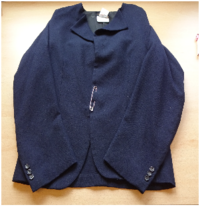
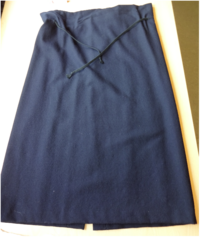
Object of the month May 2022
- Object description: Commes des Garcons costume
- Inventory number: KG2010
- In the collection since: July 2015
- Date: 1996
This ensemble consisting of a blazer and skirt comes from the Japanese designer brand Commes des Garcons. This brand is characterised in particular by the fact that the designers dissolve the conventional cuts of clothing and create new proportions on the wearer's body through deconstruction.
Designer Rei Kawakobu, who created this piece and brought it to boutiques in 1996, is no exception. She founded the label in Tokyo in 1969, with the name of the brand (translated as "like boys") already criticising the conventions and even stronger social norms and constraints regarding gender roles in clothing choices at the time.
The Japanese woman is still the head designer and owner of the company today, but there are also several other designers working for the brand alongside her. These include designer Junya Watanabe, who has been designing the designer brand's men's line since 1978. Watanabe has even been given his own side line, in which his name appears next to the CdG lettering on the labels. Over the years, he has worked with many well-known companies under his name, such as Levis, Vivienne Westwood and Fred Perry.
The costume from the IMK collection comes from the possession of the artist Silke Radhausen, who acquired it on the occasion of an exhibition of her works. According to Radenhausen, this costume would represent her well as an artist and could be worn in a variety of ways. She was also inspired by the costume, which breaks with convention by having a kind of hump on the back, but at the same time looks like an upscale occasion. A tube-like connection of the sleeves across the back of the blazer creates this unusual proportion. Another special feature is the blazer's fastening, a large safety pin. Its oversized look is quirky and also makes a reference to the punk scene, as is often the case with the brand's garments. The associated collection, which appeared in autumn/winter 1996, is characterised by these same hunchbacked proportions. The safety pin can also be found in many places.
- Jelko Wronski
Source: Images - IMK
Object of the month April 2022
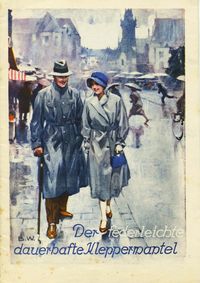
Object of the month April 2022
- Object name: Kleppermantel
- Inventory number: KG1061 + KG1976
- In the collection since: 05.09.2013 / 17.08.2021
- Dating: 1950-1959
The inventor and namesake of the coat is Johann Klepper. Even at a young age, he was interested in functional fashion and expanded his parents' tailoring business to include a sports department.
In 1907, he began manufacturing rubber boats in the attic of his house, but quickly moved on to the production of rubberised clothing. Klepper developed a cotton fabric impregnated with rubber for this purpose in 1926.
The company quickly outgrew its attic and, in addition to the private sector, also supplied the Wehrmacht and the Reichsbahn. His son took over the company in 1929, at which time it was already producing up to 90 boats and 1,000 mackintoshes a day.
In 1973, the company split into Klepper Bootsbau KG and Klepper Bekleidungsfabrik KG. During the same period, the rubberised coat went out of fashion and disappeared from the streets of Germany. The last Klepper coat was produced in 1988. Nowadays, the coats can only be found on Ebay or similar portals. Often for a price that shows the appreciation of the last Klepper enthusiasts.
Such enthusiasm was also evident in the chemist at our Institute. The coats, especially the better preserved ones, are his "favourite objects" from the collections. They provide a good introduction to the field of clothing physiology. In addition to his enthusiasm for the material, the cultural history of the coat is also impressive. Especially when you consider the consumer behaviour of the wearer and the disappearance of the coat from the fashion world.
Klepper coats laid the foundation for today's mackintosh culture. It was one of the first items of clothing to effectively protect people from rain and wet conditions. Nowadays, rain jackets come in all shapes and colours. They have a wide variety of functions and are far more sophisticated than the Klepper coat.
Current developments show that (outdoor) brands such as Arc'teryx have become a trend in the fashion scene. Original hiking and outdoor clothing is worn in leisure time. A good example of the integration of functional clothing into the fashion world are the brand's two most recent co-operations. On the one hand, there was a collaboration between Arc'teryx and the leisure/skateboard brand Palace in 2020. Secondly, Arc'teryx created a very small collection together with the designer brand Jil Sander in 2021.
Although in many places in the fashion world it may seem, especially to the less interested, that the focus is more on looks, such examples show that functionality can also play an important role.
- Jelko Wronski
Object of the month March 2022

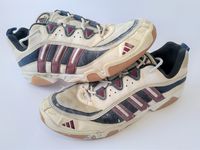
Object of the month March 2022
- Object name: Sneaker
- Inventory number: KG1011
- In the collection since: 25/05/2003
- Date: 1993-1999
This sneaker is a sports shoe with a sole designed for indoor floors in the typical beige colour. The rest of the shoe is white/blue with red details. The side of the sneaker also features the three stripes of the Adidas brand. The style of the shoe fits in with current trends in sneaker fashion, which takes up the shapes of older sports shoe models and is characterised by a certain bullishness and neon, nude and natural tones in addition to white.
Young adults in particular are enthusiastic about the sporty look and the "retro aesthetic". In discussions with colleagues at the IMK, a clear difference in the perception of the model became apparent depending on the age of the interviewees. The older colleagues found the shoe visually unappealing and in all cases, using it in everyday life was unthinkable for them. The donor of the shoes also only wore them for sports and work purposes, not for leisure. The younger colleagues, on the other hand, could imagine wearing this or at least a similar shoe in their leisure time. They were less put off by the functional design of the sole in particular; rather, the comfort this presumably provides was seen as a plus point of the model. This aspect clearly took a back seat to the evaluation of the model's aesthetics among the older colleagues.
Nowadays, many companies fall back on popular "vintage models" and "looks". These are often heavily inspired by older models. An alternative to buying new is offered by platforms such as Ebay (classifieds) or Vinted, where you can often buy well-preserved pieces for a fraction of the new price. Second-hand fashion is becoming more attractive for many people, regardless of age, as the focus is increasingly on sustainability and can therefore provide a personalised alternative to fast fashion. In addition, second-hand items offer a wide repertoire of styles and shapes that consumers outside the mainstream can also find themselves in.
- Jelko Wronski
Sources:
Surveys with IMK employees
Study: https://momox.biz/presse/28-pressemeldungen/2020/1053-studie-zeigt-klare-motivation-fuer-kauf-von-second-hand-kleidung-bleibt-nachhaltigkeit
Image (1): www.zalando.cz/adidas-originals-continental-80-unisex-tenisky-white-ad115o16x-a11.html
Image (2): Photo of the object from the IMK
Object of the month January 2022

Object of the month January 2022
- Object description: Sports bag
- Inventory number: KG1065
- In the collection since: 12.11.2003
- Date: 1983-1987
The Adidas brand bag can be hung over the shoulder. It has a blue strap for this purpose, which can be adjusted as required and thus adapted to the user's height. The top of the rectangular bag is also blue, while all the other sides and the inside of the bag have black as their base colour. An Adidas logo has been printed on the front of the bag, which is slightly angled. There is also white Adidas lettering on the left-hand side of the bag. The front lettering is also larger and is arranged in a circular design. There is also a grid on the right-hand side of the shoulder bag in which the owner's name and address can be entered.
The edges of the bag have been reinforced with a rubberised wire. There are also studs on the underside to minimise wear and tear. The zip at the top of the bag is used to open the main pocket. There is also a small zip pocket on the back.
The bag was purchased from 1984-1987 at Karstadt in Berlin for approx. 15 DM. You can see its age.
The inner lining of both compartments is torn in several places and is coming loose. Originally, the messenger bag was waterproof, but this coating has become increasingly loose as the object has aged. Leaving the inside and functionality aside, the purely visual condition of the bag is acceptable apart from minor soiling and the partially damaged print. This version has more of a sporty character due to the fabrics used and the printed labels. However, it was used by its owner for travelling and later in everyday life. This shows that it could be used in many areas
. The only disadvantage of such a lightweight bag is particularly evident in this model, as the less robust material succumbs to the influences of its environment after a longer period of time. Nevertheless, it is still definitely worth a look!
This type of bag is a classic. They have always been popular. The two examples above emphasise that although the superficial design has changed, the basic nature of the bags has not. In conversation, the donor of this bag referred to its practical size, which made it suitable for everyday use.
This observation is still relevant today. Nowadays, messenger bags are still often found in the fashion world. Whether in youth culture, designer fashion or simply in the office, their function makes these bags a timeless, frequently used and much-loved object. There is a reason why the shape has remained. Such bags accompany us humans and we trust them. We trust that they are robust, that our things are safe in them and that they offer us enough storage space in everyday life. So in a way, the wear and tear of the bag is just an expression of the owner's trust.
- Jelko Wronski
Sources:
(1) wisski-stak01.virt.uni-oldenburg.de/wisski/navigate/69/view (text)
(2) Quelle Katalog Frühjahr 1986/87 (image) Bestand Subsammlung Schriften STAK
(3) www.adidas.de/adicolor-archive-messenger-bag-s/HD7187.html (image)
Object of the month December 2021

Object of the month March 2022
- Object description: Steel helmet
- Inventory number: KG1485
- In the collection since: 08.10.2007
- Date: 1971
This helmet was worn by the soldiers of the National People's Army, the military organisation of the GDR. It was introduced for the regular armed forces in 1956 and has its roots in a prototype developed by the Wehrmacht at the end of the Second World War. The helmet was primarily known as the 604 or M56 steel helmet. The previous prototype was called Model B I. It stood out in Wehrmacht firing tests in 1943/1944 due to its good results, but could no longer be mass-produced and distributed to German soldiers due to the end of the war. Nevertheless, it was patented in 1943 and several hundred examples were distributed to soldiers for testing.
The further developed Model 56 was then manufactured from 1957 in the steelworks in Lauter, which had already been established for the production of steel helmets.
Until the dissolution of the GDR, the helmet remained unchanged in its external form and was used in many of the eastern institutions.
It is not entirely clear where exactly this helmet came from. It is only known that it was donated by a music student and added to the collection a short time later.
Punchings on the inside also reveal that the helmet is the smallest version (size Roman 1 of 3) and was produced in 1971.
It is also clear that the steel helmet was painted with symbols that speak against National Socialism. For example, a simplified motif of a swastika being thrown into a rubbish bin has been drawn twice. The context in which this helmet was painted is unfortunately not known.
- Jelko Wronski
Sources:
above: de.wikipedia.org/wiki/Nationale_Volksarmee
below: URL is no longer available
Object of the month November 2021
Object of the month November 2021
- Object description: Football shirt
- Inventory number: KG465
- In the collection since: 09/02/2000
- Dating: 1996/1997
The football shirt on display here is the long-sleeved version of an away jersey from the Borussia Dortmund club from the 1996/1997 season. Shirts of this type are referred to as "authentic replica". This means that although the jersey is original and produced by Nike, it does not fully correspond to the original worn by the players. There are differences in quality and details, such as a missing "Bundesliga" patch.
The jersey is made of 100% polyester, black is the basic colour and the sides, sleeves including cuffs and the collar have neon yellow stripes. The shirt's shark collar, typical of the time, is striking. Several embroidered, sewn-on and ironed-on elements can be found on the chest area, including the logo of the main sponsor at the time, Continental Versicherungen, a Nike logo and the BVB crest. The back of the jersey was also flocked with the name "Ricken", meaning the then BVB star player Lars Ricken.
In 2000, the harmful substance tributyltin was detected on these jerseys, among other things, which initially led to a great deal of media attention and uncertainty among some wearers. However, after more precise data became known and further investigations were carried out, the Federal Institute for Consumer Health Protection was able to quickly issue a warning. The amount of the pollutant was below the limit set by the WHO and therefore not harmful to health.
- Jelko Wronski
Source:
Object of the month October 2021
Object of the month October 2021
- Object description: Adidas Superstar
- Inventory number: KG936
- In the collection since: 01.11.2002
- Date: January 2000
The side parts of the shoe and the tongue are made of imitation suede. The inside is padded with a pile fabric. Characteristic of the "Superstar" are the front flap and the three stripes on the side of the shoe, which, like the sole of this model, are made of rubber. The sneakers in question were produced in China in January 2000. However, the "Superstar" first appeared on the market in 1970. From there, the trainers made their way into the hearts and minds of sneaker enthusiasts, particularly via the hip-hop scene. They quickly achieved a high level of popularity as they were characterised by their timeless design and high level of comfort. The original sports shoe became a model that was also worn in leisure time and the "Superstar" soon became the company's most successful model. Today, the footwear is one of the classics and is still available on the market in a similar form. Anyone who wears a Superstar wears a piece of history on their foot.
- Jelko Wronski
Object of the month September 2021
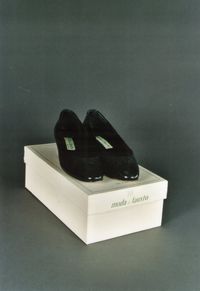
Object of the month September 2021
- Object name: Pumps
- Inventory number: KG1085
- In the collection since: 07/04/2004
- Date: 1986
"Rucke di guck, rucke di guck, blood is in the shoe:
the shoe is too small, the right bride is still sitting at home."[1]
This warning from the doves in the fairy tale Cinderella is probably one of the most famous quotes in world history when it comes to clothes that are too small or do not fit. It symbolises the cliché that women in particular regularly squeeze themselves into clothes that are too tight in order to prove something to themselves or their social environment. The object of the month for September shows that such clichés can also contain a grain of truth. Shoes made of glass or gold, as in the original version by the Brothers Grimm[2]are not in the collection, but these black pumps are. The donor bought them 35 years ago to wear to her father's 50th birthday party, and later they were also used for other festive occasions such as New Year's Eve celebrations. The reason for the purchase was that the pumps went perfectly with festive clothing. They were combined with either a black and yellow ensemble from Mondi or a black cocktail dress made of panne velvet. From the outside, the donor looked very happy, but in reality she found the shoes very uncomfortable and painful to wear because of their poor fit. Nevertheless, she kept putting them on, clearly recognisable by the signs of wear. The shoes were very important to the donor, as evidenced by the original box, which is still in existence and has been added to the collection.
- Katja Kuhlmann
Sources:
[1] Quote from the doves in the fairy tale Cinderella, when the prince wants to take one of the false sisters as his bride, see: Rölleke, Heinz (ed.): Brüder Grimm Kinder- und Hausmärchen, Ausgabe letzter Hand mit den Originalanmerkungen der Brüder Grimm Band 1, Stuttgart, 2017, p.137.
[2] Ibid, p.136.
Object of the month August 2021
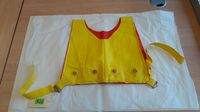
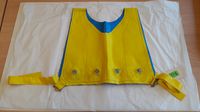
Object of the month August 2021
- Object description: Life jackets
- Inventory number: TO778a-c
- In the collection since: 29.01.2003
- Dating: 1966 - 1970
August promises beautiful summer weather and days at the swimming lake or leisure pool. The popularity of other water activities, from canoeing to boat trips, is unbroken. At the same time, the number of non-swimmers in Germany has been rising for years. To draw attention to this problem, a life jacket from the collection was selected as the object of the month for August. These yellow and orange waistcoats were used between 1966 and 1970 and are categorised as swimming aids from a water rescue perspective. Water rescuers differentiate between buoyancy aids and life jackets in various strengths[1]. The most important difference: life jackets are powerless and also keep people afloat who are no longer able to do so themselves. Life jackets turn the wearer onto their back to keep their head above water and clear their airways. Life jackets, on the other hand, only help people to help themselves and reduce the effort required to swim. People in grade need must therefore still be able to move themselves. In the leisure sector in particular, e.g. canoeing, participants are only provided with life jackets and the ability to swim is a prerequisite. For providers of these activities, life jackets are not only cheaper, but also easier to use as they often require no maintenance. Buoyancy aids are made of solid, buoyant and non-absorbent material such as polystyrene (a plastic) or cork. Life jackets, on the other hand, are made of different materials and have different functions to inflate, and their functionality requires regular inspection. The waistcoats shown here are made of plastic and slip into the wearer's face when worn, which is why they were more dangerous than helpful. This and the rusted buckles show that the materials used for functional textiles in the water sports sector have undergone massive development to ensure the safety of users. There are now various providers and guides to help you find the right lifejacket for you[2], but they are no substitute for good swimming training.
- Katja Kuhlmann
Sources:
[1] www.moritzsail.com/ohnmachtssichere-rettungsweste/
[2] www.uscgboating.org/assets/1/Publications/howtochoosetherightlifejacket_brochure.pdf
Object of the month May 2021
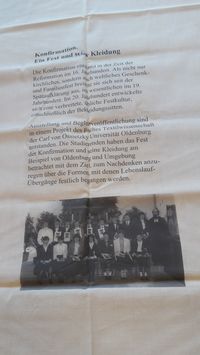
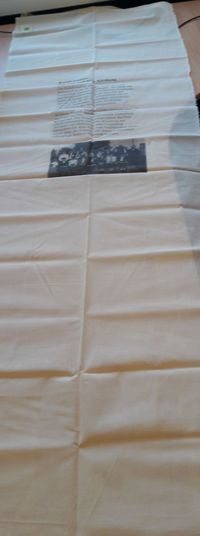
Object of the month May 2021
- Object description: Fabric panels
- Inventory number: TO873a-c
- In the collection since: 18/08/2003
- Date: 2003
The Institute of Material Culture offers students the opportunity to try out many projects and gain their first research experience. These activities are reflected in the collection in the form of objects. In May 2003, the exhibition "Confirmation: A celebration and its clothing" took place in the Oldenburg City Museum, which dealt with the changes in confirmation clothing over the last 200 years and arose from an Institute project led by Dr Kurt Dröge. A wide variety of textiles were used in the museum presentation, including these fabric panels. They served to introduce visitors to the exhibition. The canvas-like cotton fabric was printed in black in the centre and bevelled at the top by hand with needles and stitches so that a wooden pole could be pushed through it. The exhibition shows that the demand for festive fashion in the context of confirmation shows some continuities, despite the influence of contemporary fashion trends.[1] The colours black and white still characterise the choice of dresses today. Girls initially wore white dresses and boys wore black suits. Nowadays, girls also wear trouser suits and the like, but basically not much has changed from the behaviour established back then. Hairstyles should be elegant but not too conspicuous and the accessories worn usually show religious symbols, e.g. crosses. In general, clothing should be smart, elegant and formal. However, all of these specifications are "unwritten laws", as the church has never issued official guidelines on clothing. However, this did not stop pastors and parishes from setting their own rules, which led to social pressure to dress appropriately. Due to such guidelines and the special nature of the event, many families still feel obliged to buy new clothes for confirmation today, otherwise they fear they will stand out negatively in the community. As the necessary financial resources are often lacking, swap meets and second-hand sales for festive clothing are now booming.
Religious contexts are an important object of study for material culture, which is why the collection also includes confirmation dresses and christening gowns, for example.
- Katja Kuhlmann
Source:
[1] All of the following statements are based on knowledge from the exhibition catalogue:
Dröge, Kurt (ed.): Konfirmation : ein Fest und seine Kleidung ; [on the occasion of the exhibition at the Stadtmuseum Oldenburg from 6 April to 11 May 2003], Oldenburg, 2003.
Object of the month April 2021
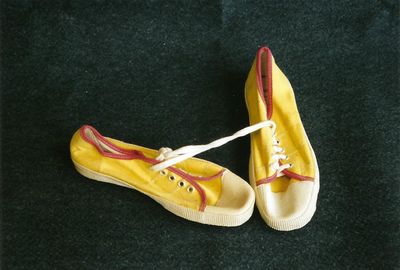
- Object description: Sneaker
- Inventory number: KG815
- In the collection since: 22.04.2002
- Dating: 1989
Millions of items of clothing go unsold in Germany's fashion shops every year - this was already the case before the coronavirus pandemic. But where to put all the clothes? One of these unwanted items has found its way into our collection. These trainers became shelf warmers in the shoe shop of a friend of the donor. Even when they were sold at a flea market, they didn't find a new home. But instead of being thrown away, the shoes ended up in a box and lived there for 10 years until the donor rediscovered them as a suitable item for our collection. However, retailers usually have to come up with other alternatives. Donating the clothes sounds like a logical step in this context, but German tax law often stands in the way. Donations in kind are subject to 19 per cent VAT, which often makes donations more expensive than disposing of them. If a T-shirt cost one euro, a donation of one tonne would have to be taxed at 900 euros, whereas incineration only costs 100 euros.[1] However, disposal is also difficult, because since October 2020, the state has been able to take legal action under the Closed Substance Cycle Waste Management Act if new goods or returns are destroyed.[2] Another option is to pass the clothing on to remnant retailers, who supply outlet shops and deliver abroad. There is currently no obligation to pass on usable products to a collection centre, so it remains to be seen how the routes taken by unwanted items of clothing will develop in the future.
Object of the month March 2021
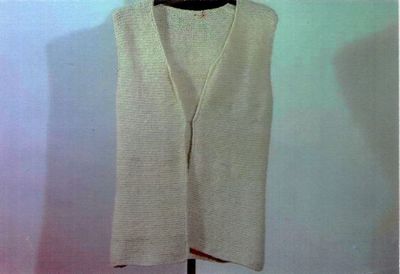
- Object description: Knitted waistcoat, long shape
- Inventory number: KG1572
- In the collection since: 31/05/2008
- Dating: 1970 to 1989
The object of the month for March is a "favourite item" of our donor. She wore this knitted waistcoat almost every day for 20 years. Even the manufacturing process was something special - at least by today's standards. Our donor wanted a waistcoat, but instead of buying one, she decided to make it herself. She received some wool from a friend who owned sheep, which she spun herself and then used to knit the waistcoat. The result was an everyday companion.
A study by Sophie Woodward, in which she analysed how clothing shapes women's relationship with the outside world, shows that such "favourite items" are connected to their wearers in a special way[1]. Long ownership and frequent wearing create a kind of symbiosis - ultimately, the fabric adapts more and more to the wearer and she feels like she is wearing a "second skin"[2]. This strong emotional bond is often formative in the biography of the person wearing it[3]. If we follow other approaches such as Alfred Gell's, who states that clothing serves to objectify the personality of the wearer for outsiders and to make opinions/feelings etc. visible[4]The great influence of clothing on everyday life is evident. For example, there is the phenomenon of "emotional dressing". Scientists at the University of Queensland, for example, found that we usually choose clothes that show us and others how we want to feel[5]. For example, if we're having a bad day but want to improve our mood, we reach for items of clothing that we associate with something good. So it's high time to give your personal "favourite item" a place of honour in your wardrobe
Katja Kuhlmann
[1] Cf: Woodward, Sophie: Looking Good: Feeling Right - Aesthetics of the Self, in: Küchler, Susanne/ Miller, Daniel: Clothing as Material Culture, New York 2005, pp. 21-40.
[2] Cf. ibid, p. 33.
[3] Cf: Bayly, C.: The Origins of Swadeshi: Cloth and Indian Society, 1700-1930, in: Appadurai, A (ed.): The Social Life of Things, Cambridge 1989.
[4] Gell, Alfred: Art and Agency: Towards an Anthropoiogical Theory. Oxford 1998.
[5] Andersen, Charlotte Hilton: 10 Unexpected Ways Your Clothes Can Change Your Mood, in: Reader's Digest, 2016, accessed: 15.01.2021 www.rd.com/list/clothes-affect-mood/
Object of the month February 2021
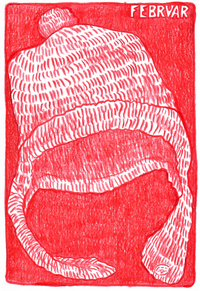
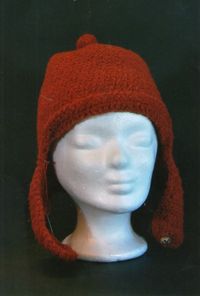
- Object description: Trapper knitted
- Inventory number: KG1525
- In the collection since: 19.12.2007
- Dating: 1996 - 2000
Although the multitude of shops and the constant availability of new items of clothing often make it seem otherwise, do-it-yourself clothing still plays a role. As the students of the Institute of Material Culture are often very interested in textiles and skilled in handicrafts, the proportion of handmade items that find their way into the STAK is even higher. In the DIY sector, many consumers find the individuality that fashion companies can only supposedly offer them. Every now and then, a trend or two emerges as a result. In 2010, for example, the company "MyBoshi" ensured that colourful crocheted hats conquered heads across Germany - both bought and crocheted.
The desire for a particular item of clothing, fulfilled by one's own handiwork, also characterises the biography of February's object of the month. Our donor really wanted to own a trapper's hat, so she set to work with her leftover wool. The result is impressive, but hardly anyone was able to see it. Our donor was disappointed with her creation as the wool was itchy and she found the fabric hard to wear. The hat was worn sporadically for two winters in her free time and at university, but then disappeared into the wardrobe for good. The orange hat was added to the collection in 2007.
Katja Kuhlmann
Object of the month January 2021
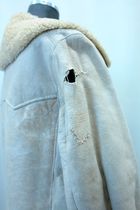
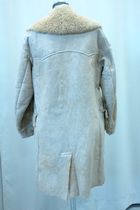
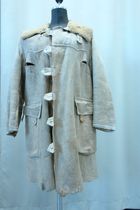
- Object description: Duffle coat
- Inventory number: KG1064
- In the collection since: 05.11.2003
- Date: 1930-1949
I looked at this coat in the database for a long time and wondered more and more about the term "fur coat", which was found in an older entry. Shouldn't it be "fur coat"? I was interested in the differences between fur and pelt and quickly found an answer on the Internet: creatures with 50 to 400 hairs per square centimetre are wearing fur (e.g. dogs, cats, cows), more than 400 hairs per square centimetre are fur (e.g. mink, beavers, foxes). However, as soon as fur is removed from the skin, it is also called fur. The term "fur coat" is therefore incorrect and is no longer used. But my astonishment at the entry did not end there. While I imagined fur coats only being worn on special occasions by extravagant wearers, this coat is said to have been part of the donor's daughters' "gown look". Looking at the biography of the item, it becomes clear to me why: the coat was probably made between 1930 and 1949 and was acquired by the donor in the mid-1980s in a second-hand shop as an occasional purchase. Its best years were probably already behind it and it was now worn by two teenage girls every day for two to three winters. Numerous wear and tears, tears and patches bear witness to its exertions. Nevertheless, I can hardly imagine wearing this coat in public today. Ethical concerns buzz through my head. Even garments with "fake fur" seem taboo, after all, there are increasing reports that "fake fur" often contains parts of real fur. I close the browser in awe of the coat's lifespan.
Katja Kuhlmann
Object of the month December 2020
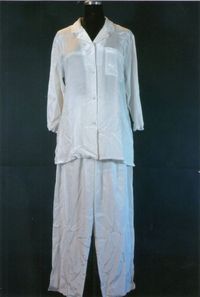
- Object description: pyjamas
- Inventory number: KG1513
- In the collection since: 19.12.2007
- Date: 1994
For many people, Christmas means spending time with family or good friends. This year in particular, many people realise how much they miss being close to others and think back to the fond memories, customs and gifts of previous years. The "classic" Christmas gifts are items of clothing. Whether it's granny's home-knitted socks, the rather conservative shirt in an SOS combination (tie, shirt, socks) or the "Ugly Christmas jumper". Almost everyone has been given clothes that only partially correspond to their own taste. However, the object of the month for December shows that even uncomfortable gifts can create beautiful memories. Our donor visited her parents in 1994 and received these pyjamas as a gift on Christmas Eve. She was taken back to her childhood days when she spent the night in a room with her brother and wore the new ensemble. Unfortunately, she couldn't stand the satin fabric on her skin, which is why this was the first and last night she wore the pyjamas. Nevertheless, she kept them for many years. She couldn't imagine parting with it until it became part of our collection in 2007. Here it can continue to spread the "spirit of Christmas".
Object of the month November 2020
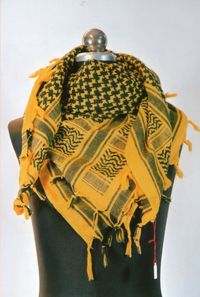
- Object description: Palestinian shawl, Kufiya
- Inventory number: KG1494
- In the collection since: 28.11.2007
- Date: 2007
Many people probably have clothes in their wardrobe that they never or rarely wear. More rarely, however, clothes are bought just for a test - like this kufiya (or kufija[1]). It was analysed and discussed during an oral exam - but it was never worn. Now one could ask: Is this kufiya a piece of clothing at all? Or is it just a piece of fabric? This raises the question of what defines clothing: the person wearing it or the source material?
In any case, it is clear to our donor that she retains memories of this item of clothing even without wearing it. She thinks back to the stressful time of preparing for exams and long discussions with friends about the Middle East conflict. This scarf has gone down in history as a symbol of resistance by the Palestinians fighting against Israel, hence the name "Palestinian scarf". Due to this political background, wearing the scarf was out of the question for the donor. In the fashion industry, the symbolism of the object was not treated with the same sensitivity; instead, mass production in China and international marketing strategies for the scarf followed. Local manufacturers were forced out of the market and the kufiya found its way back into European youth culture in the form of a scarf, among other things, but not only as a fashion accessory, but also charged with new symbolism among members of Antifa or neo-Nazis[2].
Object of the month October 2020
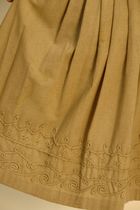
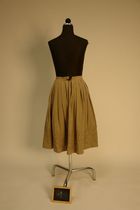
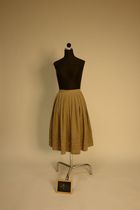
- Object description: Skirt, Full skirt, A line
- Inventory number: KG1
- In the collection since: 01.10.1997
- Date: 1953
Clothing does not simply consist of fabric, thread, a string here and a button there. It also consists of experience, practice, time and (manual) labour. Nowadays, our clothes often seem to lack a personal touch. Even though every piece passes through the hands of textile workers during production, it is not in the nature of industrial production to represent individuality. After all, the mass production of goods stands for guaranteeing the conformity of individual pieces.
Our object of the month for October is somewhat different. This item of clothing was produced in-house in 1953 as a model for a fashion show. The hand-stitched seams are particularly visible on the hem of the light beige woollen skirt. Our donor has skilfully sewn on a 20cm wide embellishment from partially drawn-in ribbons. Each slightly irregular yet precisely placed stitch conjures up an image in my mind of a person bending over the skirt with needle and thread in hand. A sentimental thought of the quiet moments of needlework.
Veronika Davydov
Object of the month September 2020
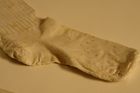
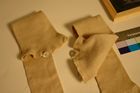

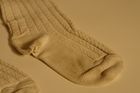
- Object description: Knee socks
- Inventory number: KG8 - KG10
- In the collection since: 01.10.1997
- Date: 1930s
Factors such as time, place, occasion, comfort and one's own aesthetic ideas play an important role in the selection of clothing. The final choice of clothes is based on personal experiences and preferences, and after a while the selection seems to take place automatically and subconsciously. Researching the processes of choosing clothes is one of many aspects that can be done with the help of the objects in the Collection of Everyday Textile Culture. Often, however, there are no notes from the former wearers, so how can such processes be reconstructed?
The first clues are provided by the traces of use and knowledge of material contexts when looking more closely at the object.
The three pairs of white children's stockings are made of cotton and have all been patched several times, are discoloured and have many stains. The elasticated bands are no longer elastic (due to age?) and are crumbly. The many signs of wear suggest that they have been used frequently or for a long time. Cotton is relatively stiff and rather unsuitable for the manufacture of socks due to its low elasticity. However, as these are children's socks, the easy-care properties (boil wash and light repairs) and skin-friendliness of cotton would speak in favour of using them as underwear. At first glance, no further traces can be recognised, so further research into historical contexts must now follow in order to be able to put ourselves in the minds of the former users. After all, a wide variety of factors can influence the choice of clothing: the household's economic situation, academic appointment (of the guardians), place of residence, local and contemporary fashion trends, possible clothing alternatives and their accessibility, and much more.
Object of the month August 2020

- Object description: T-shirt
- Inventory number: KG1876
- In the collection since: 09.09.2019
- Date: 2011-2019
"Rock the summer" is written on this T-shirt and the sight of the headbanging rocker brings to mind rousing concerts on balmy summer nights. However, this item of clothing has never seen a live band, instead it was used to help with the gardening. Although the donor of this T-shirt regularly attends concerts and festivals, he wears merchandising products from his favourite bands. He likes to buy these from the merchandising trading company E.M.P., which is also the source of our object of the month for August. E.M.P. offers its goods in printed mail order catalogues, among other things. This makes E.M.P. one of the few companies in Germany that continues to offer a printed catalogue. Other mail order companies such as Otto have long since discontinued this due to a lack of profitability caused by the shift of purchases to the Internet, and formerly famous catalogues from mail order companies such as Quelle or Neckermann were discontinued in the early 2000s in the course of company closures.[1] According to E.M.P. CEO Ernst Trapp, the printed catalogue represents an important link to regular customers and also helps them to find their way around the large product range.[2] For this reason, the catalogue is still published in a print run of one million copies. As E.M.P. appeals to a special audience - the product range only includes merchandise products for popular films and musicians from the rock and metal music genre - the company also pursues special customer loyalty strategies at concerts and festivals throughout Europe and is present there with sales stands, among other things.
[1] Neckermann and Quelle online shops now exist again, but both are now part of the Otto Group.
[2] For statements, see interview at the K5 Future Retail Conference 2019: www.kassenzone.de/2019/08/10/wie-wurde-emp-zum-marktfuehrer-fuer-metal-rock-merchandise-ernst-trapp-ceo/
Object of the month July 2020
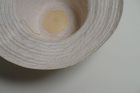
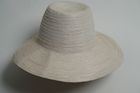
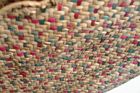
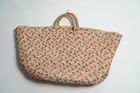
- Object description: Straw hat, basket bag
- Inventory number: 648, 1491
- In the collection since: 09/04/2001, 23/10/2007
- Dating: -
Holiday plans have been thrown into disarray for many this year. Long-distance travel is currently only possible with reservations and at your own risk. To be on the safe side, some have now planned their summer holidays in their own country. Nevertheless, they still want to go to the sea or at least near a lake. Any wickerwork items are still loyal companions for a beach holiday. Tourist shops offer timeless models of beach bags and sun hats that immediately give shoppers a feeling of being on holiday - even at home.
Object of the month June 2020
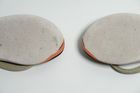
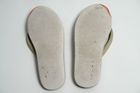

- Object description: Flip-flops
- Inventory number: 1681
- In the collection since: 28/08/2009
- Date: -
Summer is just around the corner and as soon as it gets warm, the familiar summer sounds will once again resound through the cities. Thong sandals offer an airy summer and bathing shoe that has been named after the characteristic sound made when walking since the 1960s. Flip-flops are made from a wide variety of materials and have their origins in similarly shaped shoes from ancient Egypt. Their great popularity led companies to specialise in the production of thong sandals and even design socks for use in all temperatures.
The objects shown here were apparently worn a lot and with pleasure, but the material gave way after a short time and shows clear signs of wear.
Object of the month May 2020
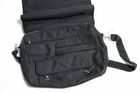
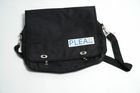
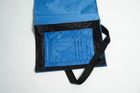

- Object name: Messenger bag
- Inventory number: 1072 & 1073
- In the collection since: 14.01.2004
- Date: 2002
These conference bags were given free of charge to participants of the conferences mentioned on them. The wearer, male, architect, travelled to Berlin and Toulouse as a conference participant. At the time, he was working as a research assistant at an architecture faculty and used the bags to transport his documents during the conference. Afterwards, however, the bags were mainly kept in the wardrobe, as they did not meet the fashion requirements. But perhaps the owner's memory of his own poor presentation at the first major international conference also played a role.
Due to the coronavirus pandemic, large conferences have mostly been moved to online formats. This means that the corresponding merchandise is certainly no longer necessary, but unfortunately the experience is also missing.
Object of the month April 2020
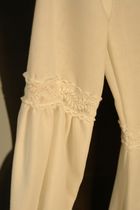
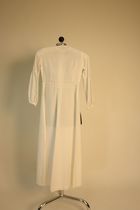

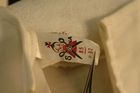

- Object description: Confirmation dress, Empire dress
- Inventory number: 1430
- In the collection since: 19/09/2006
- Date: 1972
Easter time is the time of confirmations. The donor of this dress was confirmed in Denmark in 1972 and felt very grown-up in it. Having usually worn customised dresses, she insisted on an "off-the-peg" dress for this occasion. In order to look like the other girls in her class, this dress was bought from Jacobsen in Vordingbord, Denmark.
The donor wore it twice - to her own and a week later to a friend's confirmation. Although fond memories characterise her relationship with this garment, the wearer still remembers that it was a little too tight and therefore not suitable for dancing.
Object of the month March 2020
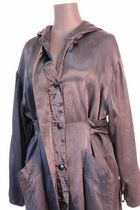
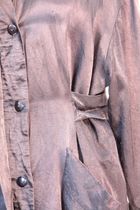
- Object description: Kimono dressing gown
- Inventory number: 1502
- In the collection since: 19.12.2007
- Date: Early 1990s
Home office? Home schooling? Video conferencing? Terms that will probably be with us for a while now...
It's not just IT providers that are making a profit in times of corona, the economy of leisure and home wear is also being boosted. If the most diverse tasks and parts of the day suddenly all take place in one place, it is best to ensure a universally suitable outfit.
A dressing gown, for example, or in this case a kimono, is a quick way to adapt. Quickly pulled over a nightdress, it offers warmth, protection from prying eyes and, depending on the look, an uncomplicated way to cover up a casual outfit and make it suitable for everyday wear.
The donor wore the kimono as a jacket during the summer months, having made it during her training as a seamstress.
Object of the month February 2020
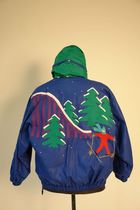
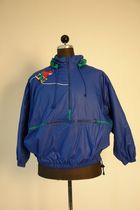
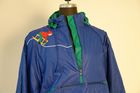
- Object description: Winter jacket, ski jacket
- Inventory number: 1403
- In the collection since: 04.07.2006
- Date: 1991
The upcoming semester break is often used to go on a real winter holiday in the mountains. For many people, functionality isn't the only thing that matters when it comes to skiing; looks are also a priority when choosing clothes. The donor of this winter jacket has even customised it herself to meet her individual requirements.
After having to cancel her summer holiday for academic appointments, she bought a sewing machine instead. She started appliquéing and chose a winter landscape with sporty motifs for the new winter jacket. At the same time, she added functional elements such as a hood, a belly pocket and an adjustable cuff.
After the intensive work, the donor thought the jacket was far too good to wear while skiing. She took it with her on her skiing holiday but mainly admired it on the hanger.
Object of the month January 2020
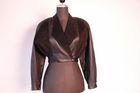
- Object description: Spencer jacket
- Inventory number: 1089
- In the collection since: 07/04/2004
- Date: 1992
The donor was immediately sure that she had to have this jacket. Purchased from Alo's Ledermoden at the Steintor in Bremen in the early 1990s, the jacket and the matching spaghetti strap dress became her companions at several parties. However, as the dress was fitted skintight to the wearer's figure, she could barely breathe in it. Although she felt "very sexy" and "never not dressed" in it, the donor was ultimately only able to wear the ensemble for a few years. The memories and probably also the high purchase price ensured that she kept it in her wardrobe for a long time afterwards.
Object of the month December 2019
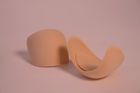
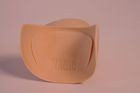
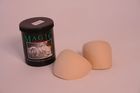
- Object description: Shoulder pad
- Inventory number: KG1118
- In the collection since: 21/04/2004
- Date: 1988/1989
The Christmas season is just around the corner and with it many occasions when special outfits are required. These shoulder pads are self-adhesive and can therefore be used for various occasions. The donor wanted a smart look, which these shoulder pads gave her.
Originally purchased with a blouse that required shoulder pads, the donor only wore these accessories on days that were not too warm. She wouldn't want to wear the foam on her bare skin today as it made her sweat. In the end, the pads were only worn on a few special occasions over 2-3 years. "You have to take great care of your body and personal hygiene to keep the pads looking good," says the donor. The items themselves also require special attention. For example, the manufacturer recommends always storing them in the box provided after hand washing to preserve their shape.
Object of the month November 2019
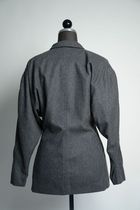
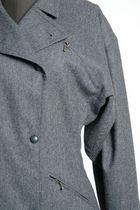
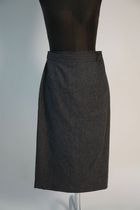
- Object description: Ensemble, blazer, pencil skirt
- Inventory number: 1903
- In the collection since: 18.11.2019
- Date: undated
Only recently added to our collection, this two-piece suit by Jil Sander impresses with its simple elegance and timeless style.
The donor bought the costume in 1985 from Mäntelhaus Kaiser in Hanover for a special occasion, namely her daughter's confirmation. Both the blazer and the skirt reflect the characteristics of Jil Sander's fashion; simple in terms of colour and style, but with an unusual cut. She combined the blazer with a short-sleeved blouse and a cast on her leg, as she had recently torn a cruciate ligament on a skiing holiday.
Jil Sander is an internationally renowned fashion designer and shines on the catwalk with her unique collections. The company of the same name was founded in 1968 - but only became famous in the 1980s. Almost 30 years after its foundation, Jil Sander sold a large share of Prada. Today, the brand is owned by a Japanese textile group, which is still in the black.
Object of the month October 2019
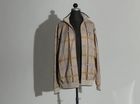
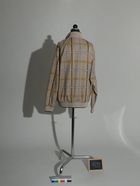
- Object description: Sports jacket, sweatshirt jacket
- Inventory number: 1899
- In the collection since: 15/10/2019
- Date: 1990s
When you think back to the greatest hits of the 1990s, what is the first thing that comes to mind? Nirvana, Spice Girls or MC Hammer? Hip-hop was imported from America in the 1990s and has since been reflected in many cultural areas, but above all in fashion. The item presented here comes precisely from this scene, to which the donor felt connected as a teenager.
The very well-preserved sweatshirt jacket from the Enyce label is particularly striking due to its colourful mix of colours. The beige base colour is interspersed with a coarse checked pattern of white, yellow, brown and blue stripes and is reminiscent of the colourful aesthetic of graffiti. The high-quality workmanship can be recognised, among other things, by the fact that the donor has worn the item every day for almost two years, but the jacket does not show it. The slightly wider cut fits perfectly into the fashion image of this cultural movement and was used at the time for freedom of movement when dancing.
Enyce is a hip-hop label that is still popular today and originally belonged to the extremely successful American rapper Sean Diddy Combs - better known as P.Diddy. After the donor had indicated several times that he would like to have something from this label, his parents bought the jacket second-hand in the early 2000s and gave it to him as a birthday present. At the time, he was very proud of the item, which gave him a sense of "coolness" and belonging among his friends.
Object of the month September 2019
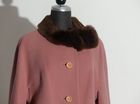
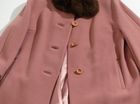
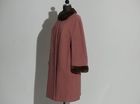
- Object description: Coat, fur collar
- Inventory number: 1843
- In the collection since: 14.02.2019
- Date: 1967
Focus on fur - never out of fashion?!
September marks the official start of the third season - autumn. The trees lose their leaves, it gets colder and this year's autumn collections are on display in the shops. A nice, warm coat is a must-have for this stormy season. And one such coat has been selected as this month's object. To be more precise, a rose-coloured coat that catches the eye not only because of its colour, but also because of the soft fur on the collar and sleeve hems.
In the autumn of 1967, the donor and her mother went to the Bauermann retail store in Bremen. She really liked the colour and bought the coat for 134 DM. That was more than her monthly rent at the time and not easy to bear in times of economic crisis. The donor cancelled her entire savings account to pay for it. But the coat was bought for a special occasion, namely the birth of her son. After that, she would give up her academic appointment - i.e. no longer have her own income. To this day, the coat has not only a material but also a high emotional value for the donor.
Wearing real fur has been heavily criticised by animal rights activists, especially since the 1990s. Low environmental standards, poor husbandry conditions and cheap labour ensure that production is profitable from an economic point of view. High-quality faux fur, on the other hand, is produced in complex processes that take a lot of time and money. In addition, many manufacturers do not comply with the labelling requirements for real fur, meaning that the difference between real and faux fur cannot be recognised at first glance. However, many well-known labels, such as Michael Kors, Tommy Hilfiger, Gucci etc., are leading by example and are increasingly doing without real fur in their production. Nevertheless, many customers still buy fur, which results in the agonising deaths of many animals. Wearing fur remains a matter of conscience in this country. Unlike in California: A law has just been passed there that prohibits the production and sale of new fur.
Object of the month August 2019
- Object description: Denim trousers, Levis 501
- Inventory number: 1880
- In the collection since: 02.06.2019
- Dating: 2015
According to the former owner, this object donation is "a milestone in fashion history" and a classic. The Levi Strauss & Co denim trousers, originally "invented" as work trousers in San Francisco in 1853, are part of the wardrobe of a man who favours brands for all his clothing and objects. For him, branded goods mean above all quality, fit and timelessness.
The "Outfit Study" (1998-2001), which surveyed 10,000 German men and women on brand awareness in the jeans fashion sector, found that 78.5% of 14-19 year olds, 72.5% of 20-29 year olds, 60% of 30-49 year olds and still 37.5% of 50-64 year old men and women attach great importance to the brand, especially when buying their jeans.
The reason for giving the Levis 501 as a gift: the trousers no longer fit because he has lost 28 kg. According to the donor, sorting out jeans that are too big from his clothing collection helps him to keep the weight off. Under no circumstances does he want to "grow back" into his oversized trousers.
Object of the month June 2019
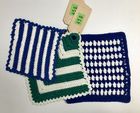
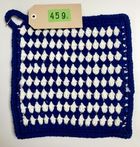
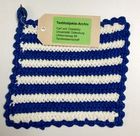
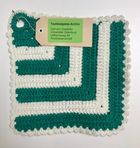
- Object description: Potholder, pot holder
- Inventory number: 459 a-c
- In the collection since: 08.05.2001
- Date: ca. 1950s - 1960s
At this point, some readers may be reminded of the 'needlework teacher' from their school days, who criticised a long thread: "Long thread - lazy girl (short thread - hard-working girl)." A long thread may seem practical at first glance, but it has many disadvantages: It knots more easily, the work takes longer overall and the thread is said to lose its natural lustre as it becomes rougher.
There are several examples of textile-related teaching from the post-war period in the Textile Everyday Culture Collection - the objects of the month in June are just such examples. These potholders were crocheted from blue, green and white cotton and donated to the collection by a 'needlework teacher' from Oldenburg. The proverb quoted at the beginning of this article makes it clear that 'needlework lessons' were a feminised practice at the time and an instrument for fixing role models. The lessons trained young girls' manual skills to prepare them for everyday life at home.
For a long time, learning about textiles remained a speechless act; nowadays, theories on the culture of things give it a language and enable the exploration of diverse socio-cultural contexts.
Object of the month May 2019
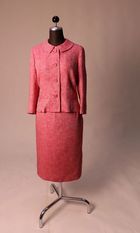
- Object description: Red and pink mottled costume, blazer and pencil skirt
- Inventory number: 1839 a + b
- In the collection since: 03.01.2019
The donor of this blazer and skirt combination brought a whole bundle of objects to the Institute. In addition to the clothing shown here, which was worn to the meeting of a women's association, she gave her honeymoon costume and debutante dresses to the collection. She was able to tell stories about all of the objects, which were from a long time ago, but were still present in her mind and also provided information about why she had not yet been able to part with the objects. When she learnt about the collection of everyday textile culture and the research focus pursued here, she felt the need to have these stories recorded and to have them stored appropriately together with the associated clothing.
The private photo albums supplied for this purpose are of particular value. The clothes in the Archive for Clothes and Stories hang on hangers in the archive cupboard, which are appropriate for conservation purposes. If we look at the photos of the donor from the times when the items were still worn, they come to life again. The material and the workmanship suggest a high standard. This impression is confirmed by the numerous newspaper cuttings in the donor's photo album.
The ensemble of objects on display here comes from a New York fashion boutique and, judging by the few signs of wear, was rarely worn. Purchased for a special occasion, bought in an upmarket fashion shop and then stored in such a way that it would not be damaged for decades. Not only does the collection seem to have been inspired by history, but the wearer apparently also attaches great importance to the preservation and storage of things and stories.
Object of the month April 2019
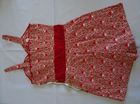
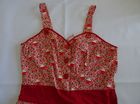
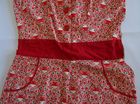
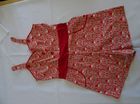
- Object description: One-piece trouser suit with short legs, red/white floral pattern
- Inventory number: 1686
- In the collection since: 31/08/2009
According to the lender, the trouser suit with bustier top was acquired in 1946. It was not worn by the lender herself, but by her mother. However, the wearer found it "quite striking and daring" due to its pattern and bright colours and so it was only worn "occasionally, not so often". The one-piece suit was ordered from the mail-order company Witt, probably the first mail-order company in Germany. The owner at the time wore it "on certain occasions", the lender characterises the item as "not work clothes, but nothing festive either".
Now that we can enjoy the first warm days in April, many people are longing for more bright colours in their wardrobe. The summer clothes are being dug out again and are waiting to be used. The wearer remembers that she always stood out with this suit, which was particularly due to the fact that her place of residence was rather small and dignified.
The red ribbon at the waist was added later after repeated washing caused the cotton to shrink and the suit became shorter and tighter. However, the owner wore it less and less as she no longer liked it as much as she did at the beginning.
Object of the month March 2019
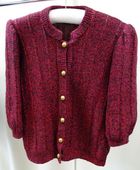
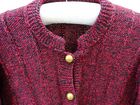
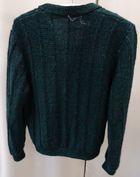
- Inventory numbers: 1837, 1838
- Object description: Cardigan green, Cardigan red
- In the collection since: 03.01.2019
The cardigans were donated to the Institute together. The donor took them from her mother's estate and kept them alongside several other items of clothing. As a child, she wore the wool from the red cardigan herself in the form of a jumper. This was unravelled and then knitted together with the wool from another jumper to make this cardigan. The green cardigan, on the other hand, was made for the donor's father and previously provided the wool for two children's jumpers for the donor's brothers.
In addition to the personal reasons for taking over the cardigans from the mother's estate, the aspect of reutilising the raw material of the wool yarn was particularly interesting. At first glance, it can be seen that the sleeves of the red cardigan are significantly shorter than the sleeves of the green one. According to the donor, this is because there was not enough wool for the small children's jumpers. The green cardigan has longer sleeves because the jumpers from whose wool the green cardigan was made were sized for the older brothers, who needed larger jumpers.
The donor's mother ended up wearing both jackets herself after her husband, for whom the green one was knitted, passed away. She always froze in the red jacket because her wrists remained free. The donor herself was able to confirm this, having worn the red jacket herself several times in memory of her deceased mother.
Object of the month February 2019

- Inventory no.: 1466
- Object description: I love NY T-Shirt white
- In the collection since: 21/02/2007
At the beginning of February, the lecture-free period begins and with it the prospect of travelling for many. Be it to their home town, to visit friends or to go on holiday abroad - holidays and public holidays offer time to do things for which there is sometimes too little time otherwise.
The 1466 object is a popular souvenir from visits to New York. Souvenir shops all over the world are now adapting the typical spelling to their cities and printing it on T-shirts, bags and fridge magnets. Whether the original is from New York is anyone's guess. However, the imprint on the object seen here is branded, indicating that this logo is protected and that it actually originated in New York.
Even if the souvenirs are intended to suggest that the wearers are at home anywhere in the world and have already seen a lot, the donor of this object was embarrassed to wear the T-shirt. He received it as a welcome gift when he was a guest at a wedding in New York in 2006. Other guests wore their T-shirts the evening before the wedding. The donor, on the other hand, "never wore his once" as it was too big for him. Nevertheless, he thought the gesture by the wedding couple was nice because "it combined hospitality and local patriotism".
Object of the month January 2019
- Inventory no.: 713
- Object description: Corduroy dungarees, green
- In the collection since: 24/04/2001
Corduroy has been worn a lot again since last year. On the one hand, the cold season seems to be fuelling a desire for soft and thicker materials among shoppers, but on the other hand, the revival of 70s fashion is certainly also contributing to the revival. Tight cuffs with wide trouser legs can currently be found in all material variants in clothes shops.
Corduroy is traditionally used especially for workwear for academic appointments belonging to the guilds. The fabric is characterised by the pile part, which is the connection between the weft and warp threads. warp threads warp threads, makes it particularly durable.
This clothing fabric is also called 'Manchester' after the factory town of the same name where it was first produced.
Today, corduroy is particularly popular in the winter months. The dense yet fluffy structure of the material is produced and used in various designs. The wide stripes of the fabric, as in these dungarees, are widely used in traditional guild clothing. The finer versions, on the other hand, are often used for fashionable purposes and often look similar to velvet.
Object of the month December 2018
- Inventory no.: 1038
- Object description: Rocky H&M rucksack
- In the collection since: 27.06.2003
- Date: ca. 1999
The rucksack, an everyday companion for many and often a classic functional item. It is worn on the back with two straps over the shoulders, allowing freedom of movement for the arms. Even as a child, the school bag heralds the start of independence and thus the beginning of a new phase in life. The process of choosing the appropriate transport textile is associated with great excitement and the object is associated with a special emotional bond. The variety of rucksacks that are designed and advertised for every possible occasion is enormous. The functionality of the textile in terms of material and features is taken into account, but the look of the product should also impress buyers.
The backpack from H&M's own brand Rocky is a lightweight city rucksack. The durable material (polyamide) convinced the buyer in 1999, as she needed a rucksack that she could use at university from then on. For three years, the item that is now part of the collection was the donor's daily companion. The rucksack was also used on a six-week trip to India. This gave the object, which was once bought for everyday use, a stronger emotional meaning for the owner and thus its value for the Clothes and Stories collection.
Object of the month November 2018
- Inventory no.: 1382
- Object description: Cardigan with Christmas motif
- In the collection since: 21.03.2006
- Date: 1990s
Did you know that "Ugly Christmas Sweater Day" is celebrated in America? The aim is to present yourself in as tacky a jumper as possible; the tackier, the better.
It seems to be a characteristic of the Christmas jumper that it is colourful - usually in red, green, blue or white - and that it is adorned with motifs such as presents, Christmas tree baubles or reindeer heads. Snowflakes seem to me to be the more dignified option.
They don't necessarily have to be knitted, but can also be purchased, especially since the 1980s. It became a trend in those years because TV presenters in the English-speaking world appeared in public wearing such jumpers. The joke became a bestseller, kitsch became cult - not least thanks to Colin Firth's appearance in a jumper with a reindeer head motif in the classic film "Bridget Jones - Chocolate for Breakfast".
This Christmas jumper was also purchased in the 1990s for around 30 euros. Not a lot of money for a joke that made the wearer look like "a decorated Christmas tree" - but it seems to have been worth it.
Last year, Christmas jackets were also commonplace at H & M. Let's see what's on offer this year.
Image source: http://wisski-stak01.virt.uni-oldenburg.de/wisski/navigate/287/view
Object of the month October 2018
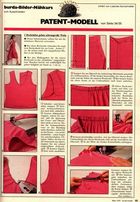
- Object description: Pattern from "burda-Moden"
- Date: 1980s
No, this is not a complex architectural drawing, but a pattern that used to be frequently included as an insert in so-called "women's" and especially sewing magazines.
It was often the case that the patterns were enclosed with the advertised dresses in the magazine.
This pattern comes from "burda moden" from 1987 and serves as a pattern for a combination of a spring dress and matching sash belt, dubbed "the new hit for petites".
The pattern was important in everyday life from the post-war period until the 1970s, as interviews with donors make clear. One donor says that it was hardly possible to do anything other than sew the items herself. Buying things yourself would have been too expensive.
Nowadays, sewing patterns are still relevant, partly because they can now be accessed online. The do-it-yourself sewing trend is in full swing, albeit under different circumstances: Whereas it used to be an economic compulsion to do it yourself, it is now a lifestyle component.
Object of the month September 2018
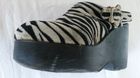
- Inventory No.: 1400
- Object description: Sling platform shoes
- In the collection since: 20 June 2006
- Date: 1997
Platform shoes have been making a comeback since last year. They were all the rage in the 1990s – for example, the ‘Buffalos’ for men and women, which were available in a range of colours and styles.
This model in faux zebra print from our collection is a real ‘eye-catcher’.
These are sling-back platform shoes. The term ‘sling’ is familiar from ‘sling pumps’ – shoes that are open at the back and held in place by a single strap around the heel.
The donor bought them in spring 1997 at Deichmann. The reason for the purchase can be summed up in three words: ‘Saw them and fell in love’. Whether she actually needed new shoes was a secondary consideration.
At the age of 19, the donor was going through a ‘colourful phase’: ‘I mixed and matched everything – the main thing was that it was colourful and not boring’.
For about five years, from 1997 to 2002, these shoes were worn every day on many different and special occasions: to school, to the disco, for a spot of shopping and even to the subject-specific A-level results ceremony.
The reason why the shoes no longer featured prominently in her outfits from 2002 onwards was quite simply that platform shoes went out of fashion and that the donor felt she was ‘too old for chunky platform shoes’.
The shoes had both advantages and disadvantages for her. The advantage was that they made the donor taller and ‘kept her feet dry in wet northern Germany’. The disadvantage was that they could not be worn during the winter months because, as they were open at the back, her feet would get cold.
Nevertheless, they were the donor’s “absolute favourite shoes”; at the time, she had a “particular fondness for animal-print designs, especially on shoes”.
Object of the month August 2018
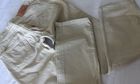
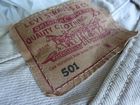
Profile
- Inventory no.: 875
- Object description: Levi`s 501
- In the collection since: 24/09/2002
- Date: 1996
"'501s' were a 'must'"
This is what the donor says about her frequently worn beige Levi's jeans from the 1990s, on whose leather patch the number 501 was printed in black. According to the donor, every one of her sixth form colleagues at school wore the 501 at the time, "even if the cut didn't suit everyone" - and at a price of DM 159 per item. She remembers that for a while there were also coloured '501s', for example in red, green or black. She also owned the '501' in many different colours, in lighter and darker shades.
More were added to her collection when she spent a year as an au pair in the USA in 1996/97. There she "bought a 501 almost every month because they were so cheap". The average price for a pair of jeans there was around 30 dollars. But the purchases were only worthwhile for a short period of time, because just one year later, the donor reports, the 501 was no longer "in".
This phenomenon, that "colour and cut were no longer fashionable", is a feature of many items of clothing that ultimately found their way into the Textile Everyday Culture collection. Examining fashion in its social context is one of the research focuses of the Institute of Material Culture.
Object of the month May 2018
Profile
- Inventory no.: 463
- Object description: Repassier thread
- In the collection since: 04/05/2001
- Date: late 20th century
DEDERON: THE THREAD OF PERFECT RELIABILITY
The polyamide fabric Dederon has a long tradition. Even the name refers to something historic:
Launched in 1959, the new synthetic fibre was named after the state in which it was developed: the GERMAN DEmocratic Republic. The suffix "-on" refers to a similar material, Perlon. This had already been developed in the 1930s as a replacement for nylon from the USA and later became an "essential" raw material for the war effort. A dispute over the trademark rights to Perlon between the GDR and FRG companies made a new name for polyamide fabrics of this type necessary. To this day, the shopping bag and the apron made of Dederon symbolise everyday life in the GDR. "Plastic and elastic" have become proverbial.
The use of man-made fibres was a cost-effective alternative to the expensive imports of cotton. In the planned economy, the population's need for clothing was thus satisfied without burdening the economically weak state. Individual consumer needs met a limited market whose determinants were beyond the control of the individual.
Today, however, Dederon is almost forgotten. However, our collection provides points of reference for material history and personal memories.
Object of the month April 2018
Profile
- Inventory no.: 1047 a,b
- Object description: Pinstriped jacket with matching waistcoat
- In the collection since: 21 July 2003
- Date: 1964
PIN and STRIPES
In April, it’s not just the air that’s getting warmer; for many school pupils, their minds are also racing. The A-level exams are just around the corner. Can you still remember what you wore on exam days? Did you tend to go for casual clothes? Did you wear a pair of comfy tracksuit bottoms? Or did you turn up in your Sunday best?
A school-leaving exam is a major milestone in life. It is therefore no surprise that the owner of this suit can still remember exactly the year in which he wore it: 1964. He wore this smart suit for his oral school-leaving exam in the subject of mathematics. His mother had bought it for him for around 80 DM at Mode Bruns, a menswear shop in Oldenburg. He still remembers the white chalk dust on his jacket, which trickled down onto it whilst he was writing on the blackboard.
The A-level exam was not to be the only occasion on which he wore this garment. Over the following two years, he wore it around 10 times, both in everyday life and on festive occasions, until it became too tight. Around 40 years later, it found its way into the collection via his niece.
Object of the month March 2018
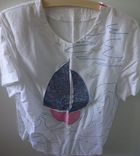
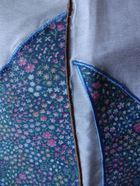
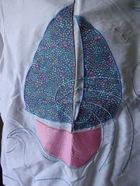
Profile
- Inventory no.: 1410
- Object description: Self-sewn summer blouse with appliqués
- In the collection since: 25/07/2006
- Date: 1991
HOME SOUVENIR
Have you already planned your holiday? But what do you do if your holiday falls through?
In the summer of 1991, the donor of this blouse was unable to take a holiday for internal company reasons. Her husband, on the other hand, was granted the holiday, which he ended up taking alone. As a consolation, she bought herself an expensive sewing machine, which she could use practically and whose results delighted her.
The first piece she completed with this sewing machine was this summer blouse. She had bought the fabric for it about three weeks before her holiday and designed the pattern herself.
She usually combined this blouse with a turquoise-coloured short stretch skirt or knee-length cycling shorts. How did she feel in it? "I thought I was dressed very summery and chic and felt very comfortable."
Object of the month February 2018
Profile
- Inventory no.: 893 a-d
- Object description: Theatre costume (Kurt Weill production)
- In the collection since: 24/09/2002
- Date: 2000
(ET)WHAT A THEATRE
This theatre costume from the summer months of 2000 is one of the few costumes in the "Textile Everyday Culture" collection. It therefore fits into the collection category "Specialised histories".
Around 18 years have passed since this combination shone in its colours on stage. The costume is a product of a project seminar, a co-operation between the Institute of Material Culture and the Institute of Art and Visual Culture and the Institute of Music. To mark the 100th anniversary of Kurt Weill's birth, the institutes re-staged some of his songs and texts under the title "... of the inadequacy of human endeavour". Students from these disciplines designed this costume and made it themselves. It consists of a top, trousers, an elasticated top, gloves and, surprisingly, a medicine tube from the pharmacy. The actress also wore a cape made from a former dress petticoat.
The costume was used around five times, including in the concert hall at Towson University in the US state of Maryland. This is a partner university and the piece had a guest performance there as part of the Kurt Weill Centennial Celebration.
"Sewing costumes "at the last minute" as one person tried it on for the first time a day or two before the premiere. A funny flight, lovely people, an interesting country, beautiful voices and beautiful music," the donor's notes on the object read.
Object of the month January 2018

Profile
- Inventory no.: 1087
- Object description: Pumps, pink-white
- In the collection since: 07/04/2004
- Date: 1985/86
" ...that they don't end up in the rubbish, because I couldn't bear to find out!"
Did you know that there are shoe shops for plus and minus sizes?
One such shop - called "Kosy Schuhe" - existed in Bremen in the spring of 1985. This is where these two pairs of pumps in pink and white and yellow and white in size 32 came from.
The former owner wrote the following on the record sheet of the pieces for the collection: "bought to match the summer fashion of the time, especially suitable for an ensemble in pink and yellow". She revealed that they cost DM 179.90 per pair and that these newly acquired pieces were worn for around three years, especially in the summer months.
There was one catch with the shoes, which the donor noted as follows: "I couldn't walk in the shoes at all, so I only wore them when I knew in advance that I wouldn't need to move around so much." She speaks of a dilemma: "The shoes have a very bad fit - I lose them when I walk ... I think I was blinded by the beauty of these shoes when I bought them. In any case, I didn't realise in the shop how badly you could walk in them. Nevertheless, I couldn't part with them for a long time. I took them out of the wardrobe again and again, unpacked them, looked at them, tried them on ... only to pack them away again. Even though today I would like to treasure the shoes like a treasure, I have decided with a heavy heart to "sacrifice" them for the clothing archive - in the hope "that they - as quoted in the title - will not disappear into the rubbish.
We have 20 to 30 pairs of these pumps in the collection. The donor thus has an emotional connection to her clothes that goes beyond their function.
Object of the month December 2017
Profile
- Inventory no.: 1634
- Object description: Muff
- In the collection since: 20/10/2008
- Date: 1990s
FOR THE COLD SEASON
When it gets cold outside, it's time to bundle up again - with hats, scarves and gloves. But not only gloves, but also so-called "muffs" helped and still help to protect the hands from the cold. The term "muff" comes from the Latin word "muffula", which translates as fur glove. They are a form of hand warmer which, unlike gloves, consist of one piece and are worn in front of the body. Such a "muff" was and is mainly worn by women to match the rest of their outfit. The Institute's collection contains several of these "muffs". A dark red model from the 1990s was donated to the Institute in 2008. The second example is more of a muff pocket. Muff bags are characterised by the fact that they have the function of a muff but, as the name suggests, look more like a bag. This grey muff bag is a muff with a pocket handle and a small mirror integrated into the lining. It is a grandmother's heirloom and was worn around the turn of the century and beyond into the 1960s. It is not a self-made piece, but was bought in a shop in Braunschweig.
The donor of this muff said she was giving it away because it was "no longer modern". Even if you look at the streets, hardly anyone seems to wear "muffs" as accessories these days. Perhaps there will be a revival at some point?
Object of the month November 2017

Profile
- Inventory no.: 1061
- Object description: Klepper coat
- In the collection since: 05/09/2003
- Date: 1950s
This Klepper coat consists of a cotton fabric to which a rubber coating was applied using a coating process. The process was developed in the 1920s and created a lightweight, easily stowable, rainproof textile that still allowed good air circulation under the coat.
This coat in particular was found in an attic and dates back to the 1950s. The Klepper coats were continuously developed and improved until 1969. The donor stated that the coat was above all very practical and durable. The "Klepper" brand also stood for quality.
Unfortunately, the coat became very well known during the Nazi dictatorship, when various officials wore the coat and it became popularly known as the "Gestapo coat". These rubberised coats were also taken up in the fetish scene, especially in Great Britain, and thus became part of this culture. The "Klepper" was very popular in the 1980s, and the company produced a limited edition for sale as late as 1997. Today it is no longer produced.
Klepper coats have thus accompanied many developments and chapters of modernity. This Klepper coat in particular epitomises the world and conditions in Germany in the 1950s. Its purchase and use are inextricably linked to this period. The rubber that made it durable has become brittle and is beginning to disintegrate in some places. A protective cover that was recently made for it will preserve it for the future.
Object of the month October 2017
Profile
- Inventory no.: 824
- Object description: Back massage seat, car seat base
- In the collection since: 24/02/2004
- Date: 1990s
This object comes from the estate of Prof Ingrid Köller, founding director of the Institute of Material Culture.
Köller strongly promoted the theorisation of textile-related teaching.
Originally, this was often an instrument for fixing role models. It was also intended to prepare children for everyday life at home.
For a long time, learning about textiles remained a speechless act.
In order to give it language, it must establish a link to people's everyday lives.
Theoretical references must be established that contextualise the production and consumption of textiles. The cultural-historical significance, but also its aesthetic dimension, must become negotiable.
The car seat underlay thus triggers questions that old-style textile-related lessons could not or would not ask.
Labelled "Handmade?", this object blurs the boundaries between different manufacturing techniques. How can you tell from this car seat pad whether it was made by hand or as a standardised product? What difference does this make to the meaning of the object?
Is it a "textile" at all? Is its knotted structure or the surface of the material made of wooden beads a sufficient characteristic? Or is its close relationship to the body of a car driver and the paths he takes a more significant reference than its texture?
As new assistants to the Institute of Material Culture's collection, we, Nina Ahokas and Felix Otte, are looking forward to addressing these questions and working on new ones.
Object of the month August 2017
Talking about images
This object of the month lives from images. Images of fashion, household items or leisure articles that were advertised in the "Wenz" department stores' catalogue in 1967.
Alongside many other thousands of magazines, specialist literature and catalogues, this copy is part of our Institute's collection of publications. But what use can be made of such a catalogue, which was created 50 years ago?
After leafing through the catalogue, the answer is obvious. Questions spring to mind such as:
Which items of clothing were and would still be fashionable today, which household items are no longer available to buy, how has the price changed or how were the products advertised?
Such a fashion catalogue is a good testimony to the fashion trends of the time, the ideas and representations of gender, beauty, the value of make-up, the type of hairstyles, the appearance of accessories such as jewellery or handbags - from household items to designer pieces.
The question constantly arises: Where are the parallels and differences to today? How much have consumer goods changed over the last 50 years?
The catalogue is therefore an important source for researching social values and ideals through the ages.
Object of the month July 2017
This year's eighth object adorns the poster for the exhibition "In der Mode kommt ja nix weg!" - 1967 in clothes and stories, which can be seen throughout August at The Smart House Oldenburg. The "Textile Everyday Culture" collection of the Institute of Material Culture contains a number of pieces from the 1960s that are particularly suitable for presentation due to their object history, regional reference and/or material. The exhibits provide information about what is collected in the Institute's collection, why these items of all things have been included (see collection concept) and what can be read from items of clothing about personal attributions and the costume history of the 1960s.
The colourful woollen dress comes from Mrs Margarete Kunze-Groß. She was a close friend of the founder of the institute, Prof Ingrid Köller. Together they published the book "Form-Muster-Rapport" in 1980, in which the fabric pattern of this dress is illustrated. According to Mrs Kunze-Groß, she made this dress in her studio in 1966 and wore it for about 3 years. Thick yarn, known as wick wool, in orange, pink and red was worked into the black and brown wool base fabric by hand.
Other items of clothing, writings, fabrics, textile objects and their stories can be viewed until 26 August at The Smart House Oldenburg (entrance to the Tourist Information centre) near Schlossplatz in Oldenburg. We look forward to your visit!
Especially on 15 August:
Lecture and guided tour of the exhibition "In der Mode kommt ja nix weg! 1967 in clothes and stories"
Lecturers from the Institute of Material Culture, University of Oldenburg
The Institute of Material Culture invites you to a guided tour of the exhibition followed by a lecture on the work of the "Textile Everyday Culture" collection. Visitors are kindly asked to bring their own textile memorabilia and photos from the 1960s. The curators would like to discuss this with the public afterwards over snacks from the sixties.
Object of the month June 2017
PROFILE:
- Inventory no.: 1069
- Object description: Rain cape with Disney motif
- In the collection since: 25.11.2003
- Date: 2000
Mickey Mouse in summer
Objects go through careers in a collection. While we are particularly interested in some groups of objects at certain times and on certain themes, these later recede into the background in favour of others. This can be due to the aesthetic preferences of individual researchers as well as current research trends. So why has this rain cape of all things made it to the "Object of the Month: June"?
- Rain capes have been our constant companions as cyclists in the changeable weather of recent weeks. The object thus ties in with current everyday experiences.
- From a conservation point of view, plastics and their decomposition are extremely exciting.
- The refreshing, summery yellow colour of the rain cape fits in well with this time of year and therefore appeals to us spontaneously. Mickey Mouse brings back spontaneous childhood memories. Many of us are already looking forward to our summer holidays - and the story of this cape has something to do with that.
We like to bring souvenirs back from our holidays. They allow friends and relatives to share their own holiday beyond WhatsApp messages and postcards. For the owners, they are mementos and conversation starters.
This rain pocho became a memento, even though the wearer and object donor only wore it for 1-2 days in the summer of 2000. She was an au pair with a host family in the USA. The host family took her to Disneyland for a week. It was raining on the day of the holiday when the host mother bought the poncho. How practical that a water-repellent cape made of 100% PVC, i.e. polyvinyl chloride, was available to buy there.
As practical as this material may have been at the time, it is extremely difficult to store plastic for decades or even centuries. Plastic is not an eternal material. It becomes porous and brittle. The photographic documentation captures the condition of the object in June 2017. It will look very different in a few years' time.
Object of the month May 2017
PROFILE
- Inventory no.: 315
- Object description: Hemp-cotton trousers
- In the collection since: 15.11.2000
- Date: ca. 1980s/90s
The proof of the pudding is in the eating
Clothes don't just make people, people also make clothes. They not only produce them, but also use them. In doing so, they often leave irreversible marks on the garments. In most cases, the stains and holes are unintentional and therefore annoying for the wearer. Researchers, on the other hand, can often draw conclusions about the fabric properties and the biography of the object and its wearer.
Prof Ingrid Köller, who was interested in ecological issues and laid the foundations for the collection, was also convinced that the use of textiles can reveal a lot about their nature.
She ventured a wearing experiment. She cut two pairs of trousers, one made of cotton and one made of hemp, into two equal parts. One cotton trouser leg was sewn to the other made of hemp fabric. This gave her two identical pairs of trousers with no difference in fabric quality. She took one pair of trousers with her to her home town of Detmold at the weekend to use for housework and gardening. Accordingly, they were washed regularly - a total of 19 times according to the database of the textile object collection - in contrast to the second pair of trousers, which were never used.
After a longer period of wear and detailed documentation of use - including the effects of light, the resilience of the fabric and the degree of soiling - a clear difference between the two pairs of trousers was recognisable. Ingrid Köller found that the hemp fibre is much more durable and colourfast than the cotton fabric.
The proof of the pudding is in the eating.
Object of the month April 2017

Profile
- Inventory no.: 496
- Object description: Nyltest outer shirt
- In the collection since: 21/05/2001
- Date: 1960s
Why iron? There is Nyltest!
"So we see the gum-chewing Yank and the Italian in the red and white striped shirt who turns women's heads, while the ugly German scores at best with an Isetta and a Nyltest shirt" - Hans von Seggern jokes in the Tagesspiegel. We'll leave the clichés about the gentlemen of the 1950s to one side and turn to the material.
Nyltest is not just a term for the nylon we still know today. The fibre, which some people associate with women's stockings, was a component of shirts, blouses, smock aprons and other everyday clothing in the 1950s and 1960s.
Why was Nyltest fabric so popular from the mid-1950s?
In the 1950s and 1960s, not every household had a washing machine. The dirt still had to be removed from the laundry by hand. This was quite a strenuous task. The clothes also had to be ironed, which took a lot of time and nerves in the household.
Then came the Nyltest shirt, which promised the following according to the label:
"Tested and inspected, guaranteed non-iron, 60° wash, Nyltest, nylon 66, Optima"
"Nyltest" promised comfort: a shirt that could be hung on the hanger after washing and put on the next day without creasing.
In return for this relief, many wearers accepted that they could only wear the shirt or blouse for one day at most. The odour of sweat quickly became trapped in these garments.
But what are personal odour and wearing comfort against such a relief at work?
Object of the month March 2017
Turn old into new
When was the last time you sewed something yourself instead of ordering it online?
Martha Eller, born in Guntersblum am Rhein in 1928, made this dress around 1948 at the age of 17. She was not alone at that time, shortly after the war. There was a lack of everything, improvisation was needed everywhere. Only if the women hadn't learnt to do it themselves did seamstresses take over the work. Martha Eller, for example, learnt to sew from Catholic sisters who gave sewing lessons in the church annexe.
For the top of the dress, she used a former suit jacket, possibly from her father. She bought a chequered, flannel-like fabric for the skirt. She also used this for the sleeve inserts on the top. The sleeves were generally quite tight, as the fabric was scarce.
The dress was something special in that it was only worn on special occasions. Less "good" clothes were worn in everyday life. Unlike her old skirt made of red flag fabric, for example, Martha Eller only wore it on Sundays for walks and to events such as "der Kerb", the Hessian term for fair, or at the Guntersblum market and when singing in the church (choral society).
After an eventful day, the folds were ironed from top to bottom in the evening so that everything was in order again the next Sunday. This took time, as the fabric is not suitable for pleats.
Martha Eller was very proud when her relatives and friends praised her work. She was particularly pleased with her sister Louise's enthusiasm for her dress, as Louise was the wife of a gentleman's tailor and therefore knew a thing or two about quality.
Do you have any old clothes in your wardrobe that you could turn into a dress? To the sewing machine, get set, go!
Object of the month February 2017
Profile
- Inventory no.: 1512 a+b
- Object description: Satin pyjamas (patterned)
- In the collection since: 07/08/2008
- Date: ca. 1990
The life of the patterned satin pyjamas
Once upon a time there were pyjamas that shimmered beautifully because they were made of satin. The pattern of the pyjamas was grey, brown, white and black and they were hanging in a second-hand shop in Bochum. He couldn't remember how he had got there, but he had realised that there was a way to get out of the shop: Look good, fit well and, above all, feel good.
Then Charlotte came by with her first boyfriend. She liked the pyjamas and she liked the pyjamas. He heard the magic words "I would like a pair of grandad pyjamas." Did Charlotte know where he came from? He wanted to go to her, she seemed to know him so well. So he made an effort by shining and making his colours glow. Charlotte smiled at her friend and he bought the patterned satin pyjamas.
An exciting life began for the pyjamas. Charlotte wore them almost every day. She washed it, she put it in the wardrobe, she took it out, she put it on and went to sleep. He noticed that the fabric around the buttonholes was already fraying. Charlotte opened and closed the buttons so often. But that didn't bother him, because it just showed that she really liked him. Grandad was never mentioned and the pyjamas never found out where he came from. Instead, he was all the more pleased that he brought Charlotte joy. She liked wearing it, so what did he care about the past? But then it happened. Charlotte started wearing different pyjamas. They didn't have long legs, weren't made of satin and weren't patterned. They were in the wardrobe more and more often. He was picked up less and less often. He fell asleep in the wardrobe and reminisced about the last five years.
Then Charlotte took it out again. He thought to himself that she had probably come to her senses, after all, it was the best pyjamas anyone could wish for. She took it, smiled and put it in her bag. The next thing he saw were bare rooms. Charlotte talked to someone, told them about her time with the pyjamas and then - she left. Would Charlotte come back? At first, the pyjamas couldn't believe it. Charlotte had left him. The pyjamas were taken and examined. It looked at its new owner, but he didn't seem to want to put it on. It was carefully examined, measured, photographed and given a number. Now it hangs between other pyjamas and is occasionally taken out and looked at again. Then the pyjamas tell its story, about its birth, grandad and Charlotte and how it has fared so far. From time to time, when it is very quiet, he dreams and wishes that Charlotte is doing well.