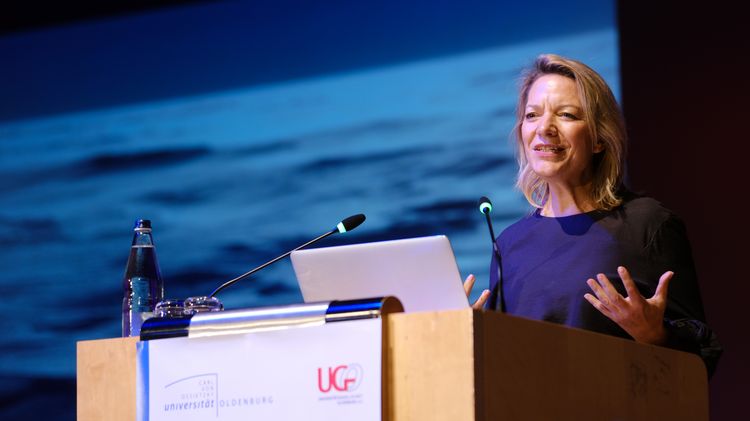
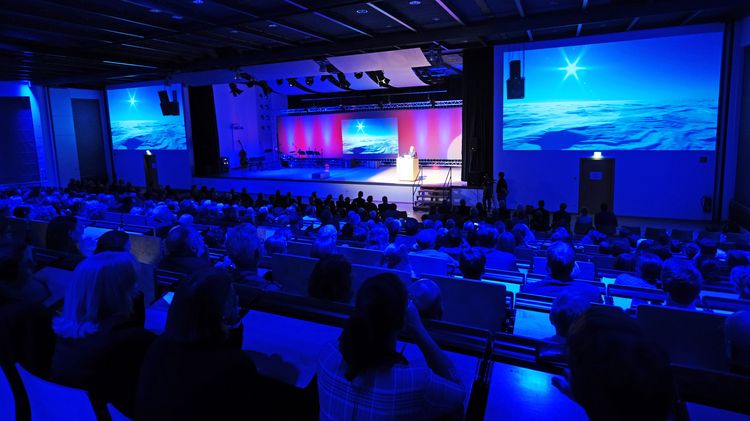


"There is a danger that by the end of the century, the North Polar ice - and with it a part of humanity's climate history - will have disappeared. Knowledge must finally translate into action!" Renowned marine biologist and polar researcher Prof Dr Antje Boetius opened the academic year at the University of Oldenburg on Tuesday evening with powerful words and examples.
As the keynote speaker at the joint event organised by the University and the Universitätsgesellschaft Oldenburg e.V. (UGO), Boetius dedicated her lecture to the topic of "Expeditions to the end of the world - new departures in science". In front of around 800 guests from the city, region and university, she explained: "In times of rapid Arctic change, we still lack observation data from the polar night, the Arctic winter. We are therefore currently organising the largest North Pole drift expedition. An international team will spend a year drifting with the ice from the research vessel "Polarstern" for the MOSAIC expedition and provide us with a completely new view of the connection between the polar region and our latitudes." The polar researcher reported on initial findings on the state of the ice.
Boetius is Director of the Alfred Wegener Institute, Helmholtz Centre for Polar and Marine Research (AWI) in Bremerhaven and Professor of Geomicrobiology at the University of Bremen. Her research focuses on the effects of climate change on the Arctic Ocean and the diversity of life in the deep sea. To date, she has taken part in almost 50 expeditions with international research vessels. The scientist has received numerous awards, including the Gottfried Wilhelm Leibniz Prize from the German Research Foundation (DFG), the Communicator Prize from the DFG and the Stifterverband and the German Environmental Award. She was recently awarded the Federal Cross of Merit for her commitment to protecting the oceans and the Leibniz Ring of the Hanover Press Club.
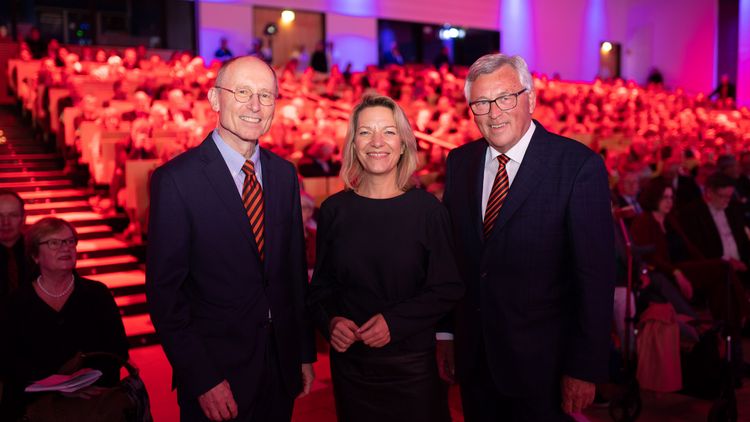
"Today's kick-off ceremony brings us together once again: the university with its friends and sponsors from the region. We are aware of your support and are approaching the many tasks and challenges of the new academic year with this knowledge: be it the education of our students, our research, our promotion of young talent or the spin-off of companies," explained University President Prof Dr Dr Hans Michael Piper when welcoming the guests. The Chair of the University Society, Hon. Prof. Dr Werner Brinker, also emphasised the important anchoring of the university in the region in his speech: "As UGO, we see ourselves as a link, as bridge builders between science and society, as critical companions - in the service of free and critical research and teaching," said Brinker.
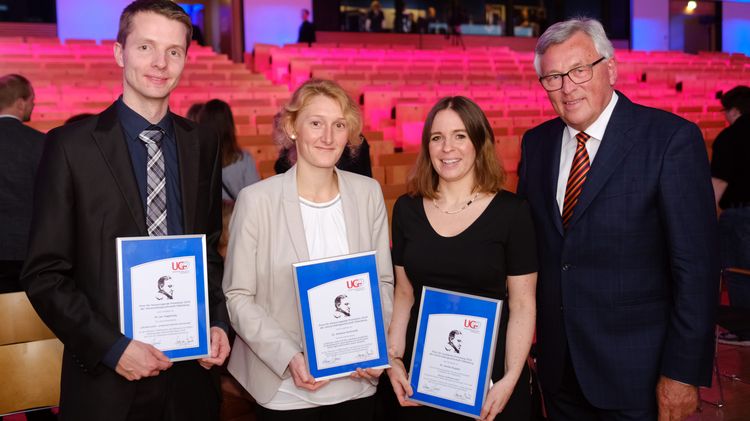
One of the highlights of the evening was the awarding of the UGO prizes. This year, historian Dr Annika Raapke received the "Prize for Excellent Research", which is endowed with 5,000 euros. The UGO also awarded the "Prize for Outstanding Doctorate" twice. Physicist Dr Stefanie Kerbstadt and physicist Dr Jan Vogelsang each received 2,000 euros.
The musical programme was provided by students from the Institute of Music under the direction of Axel Fries, Peter Janßen and Volker Schindel. The guests were treated to a varied musical programme, including a percussion ensemble, excerpts from the latest musical theatre production "Heimat im Koffer" and the band "6 p.m jam". The festive event concluded with a reception in the foyer of the lecture theatre centre. Here, young business founders also presented their business ideas to the guests.
The award winners
Dr Annika Raapke studied History, German and French in Münster and Oldenburg. During her doctorate, she was a scholarship holder and then a postdoctoral researcher in the DFG Research Training Group "Self-Formation" at the University of Oldenburg. She is currently researching in the academy project "Prize Papers" under the direction of Prof Dr Dagmar Freist at the Institute of History. Her focus is on the history of the body and medicine in the early modern period: one of the key questions is how social reality is produced and represented through bodily practices. For example, what does the thematisation of one's own body reveal about ideas and constructions of "race" and gender, nature and "civilisation", health and illness? Specifically, Raapke analysed the physical experiences of Europeans who populated the colonial structures of the Caribbean in the 18th century. Her work is based on letters from British privateers that were written between 1744 and 1826 and should have reached France from the Caribbean.
Dr Stefanie Kerbstadt completed her doctorate under Prof Dr Matthias Wollenhaupt at the Institute of Physics at the University of Oldenburg. In her work, she developed a new setup with which she can generate precisely defined laser pulses. These pulses are only a few femtoseconds short, i.e. quadrillionths of a second. Kerbstadt used the customised light flashes to observe and manipulate the physical processes underlying the interaction between light and matter. Among other things, she succeeded in specifically controlling electrons that are released during this photoionisation. The physicist is currently conducting research at the Centre for Free-Electron Laser Science (CFEL) at the German Electron Synchrotron DESY (Hamburg).
Dr Jan Vogelsang also completed his doctorate at the Institute of Physics. Under the supervision of Prof Dr Christoph Lienau, Vogelsang built a new type of electron microscope that can record the movement of electrons as a video. He succeeded in filming processes such as charge separation in nanostructures with a spatial resolution of 20 nanometres and a temporal resolution of 20 femtoseconds. This simultaneously achieved high spatial and temporal resolution represents a new world record. In May, Vogelsang was honoured with the Friedrich Hirzebruch Doctoral Prize of the German National Academic Foundation for his doctorate. After completing his doctoral thesis, he moved to Lund University in Sweden, where he is funded as a postdoctoral researcher by the EU's Marie Sklodowska Curie Programme.