
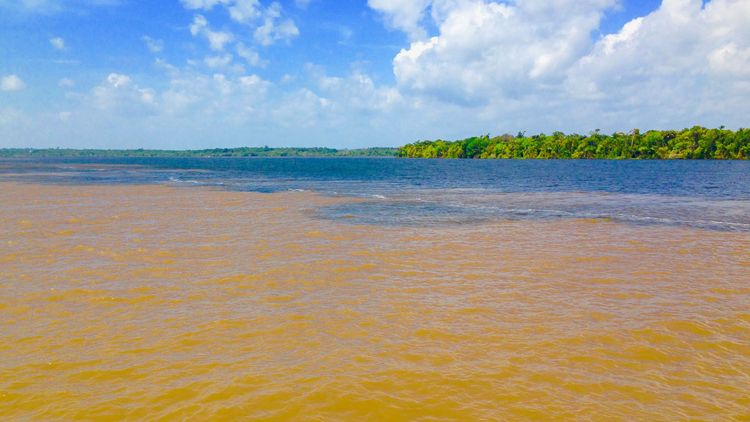


The huge Amazon River is gradually transporting long-lived carbon particles to the sea. This is shown by a recent study with Oldenburg participation in the journal Nature Communications.
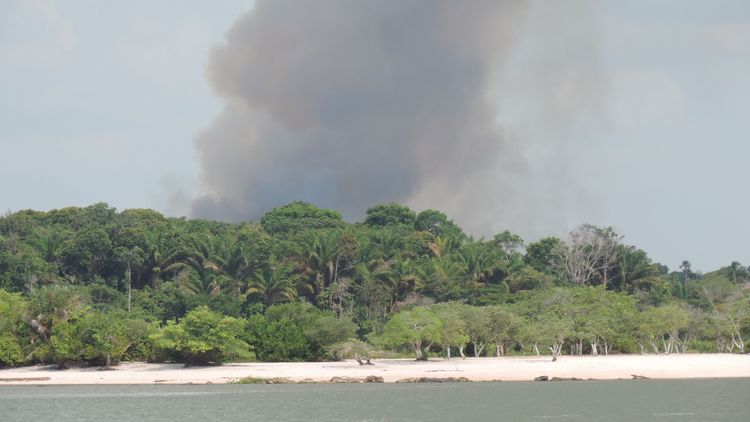
Forest fires, such as those currently raging in the Amazon region, not only release carbon dioxide, but also large quantities of soot and tiny charcoal particles, which consist mainly of carbon. What role this "black carbon" plays in the global cycle of the element and thus in the climate system as a whole is not yet fully understood. An international team of researchers led by Oldenburg geochemists Prof Dr Thorsten Dittmar and Dr Michael Seidel has now reported in the current issue of the journal Nature Communications that the Amazon transports large quantities of dissolved charcoal to the sea.
"A new finding is that the particles are of different ages. Some of the dissolved charcoal enters the river shortly after a fire, while other particles are several thousand years old," reports Dittmar, head of the Marine Geochemistry Bridge Group at the Institute of Chemistry and Biology of the Marine Environment at the University of Oldenburg and the Max Planck Institute for Marine Microbiology in Bremen.
Long-term carbon store
The fate of black carbon is interesting because these substances are among the most stable natural carbon compounds and therefore represent a long-term store. Carbon that turns into soot and not carbon dioxide during forest fires ultimately ends up in marine sediments and is thus removed from the atmosphere for long periods of time. Earlier studies by researchers led by Dittmar showed that after forest fires, some of the charcoal particles are deposited in the soil and some are blown out to sea by the wind. The majority, however, is gradually washed out of the soil and transported by rivers into the oceans. According to the study, around 26 million tonnes of black carbon enter the oceans through rivers every year - more than twice as much as the annual input of plastic into the world's oceans. "We have found remnants of charcoal in the most remote water masses of the Antarctic," reports the geochemist.
However, what exactly happens to the tiny particles as they are transported from land to sea was largely unclear until now. In the new study, the research team led by the University of Zurich has therefore characterised the black carbon exported from the Amazon more precisely. The scientists took water samples from the Amazon and four of its tributaries. They analysed the black carbon it contained and determined the age of the particles using the radiocarbon method, with a large proportion of the chemical analyses taking place in Oldenburg.
Chemical reactions on the way to the sea
The investigations show that the Amazon is one of the most important sources of black carbon in the sea: around a tenth of the material transported from rivers to the sea worldwide each year comes from the South American river. A large proportion of this is relatively young. In the oceans, on the other hand, there are mainly very old particles, some of which were formed thousands of years ago. The researchers are now wondering what happens to the younger charcoal particles as they flow with the Amazon towards the sea. They suspect that some of the substances may be destroyed during the journey by chemical reactions and the influence of light.