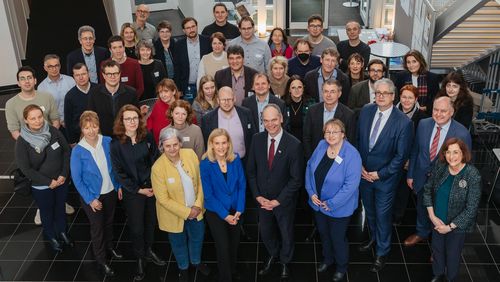


Prof Manuel Hartung gave the keynote speech at the "Auftakt 25/26" on 9 October. This contribution is based on his speech "The controversial university: Why universities must contribute to defending the freedoms of our society".
Universities must be controversial universities. I am convinced of that. This is more necessary today than it has been for a long time; the rise of autocrats, war in Europe, drones over Germany: we are living in an age of uncertainty - we have not reached the "end of history", but the end of our history of naivety.
In the age of uncertainty, authoritarian political forces are primarily attacking the institutions that want to make uncertainty comprehensible. Media, culture, science.
Universities are institutions of freedom. Timothy Snyder, the great historian, distinguishes between two dimensions of freedom: freedom FROM and freedom TO.
Freedom FROM is freedom against someone. Freedom TO is the freedom that makes you great - the freedom of the contentious university. There are four elements to a contentious university.
Firstly, the ability to fend off evil. Financially, the resilience of our institutions is not so good - they are dependent on the state budget. It is therefore all the more important to have strong institutions. Academic self-administration and institutional self-confidence are linked. In addition, the crisis response capacity of German universities must be expanded. One example: Scicomm Support, funded by the Volkswagen Foundation, Gerda Henkel Foundation, Klaus Tschira Foundation and ZEIT STIFTUNG BUCERIUS, has succeeded in providing concrete help to academics who have come under public attack.
Dealing with uncertainty as a learning objective
Secondly, a controversial university is a university that has the talent to develop the good. Karl Jaspers once said that the work of the university is "only fruitful if the people who lead this life of study are at the same time gripped by the real needs of the time". Our graduates need this mixture of alertness and empathy. They also need new tools: if the hallmark of this time is uncertainty, then dealing with uncertainty is a learning objective.
Thirdly, universities need to create something unifying - and reassess their role as central institutions in this society. Universities should take their third mission seriously: to have an impact on society alongside research and teaching. Transfer, science communication, dialogue with politics and society must be at the top of Presidential Boards and their agendas.
Fourthly, universities need the strength to fight for what is defensible: Snyder defined five levels of freedom - and solidarity as the highest level. Only together with others is man truly free: "Solidarity is a high and living form of freedom. It turns freedom into justice," he writes. Solidarity can strengthen the university's powers of survival in an age of uncertainty. It is worth fighting for.