

A lot often changes for older people after a serious fall. Senior citizens who have experienced falls advise researchers - and help them to view the research objective from different perspectives.
They are neither test subjects nor researchers in the traditional sense - and yet they have an important task in the SeFallED study: a total of six older people are involved in the research project as an advisory board. Scientists at the Department of Health Services Research are investigating the recovery process of elderly patients who have suffered a fall - a painful experience that the advisory board members also had to go through.
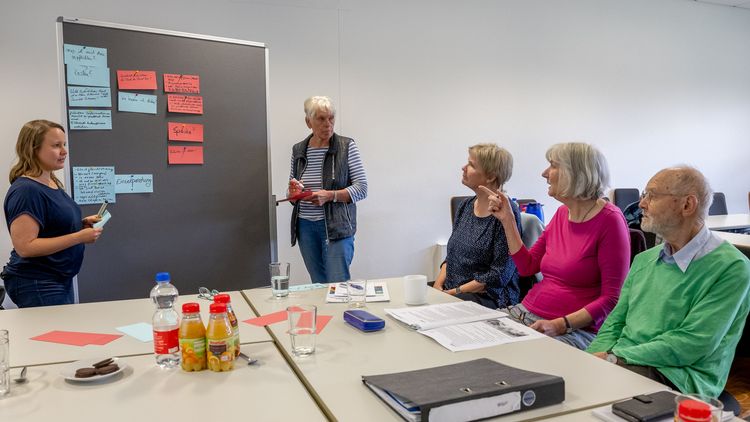
"I had a bad fall while jogging at the end of June 2020. It was a big shock and I had to have several operations on my face," says Margrit Pape. The accident is one of the reasons why she now has a fixed monthly appointment at the university. This is when the SeFallED advisory board, of which the 74-year-old is a member, meets and discusses upcoming surveys and analyses as part of the project with the other advisory board members and researchers.
Dr Tim Stuckenschneider conducts research in the Geriatrics Division at the Department of Health Services Research. "We always get the perspective of those affected from the members of the advisory board - it's time-consuming, but also very valuable," he says. With their advice, the senior citizens actively influence the study. Following the dialogue with the advisory board, the researchers adapted the course of their interviews and examinations so that the study participants, who were also older, had more time for breaks. In addition, the advisory board members tested the planned gait analysis, which takes place on a special treadmill, before the start of the study. The treadmill simulates challenging everyday situations such as braking a bus.
"We realised together that it would cause too much anxiety if we carried out the analyses without a railing," explains Stuckenschneider. Although from a purely scientific point of view, the analyses would have been more realistic without railings, the researchers reattached them for their investigations with the study participants.
Directly involved in the research
PhD student Nadja Reeck coordinates the advisory board and is the link between the research team and the senior citizens. She is also conducting research for her doctoral thesis on the participation of older people in geriatric research. "The aim of participatory research in general is to involve citizens in the entire process so that research is not conducted about them, but together with them," she explains.
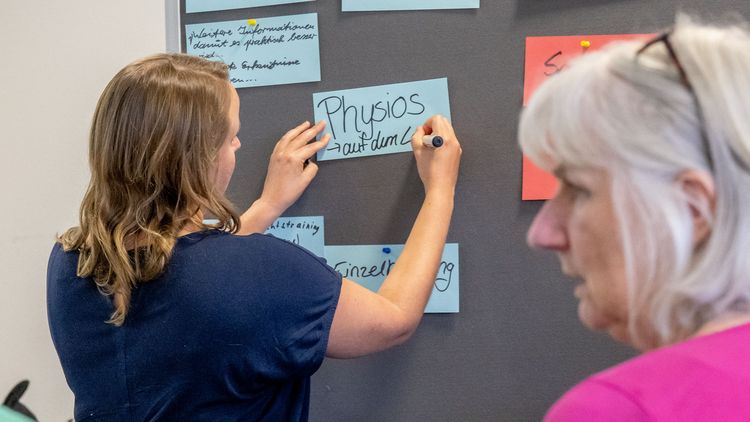
For the members of the SeFallED advisory board, this also means that they take on research tasks themselves. For example, advisory board members Dagmar Urbahn-Schiefer and Marlies Mammes are currently analysing minutes from discussion groups in which study participants shared their experiences of falls. Nadja Reeck is analysing the same data in parallel with her colleague Anna Völkel and then examining the differences between the perspectives of the researchers and the advisory board members, for example in terms of setting priorities. It has already been shown that the perspective of the advisory board members can be an advantage - for example, when they understand formulations from their peers that leave the younger researchers at a loss.
"We also took a critical look at the information material that participants in the study receive," explains Advisory Board member Bettina Reineking. As a result, individual images and texts were exchanged which, in the eyes of the advisory board, were not as appealing as the researchers thought. The 71-year-old has increasing problems keeping her balance due to a nervous disorder and has already fallen frequently. When she read about the planned study in the newspaper and learnt that advisory board members were being sought, she wanted to be part of it. "It was important to me that I could tell researchers who are much younger than me what it feels like to fall in old age. There is a lingering fear that it will happen again. Falling down, straightening your crown and getting up again - that's no longer possible."
Support for the next proposal
The senior citizens take the work of the advisory board very seriously. They engage in lively discussions, take notes, collect information and work results. "We're not a chattering group, we're constructive," says Bettina Reineking energetically. Everyone feels at home at the university - regardless of whether or not they have had any previous contact with the academic world. Marlies Mammes describes it like this: "The atmosphere is great and I feel taken very seriously by the researchers."
The members of the advisory board want the scientific debate on falls in old age to continue - even beyond the current project phase. This is why they are supporting the researchers in preparing the proposal for the next phase: the aim is to develop measures to help those affected to get around safely again after a fall so that they can overcome their fear of falling again.