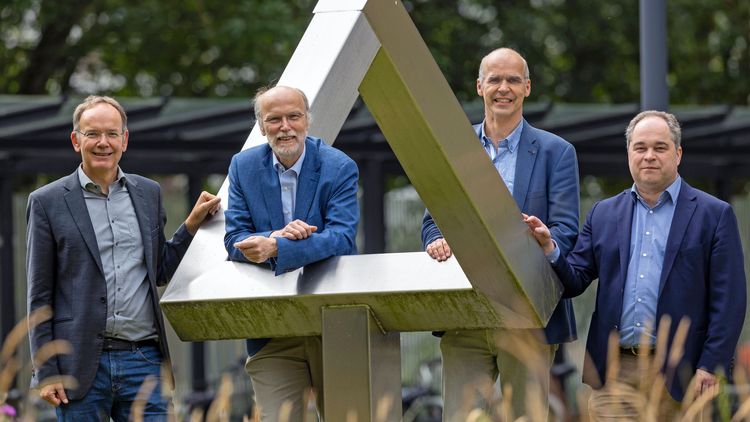

They pursue a common goal - hearing for all - and research, develop and teach at the interfaces between medicine, physics and engineering: the scientists of the Department of Medical Physics and Acoustics at the university and its Cluster of Excellence Hearing4all. They celebrated the tenth anniversary of both the Cluster of Excellence and the Department with alumni and guests at a festive colloquium.
"We have two and three reasons to celebrate," said the founding director of the Department and Hearing4all spokesperson Prof Dr Dr Birger Kollmeier. In addition to the anniversaries, there is also the joy of the recent promise of further funding for the Collaborative Research Centre "Hearing Acoustics", which is also based at the Department. Founded almost 30 years ago, Oldenburg's hearing research can look back on an extremely successful decade as a "pacesetter" for the university, summarised the physicist and physician.
"The fact that around 80 per cent of hearing aids worldwide contain know-how from Oldenburg impressively illustrates the importance of our hearing research. It enjoys the highest national and international recognition," said University President Prof Dr Ralph Bruder. In addition to Hearing4all, which scored points in the Excellence Strategy of the federal and state governments for the second time in 2018 and will be funded until the end of 2025, the structure of the Department has also proven its worth. Its graduates are "in great demand from industry, clinics and science".
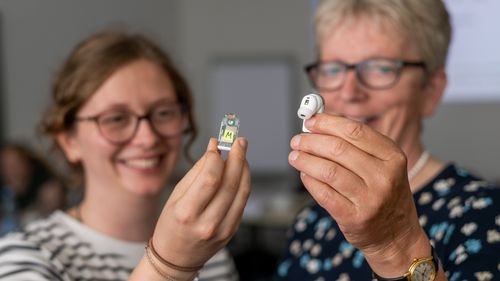
Some of these graduates returned to Oldenburg to mark the anniversary and met up for an alumni morning. The keynote speeches at the subsequent colloquium were given by Bremen computer scientist Prof Dr Tanja Schultz, an expert in cognitive systems, and Dresden communications engineering expert Prof Dr Gerhard Fettweis. The day was rounded off with afternoon tours of the Department's laboratories, which were also open to the general public.
The roots of hearing research in Oldenburg lie at the Institute of Physics, where acoustician Prof Dr Volker Mellert taught and researched from 1974, and at the then Institute for Human-Environment Relations, which also appointed psychologist and noise researcher Prof Dr August Schick in 1974. In 1993, Kollmeier was appointed to what was then the Fiebiger Professorship - a funding programme for young researchers - and subsequently established the Department of Medical Physics. The foundation stone for hearing research in Oldenburg was laid.
Today, the ten departments and seven other working groups of the Department of Medical Physics and Acoustics employ a total of almost 120 people. Ten years ago, it played a key role in establishing the School V - School of Medicine and Health Sciences. In the Cluster of Excellence Hearing4all, researchers from the Department and those from the Department for Neuroscience and the Department of Psychology cooperate with Hannover Medical School and the University of Hannover. Other partners include the Jade University of Applied Sciences and Arts, the Oldenburg and Hanover Hearing Centres, the Fraunhofer Institute for Digital Media Technology and the Hanover Laser Centre.