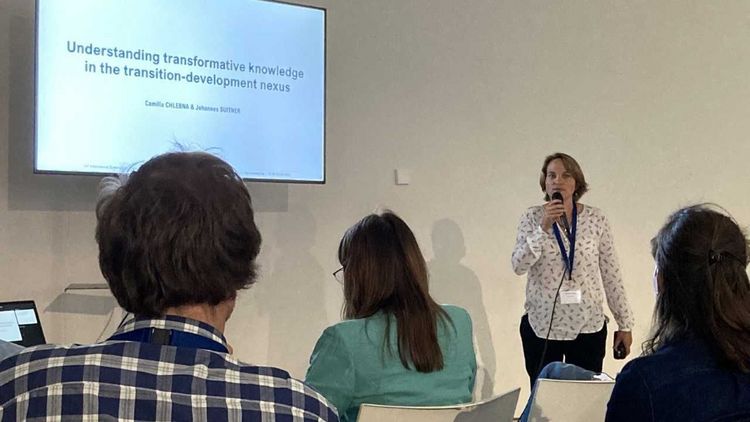
Several researchers from our Oldenburg working group presented their work at this year's IST conference. Meike Löhr and Camilla Chlebna presented their joint paper on "Multi-system interactions in hydrogen-based sector coupling projects: System entanglers as key actors", which deals with the actors who work at the interface of two sectors and contribute to the coupling of these sectors through cross-sectoral competences, among other things. The corresponding journal article is about to be published. Camilla Chlebna and Jannika Mattes presented their work on "Regional transition fields: How processes of adaptation and delimitation shape regional transitions". In it, they develop a concept based on institutional organisational sociology to explain the entrenched positions of actors in the course of the regional energy transition. Sven Alsheimer, Tamara Schnell, Camilla Chlebna and Sebastian Rohe presented their literature review on the often used but rarely carefully defined terms legitimacy and acceptance entitled "Competing terms for complementary concepts? A systematic literature review on social acceptance and legitimacy of low-carbon technologies". The corresponding journal article will soon be submitted to a scientific journal. Camilla Chlebna also took the opportunity to give a short presentation on ongoing work with Johannes Suitner from the Vienna University of Technology, which deals with the tension between (growth-orientated) regional development and sustainable transition.
The IST was organised by the Copernicus Institute of Sustainable Development and took place under the motto "Responsibility & Reflexivity in Transitions" from 30 August to 1 September 2023 in Utrecht.
Several researchers from our Oldenburg working group presented their work at this year's IST conference. Meike Löhr and Camilla Chlebna presented their joint paper on "Multi-system interactions in hydrogen-based sector coupling projects: System entanglers as key actors", which deals with the actors who work at the interface of two sectors and contribute to the coupling of these sectors through cross-sectoral competences, among other things. The corresponding journal article is about to be published. Camilla Chlebna and Jannika Mattes presented their work on "Regional transition fields: How processes of adaptation and delimitation shape regional transitions". In it, they develop a concept based on institutional organisational sociology to explain the entrenched positions of actors in the course of the regional energy transition. Sven Alsheimer, Tamara Schnell, Camilla Chlebna and Sebastian Rohe presented their literature review on the often used but rarely carefully defined terms legitimacy and acceptance entitled "Competing terms for complementary concepts? A systematic literature review on social acceptance and legitimacy of low-carbon technologies". The corresponding journal article will soon be submitted to a scientific journal. Camilla Chlebna also took the opportunity to give a short presentation on ongoing work with Johannes Suitner from the Vienna University of Technology, which deals with the tension between (growth-orientated) regional development and sustainable transition.
The IST was organised by the Copernicus Institute of Sustainable Development and took place under the motto "Responsibility & Reflexivity in Transitions" from 30 August to 1 September 2023 in Utrecht.