
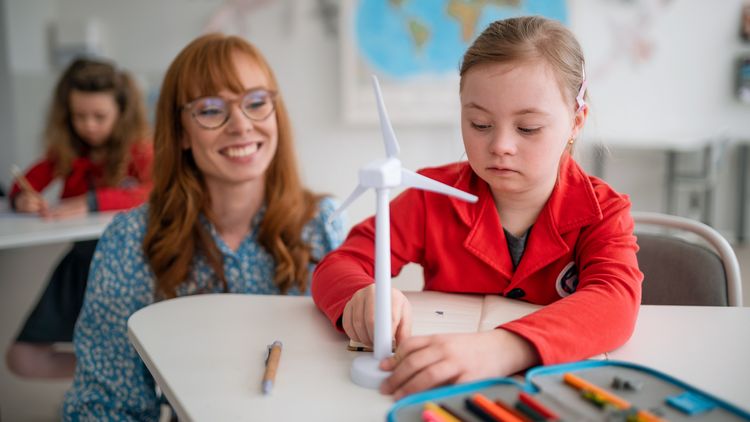
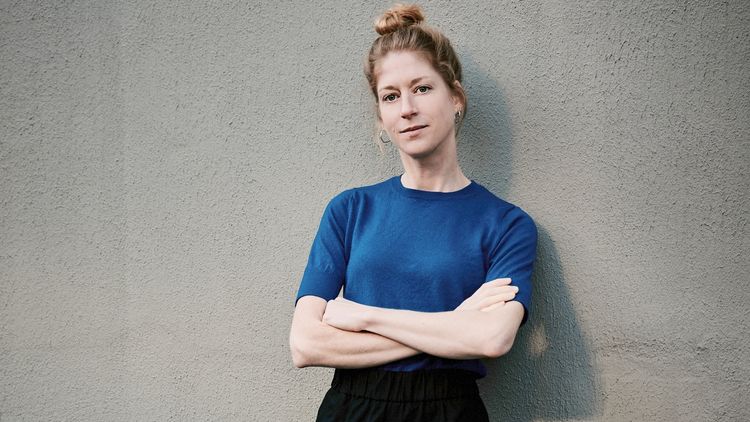


How can learning processes be stimulated in pupils with intellectual disabilities? Through lessons that – alongside clear routines – remain open to surprises, according to special needs education researcher Theresa Stommel.
You are currently completing a research project in which you have examined the educational processes of children and young people with special educational needs relating to intellectual disabilities. What is the situation regarding their educational opportunities?
These children and young people are particularly at risk of exclusion from the education system. They are significantly less likely to be taught in inclusive schools. Furthermore, they often have far less access to educational content, particularly material considered more challenging, such as literature or certain pieces of music, foreign languages and historical contexts. This is because, due to their limited cognitive abilities, very little is often expected of them; they are also frequently limited in their verbal, communicative and motor skills. All of this results in this group’s participation being significantly restricted.
Yet their educational needs can vary greatly from one individual to another…
Indeed, they form a very heterogeneous group with an incredibly diverse range of learning and developmental needs. Essentially, it is almost impossible to formulate expectations regarding their performance, which makes it difficult to plan lessons and make pedagogical decisions. This reinforces their exclusion and drastically reduces their educational opportunities.
Is this also evident, for example, in terms of formal educational qualifications?
Formally speaking, pupils at special schools specialising in intellectual development do not obtain a general school-leaving certificate. These young people are therefore significantly less likely to obtain a school-leaving certificate than those with other special educational needs. The barriers to participation in the general labour market, for instance, are correspondingly high. As is well known, the foundations for the future are laid at school. To improve the situation, we should take a closer look and observe these children’s educational processes – and that was precisely the core of the project. If we know more about educational processes, we may also be able to draw pedagogical conclusions that could help make more inclusive and ‘challenging’ teaching possible for this diverse group.
What exactly are the educational processes you have investigated?
For me, education here describes less the acquisition of knowledge, skills and competences – in other words, not what someone is able to do or knows afterwards. It is better understood as an experience and is based on the fact that we humans are responsive beings who react to our environment and its demands. We are therefore challenged by things, people and events. When a challenge is so great that we have to become creative in order to respond to it, and when this leads to a change in our attitudes and perspectives towards the world and ourselves, that is what I refer to as ‘education’ in this project. Exploring such processes in the first place is somewhat difficult. But in this project, I was able to demonstrate that these processes of change – or at least moments that point towards them – do indeed take place among pupils with special needs regarding intellectual disabilities.
You observed teaching and learning at four inclusive primary schools and eight special schools in the region. How does learning progress manifest itself in these pupils?
To do this, I use a relatively new research method known as phenomenological vignette research. In this approach, observations from the classroom are condensed into so-called vignettes – that is, short, vivid descriptions – through a multi-step process. They summarise small, specific moments from the classroom. These moments can serve as examples to illustrate broader contexts – such as how a pupil learns, participates or becomes more independent. Incidentally, the word ‘vignette’ originally means ‘small vine’.
And what, so to speak, do ‘vines’ have to do with your classroom observations?
Originally, they were decorative depictions of vine tendrils, used, for example, in medieval books. This is also how the vignettes used in the project can be understood: they ‘entwine’ and condense a single snapshot of an experience. A vignette can, for example, describe a specific moment, an atmosphere or spatial relationships in the classroom in such a way that one can easily imagine oneself in that particular situation. As this method does not rely on verbal data, it was particularly well-suited to this context. Conventional methods – such as interviews – reach their limits when working with young people with intellectual disabilities. The vignettes, on the other hand, enable us to take a closer look: What happens at a particular moment? How does a pupil participate? What changes?
Her aim was to draw pedagogical conclusions from the research. What sort of teaching is actually conducive to learning processes?
Teaching that leaves room for new ideas and for wonder, which – whilst operating within a structured framework and with clear routines and rules – also offers scope for breaking the mould.
What do you mean by that?
The research shows very clearly how educational provision in the area of intellectual development is structured: pupils work in a differentiated and individualised manner, mostly on worksheets. In doing so, they follow a set path geared towards a specific goal. If they stray from this path, they are brought back on track by the teacher or support staff. Such teaching can help with learning – and indeed, that is its purpose. Less attention is paid, however, to initiating educational processes in the sense just described. This requires scope for the unfamiliar, the new and the unexpected to engage the learners.
Where are such spaces lacking, and what might they look like?
An example from the research project: in a German lesson, a pupil is examining a fire service magazine to create a profile based on specified categories. The boy turns a page and pauses: a double-page spread shows a bus accident. The pupil is fascinated and astonished; he calls out to the teacher, wanting to share his discovery. The teacher, however, does not respond to this and reminds the boy of his task: to write the profile. For lessons which – in contrast – also allow space for uncertainty and wonder, we need teachers who are willing to take this risk and who also occasionally provide opportunities to step outside the box, whilst offering pedagogical guidance. Lessons that take place collaboratively – that is, in small groups, in pairs or through the interaction between pupils and teachers – seem particularly well-suited to stimulating learning processes.
How can the educational and participatory opportunities for these young people be improved based on your findings?
Fundamentally, there are numerous important factors, such as accessible buildings, staffing resources and smaller learning groups. The study shows that the children are open to interaction and respond creatively – that is, inventively – to what happens to them, and that new understanding is formed. Educational and participatory opportunities can therefore be improved by having faith in these children’s abilities, enabling them to engage with culturally significant content and supporting them throughout their learning process. We can only encourage teachers – including those at primary schools with inclusive teaching – to enable children with intellectual disabilities to participate more fully in classroom activities.
Interview: Deike Stolz