
Small organism, big effect
Small organism, big effect
Prof Dr Bettina Meyer is a university lecturer in biodiversity and biological processes in the polar seas. She reports on the results of her research and the impressions she has gained on various expeditions to the Southern Ocean.
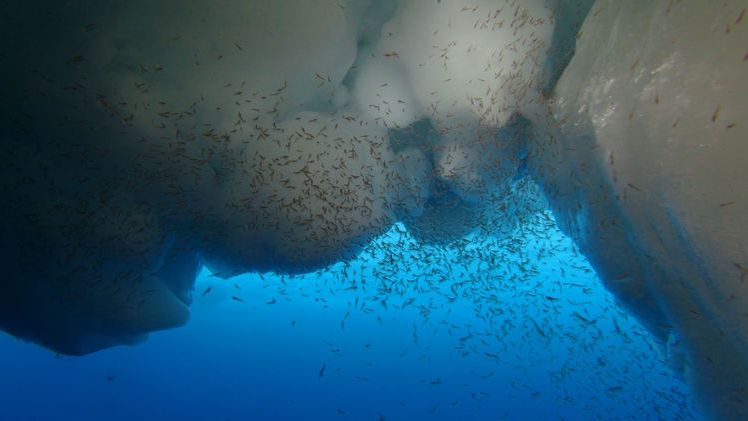
"In the Southern Ocean, we are investigating how krill can adapt to climate change. The small crustacean plays a central role there: it eats the microscopically small algae and zooplankton. And the large charismatic animals we know - whales, seals, penguins - all eat krill. In this respect, this small organism has an incredible impact on the entire ecosystem. For example, what happens if the population decreases massively? How does this affect the organisms that krill feed on?
We are also investigating various krill species in the Arctic that play a key role as food for commercial fish. This is because we want to uncover the basic principles of how the Arctic and Antarctic krill group deals with the changing conditions. So far, long-term studies have shown that The amount of krill has decreased in the Atlantic part of the Southern Ocean. However, we do not yet understand why this is the case.
The difficult thing is that we can only carry out targeted experiments on site on a research vessel. But we don't get there every year. The only laboratory outside the Antarctic where you can carry out long-term experiments with live Antarctic krill is the Australian Antarctic Division in Tasmania. We have just completed a two-year experiment there and are now analysing the results. I've been to the Antarctic eight times on the research vessel 'Polarstern'. It's always totally fascinating. When I see the landscape - especially on the Antarctic Peninsula - it's breathtaking and very moving. You can feel that this is one of the most unspoilt areas on our planet. And that it's worth fighting to keep it that way."