
Internal reporting office in accordance with the Whistleblower Protection Act
The legal basis for the processing of personal data by the Internal Reporting Office of the University of Oldenburg is Art. 6 para. 1 sentence 1 lit. c GDPR in conjunction with §§ 10 and 12 HinSchG.
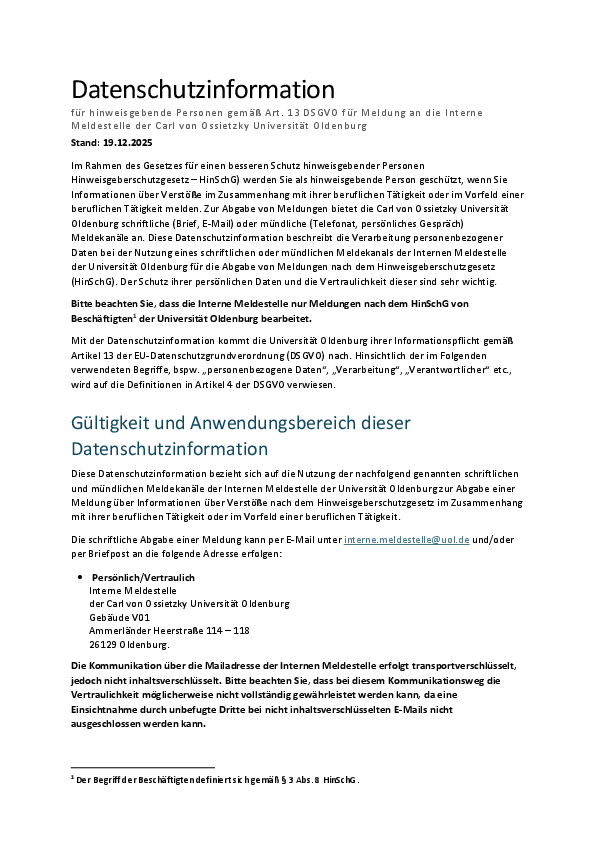
Please also note the data protection information for whistleblowers in accordance with Article 13 GDPR.
External reporting centres
- Federal Financial Supervisory Authority (BaFin)
Graurheindorfer Straße 108
53117 Bonn
Phone: +49 228 / 4108 - 2355
Email:
To the reporting system
To the website
- Bundeskartellamt
Kaiser-Friedrich-Str. 16
53113 Bonn
Phone: +49 228 9499 386
To the reporting system
To the website
Legal basis
- EU Directive 2019/1937 of the European Parliament and of the Council of 23 October 2019 on the protection of persons who report breaches of Union law ("Whistleblower Directive")
- Act for better protection of whistleblowers (Whistleblower Protection Act - HinSchG)
Internal reporting office in accordance with the Whistleblower Protection Act
What is the Whistleblower Protection Act?
The Act for Better Protection of Whistleblowers (Whistleblower Protection Act - HinSchG) regulates the protection of natural persons from disadvantages due to a report or disclosure of information about violations in accordance with the provisions of this Act that occur in connection with their academic appointments or in advance of these.
Furthermore, the Whistleblower Protection Act protects persons who are the subject of a report or disclosure and other persons who are affected by a report or disclosure from discrimination.
To implement whistleblower protection, internal reporting centres must be set up in companies and authorities to which whistleblowers can turn(cf. Section 12 HinSchG).
The University of Oldenburg's internal reporting office is organisationally part of the internal audit department.
The tasks of the Internal Reporting Office(cf. Section 13 HinSchG) at the University of Oldenburg are entrusted to employees of the internal audit department.
The employees of the Internal Reporting Office are independent in the performance of their duties(cf. Section 15 HinSchG). They are subject to the confidentiality requirement(cf. Section 8 HinSchG), according to which the identity of the whistleblower, the persons who are the subject of a report and other persons affected by the report are protected.
The identity of the whistleblower is not protected if the whistleblower reports false information about violations through gross negligence or intent(cf. Section 9 HinSchG).
Anonymous reports are not intended and are not processed by the Internal Reporting Centre.
Disclosing the identity of the reporting person serves to clarify the subject of the report and to avert a possible violation of the law.
Whistleblowers who wish to submit a report anonymously, as well as persons who are not covered by the term "employees"(see Section 8 HinSchG), can contact an External Reporting Centre
(see Section 7 HinSchG).
The external reporting centres(cf. Sections 19-23 HinSchG) have been set up at the
Which offences are covered by the Whistleblower Protection Act?
The Internal Reporting Office is responsible for reporting information on violations, i.e. unlawful acts or omissions that are related to professional or official activities at the University of Oldenburg and fall under the material scope of application in accordance with Section 2 HinSchG. The material scope of application includes offences (cf. Section 2 HinSchG) which
- are punishable by law, e.g. corruption, theft, fraud and similar offences
- are subject to fines if the violated regulation serves to protect life, limb or health or to protect the rights of employees or their representative bodies.
Examples that fulfil the offence of § 2 No. 3 to No. 10 HinSchG are
- Statements made by civil servants that constitute a breach of the duty of loyalty to the constitution,
- Violations of regulations for contracting authorities regarding the procedure for awarding public contracts,
- breaches of regulations on the protection of personal data.
The reporting of information on violations may include ongoing or completed processes.
Please note
- The following reports of information on violations will not be processed by the Internal Reporting Centre:
- Reports of information on violations without an academic appointment
- Reports of information on violations with an academic appointment, but which do not fall under the material scope of application of § 2 HinSchG are covered.
- The Internal Reporting Centre is not responsible for information on private misconduct unrelated to academic appointments, complaints of a general nature or without a specific violation of the law.
- The Internal Reporting Centre does not serve to avert acute emergencies or dangerous situations.
- The disclosure of incorrect information about violations is prohibited (§ Section 32 (2) HinSchG).
The whistleblower is obliged to compensate for any damage resulting from an intentional or grossly negligent report or the disclosure of incorrect information (cf. § Section 38 HinSchG). - The Internal Reporting Office expressly does not replace other contact persons, representatives and authorised representatives, such as the respective supervisor, higher-level committees, the Staff Council, the Equal Opportunities Officer, the Representative for Employees with Disabilities, the staff units responsible for data protection or occupational safety, the HR department or similar institutions.
For matters that do not fall within the scope of application of § 2 HinSchG the aforementioned bodies should be contacted. A non-exhaustive list can be found at https://uol.de/beschaeftigte and https://uol.de/verwaltung.
FAQs on the Whistleblower Protection Act
Who can report offences?
The Internal Reporting Centre at the University of Oldenburg accepts reports from employees of the University of Oldenburg.
Employees are according to § 3 para. 8 HinSchG:
- Employees,
- those employed for their vocational training,
- civil servants,
- Judges with the exception of honorary judges,
- soldiers,
- Persons who are to be regarded as employee-like persons due to their economic independence; these also include those working from home and those treated as such,
- people with disabilities who are employed in a workshop for people with disabilities or by another service provider in accordance with Section 60 of the Ninth Book of the German Social Code.
How can tips be reported?
The reporting of information(see § 16 HinSchG) to the Internal Reporting Office of the University of Oldenburg can take place
- verbally, i.e. by telephone or in a personal conversation
- in written form, i.e. by email or letter post
- in German and in English.
Please refer to the information and details in the contact details of the Internal Reporting Centre.
Anonymous reports are not intended and will not be processed by the Internal Reporting Centre (see Section 16 (1) HinSchG) .
Disclosure of the identity of the whistleblower serves to clarify the subject of the report and to avert a possible violation of the law.
The identity of the whistleblower is known exclusively to the authorised representative of the internal reporting office.
What should a notice contain?
A notice should contain the following information:
- A precise description of the facts of the case
- Information on the persons involved,
- Date (and time) of the incident,
- Communication of background information and related facts
- Orientation on the W questions (Who did what, when, where, how and why?)
If there is knowledge of evidence and/or documents relating to the facts of the case, these should be made available to the internal reporting centre.
What happens after a report?
Confirmation of receipt
The reporting person receives a confirmation of receipt via the reporting channel within 7 days of receiving a report(see Art. 17 HinSchG).
Preliminary review
The preliminary review includes checking
- the responsibility of the internal reporting office,
- whether the report falls within the material scope of the Whistleblower Protection Act(see Section 2 HinSchG) and
- the validity of the report(see § 17 HinSchG).
If further information is required for clarification, the FIU will contact the whistleblower and ask them to submit further information if necessary.
Follow-up measures
Appropriate follow-up measures(see Section 18 HinSchG) are determined based on the preliminary assessment. These are in particular
- internal investigations and enquiries into the facts of the case,
- refer the whistleblower to another competent body
- the procedure for further investigations
- hand over to a work unit responsible for internal investigations at the employer or respective organisational unit
- hand over to a competent authority
- discontinue the proceedings for lack of evidence or other reasons(cf. Section 18 HinSchG).
Within three months, the whistleblower will receive a re-registering student regarding the planned and/or taken follow-up measures(cf. Section 17 HinSchG).
Exceptions to this are regulated in Section 17 para. 2 HinSchG.
What is the confidentiality requirement?
In accordance with the confidentiality requirement(cf. § 8 HinSchG), the Reporting Centre shall protect the identity of
- the person making the report,
- the persons who are the subject of a report, and
- the other persons named in the report.
The identity of these persons may only be disclosed to the persons responsible for receiving reports or taking follow-up measures and persons who support them in the fulfilment of these tasks.
Protection of the confidentiality of the identity of a whistleblower is excluded if the whistleblower reports untrue information about violations through gross negligence or intent(see Section 9 para. 1 HinSchG).
Further exceptions to confidentiality are regulated in Section 9 HinSchG .