Archive 2007/2008/2009
Archive 2007/2008/2009
Lecturer exchange with the University of Salzburg
As part of the European ERASMUS programme, Prof. Dr. Ingo Mose visited the partner university in Salzburg as a guest lecturer from 10 to 16 June 2007. Together with his colleague there, Ulli Vilsmaier from the Department of Geography and Geology, he led a project internship with 18 students on the Master's degree programme in Landscape, Urban and Regional Management to test selected methods of empirical regional research. The event took place in the municipality of Fusch an der Glocknerstraße, where the students conducted various surveys on the significance, acceptance and future development of the Grossglockner High Alpine Road and the neighbouring Hohe Tauern National Park. Surveys of tourists and expert interviews with representatives of various relevant stakeholders from the region were at the centre of the investigations. During their stay, the group was also welcomed by the mayor of the municipality of Fusch, Mr Madreiter, and the technical director of Großglockner-Hochalpenstraße AG, Mr Pils, a graduate engineer. With over 900,000 visitors a year, the Grossglockner High Alpine Road is one of Austria's biggest tourist attractions.
Protected areas and regional development in Europe
 Prof. Dr Ingo Mose is the editor of a recently published anthology that addresses issues relating to the connection between territorial protection and regional development in Europe. The volume, published by Ashgate, Aldershot, UK, brings together thirteen English-language contributions by renowned academics from seven EU countries, who came together for the first time to realise the book project on the initiative of Prof. Mose. The contributions discuss central theoretical principles of area protection and regional development as well as selected best practice examples of area protection development from nine European countries. The centre of interest is the question of the extent to which large protected areas in Europe today can increasingly function as instruments of sustainable regional development and what conditions are required for this. The authors of the volume include Thomas Hammer, University of Bern, Switzerland; Rory MacLellan, University of Strathclyde, Glasgow, UK; Jarkko Saarinen, University of Oulu, Finland; Dominik Siegrist, University of Applied Sciences Rapperswil, Switzerland; Norbert Weixlbaumer, University of Vienna, Austria.
Excursion
"Problems of Regional Development - Scottish Hebrides" from 5 September to 16 September 2007
Symposium at Södertörns högskola Stockholm
 Members of the Regional Studies working group took part in a specialist conference at Södertörns högskolan, Stockholm, Sweden, from 8-10 November 2007. Under the conference motto "Focal Point Germany", the conference brought together a number of different contributions on current political developments in Germany. Dipl.-Umweltwiss. Pia Steffenhagen gave a presentation on "Corporate social responsibility as a way of financing environmental and nature conservation projects", while Prof Dr Ingo Mose spoke on "Territorial inequality in Germany - a mortgage and a challenge for spatial planning".
The Regional Sciences working group has been in close contact with the Swedish partner institution for some time. The university is also an ERASMUS partner of the University of Oldenburg in various subject areas, including environmental sciences.
Austrian Environmental Award 2007 - Winner Prof. Dr Ingo Mose
A few days ago, 29 lecturers and 46 students from the University of Salzburg and the University of Natural Resources and Life Sciences, Vienna, who participated in the "Life 2014" research project between 2002 and 2005, were awarded one of two main prizes in the 2007 Austrian Environmental Award. Prof Dr Ingo Mose from Oldenburg is one of the winners. Mose, a geographer and regional scientist from Oldenburg, was the only foreign lecturer to take part in the project as a visiting professor and lecturer at the University of Salzburg during the period in question, when he was still a university lecturer at Vechta University of Applied Sciences.
At the time, the "Leben 2014" project was funded by the Austrian Federal Ministry of Education, Science and Culture as part of the "Cultural Landscape Research" priority programme. Its aim was to develop an exemplary scientific basis for the future development of the Oberpinzgau region in the Salzburg part of the Hohe Tauern National Park. The guiding principles of the project were interdisciplinarity, transdisciplinarity and a women- and youth-specific approach to selected regional development topics. The project was carried out under the joint responsibility of teachers and students and with the participation of selected stakeholders in the region.
The Hohe Tauern National Park provided an outstanding setting for carrying out the research project: With an area of almost 1,800 km2, it is the largest protected area in the whole of Central Europe and has always been the focus of increased attention with regard to the requirements of cultural landscape protection and regional development.
Working Group Sustainable Spatial Development: Lecture Series WS 07/08
On Monday 14 January, Dr Reinhard Loske, Senator for Construction, Environment, Transport and European Affairs of the Free Hanseatic City of Bremen, was a guest at the University of Oldenburg. The Senator spoke as part of the spatial science colloquium of ZENARiO - Center for Sustainable Spatial Development Oldenburg, which is currently being founded and which invited Dr Loske to give a guest lecture. The topic of his lecture in the lecture theatre building, lecture theatre H 2 at 4 p.m. was the challenges of climate change at the municipal level.
Before Dr Loske moved to Bremen as a senator in summer 2007, he was a member of the German Bundestag for several years for Bündnis 90/Die Grünen. Prior to this, the habilitated economist and political scientist worked at the Institute for Ecological Economic Policy in Berlin, as a consultant at the State Ministry for Economic Affairs and Technology in Düsseldorf and at the Institute for Climate, Environment and Energy in Wuppertal. Loske also taught as a private lecturer at the FU Berlin.
The lecture by climate researcher and environmental senator Loske was held in cooperation with ZENARiO and COAST - Center for Environmental and Sustainability Research in Oldenburg.
University exchange with Salzburg continues
As part of the partnership with the Department of Geography and Geology at the University of Salzburg, Dr Peter Schaal was in Austria from 4 to 8 February to teach a course on the Master's degree programme in Landscape, Urban and Regional Management at the partner institute.
From 21 to 25 April this year, Prof. Dr Ingo Mose will also be travelling to Salzburg for a short teaching visit.
From 2 to 4 April, the Regional Studies working group is expecting 15 students from the aforementioned Master's degree programme to visit from Salzburg. Together with students from Oldenburg, the students will take part in an excursion led by Prof. Dr. Ingo Mose to revitalise the old harbour district in Bremen.
Groningen: Nora Mehnen's application successful
 Mrs Dipl.-Umweltwiss. Nora Mehnen, a doctoral student in the Regional Sciences working group, has successfully applied for a doctoral scholarship at the Rijksuniversitet Groningen. She is expected to start her four-year studies at the beginning of July at the Mansholt Chair of the School of Spatial Sciences there (Prof Dr Dirk Strijker). Ms Mehnen is working on the development of large protected areas, in particular nature parks in Central Europe. Her doctoral project focuses specifically on the comparative analysis of governance structures in nature parks in Germany, Austria and other countries. It is intended to anchor her doctoral project jointly in Groningen and Oldenburg and to supervise it at both locations.
Rural development in a global perspective
German-British Geographers' Conference at the University of Oldenburg
A three-day conference of around 40 German and British geographers at the University of Oldenburg ended last Sunday with a visit to various innovative projects for rural development in the Wesermarsch district. The central theme of the event was the consequences of globalisation on the development of rural areas and the possibilities of influencing the changes taking place through suitable forms of spatial management. The conference was a joint event organised by the German Rural Working Group of the German Geographical Society, the Rural Geography Working Group of the Royal Geographical Society and the national British Rural Geography Research Group. Members of all three organisations came to Oldenburg at the invitation of Prof. Dr. Ingo Mose's working group on regional sciences (spokesperson for the German working group). The discussion of the numerous presentations crystallised numerous similarities, but also differences in the perception of current problems of spatial development and approaches to their solutions. Everyone emphasised the need to view rural development from a holistic perspective that attempts to integrate economic, socio-cultural and ecological aspects. In this respect, regional policy in both countries was recognised as still having obvious deficits. Against this background, Prof. Dr Geoff Wilson from the University of Plymouth, spokesperson for the Rural Geography Research Group, emphasised the importance of international comparative research on rural development issues. Its potential is far from exhausted, he said. At the end of the conference, the participants agreed to continue the bilateral exchange of ideas. Agreements were also reached on the development of opportunities for the exchange of teaching staff and students, as well as for joint research projects. This also includes an existing cooperation agreement with the Institute of Geography at Kington University in London, which is to be developed more intensively in the future. Kingston is a twin city of Oldenburg. 
Guest from Salzburg in Oldenburg
From 25 to 29 August, Ulli Vilsmaier from the Department of Geography and Geology at the University of Salzburg will be visiting the Regional Sciences working group. The purpose of Mrs Vilsmaier's visit is to discuss joint research, publication and teaching activities with members of the working group. The Regional Sciences working group and the Institute of Biology and Environmental Sciences are institutionally linked to the University of Salzburg through an ERASMUS partnership.
Rural areas
At the 14th conference for planners in North Rhine-Westphalia on the subject of "Rural areas" on 23 October 2008 in Münster, Prof. Dr Ingo Mose gave the opening lecture entitled "Developments in rural areas: status and prospects".
The conference was jointly organised by the ILS - Institute for Regional and Urban Development Research, Dortmund, the Academy for Spatial Research and Development (ARL) - North Rhine-Westphalia Regional Working Group and the German Academy for Urban and Regional Planning (DASL) - North Rhine-Westphalia Regional Group.
Information event for students: "Studying abroad with ERASMUS"
On 15 December 2008 at 4 p.m. in room A1 0-005 there will be an information event on ERASMUS and study visits abroad. The event is primarily aimed at students of the subjects Environmental Sciences, Marine Environmental Sciences and Landscape Ecology. Students who have completed a stay abroad as part of the ERASMUS project will report on their experiences. Afterwards, there will be an opportunity for a question and answer session, in which Prof. Dr Ingo Mose (AG Regional Sciences) and Ms Adelheid Demmer from the ICBM will also take part.
Under "ERASMUS Partnerships" you will find a current overview of all partner universities.
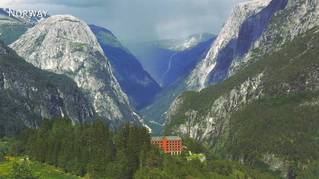
"National Conference for Regional and Local Landscape Parks" in Norway
At the "National Conference for Regional and Local Landscape Parks" in Stalheim, Norway, Prof. Dr Ingo Mose gave a keynote speech on 12 May 2009 on the subject of "Dynamic Park Models and Integrated Rural Development: A European Perspective". In front of over 120 representatives from various ministries, regional and local authorities and protected area administrations, Mose argued in favour of the dynamic design of future new protected areas in Norway, which should be committed to the idea of integrating protection and use. They could thus also become motors for the development of rural areas. In Norway, there is currently an intensive scientific and political debate about the introduction of new categories of protected areas that are intended to combine the objectives of nature conservation with those of regional development.

Anniversary volume and new editor: Volume 25 of the series "Wahrnehmungsgeografische Studien (WGS)" just published
 "Perception and acceptance of large protected areas" is the title of a new anthology from the WGS series that has just been published. In this book, Prof Dr Ingo Mose (editor) and other authors present various large protected areas in Europe and also explain how these areas are perceived by individual groups of people. The book was published by BIS-Verlag of the University of Oldenburg.
International workshop
The international workshop on "Perspectives for Collaboration in the Spatial Sciences: Exploring the Potential at Oldenburg, Bremen and Groningen Universities", funded by the NOWETAS foundation "Nord West Universitas", took place on 13 August 2009.
Founding event of the Center for Sustainable Spatial Development Oldenburg - ZENARiO
The founding event took place on Tuesday, 29 September 2009 with a lecture by Prof. Dr Michael Succow, winner of the Alternative Nobel Prize, in the BIS hall. Further information about ZENARiO can be found here.
Successful re-election
Prof Dr Ingo Mose has been confirmed for a further two years as spokesperson for the Rural Areas Working Group of the German Geographical Society. He was re-elected at the working group's general meeting in Vienna in October 2009. He holds the office together with Prof Dr Ulrike Grabski-Kieron from the University of Münster.
Co-operation in the north-west
The AG Regional Sciences receives funding to organise a perspectives workshop
The North-West Science Coordination Office has granted the Regional Sciences Working Group funding to organise a workshop together with the departments of spatial planning and geography at the universities of Oldenburg, Groningen and Bremen.
In view of the fact that initial discussions have already taken place with the other universities, the workshop applied for aims to give colleagues from all three participating partner institutions the opportunity to engage in an intensive exchange of ideas. The primary aim is to
- to identify common interests in future co-operation
- to identify suitable fields of action for the realisation of concrete forms of cooperation,
and - reach agreements on initial projects.
It is expected that the outcome of such a workshop will realistically be agreements on the establishment of regular forms of information exchange, the establishment of joint academic events (e.g. trilateral colloquia), the exchange of selected modules in teaching or joint applications for research projects. Based on the talks held so far, joint research interests are emerging, particularly in the areas of metropolitan region formation, regional development of rural areas and tourism.
The further organisation and coordination of this workshop is the responsibility of the Regional Sciences working group.
ZENARiO: New centre bundles spatial sustainability research
ZENARiO - Center for Sustainable Spatial Development Oldenburg: This is the name of a new scientific centre at the university. ZENARiO bundles spatial and regional science expertise in sustainability research at the university and complements natural, economic, social and regional science working groups with spatial and regional science perspectives. The founding members of the centre include academics from School I (Educational and Social Sciences), II (Computing Science, Economics and Law) and V (Mathematics and Science).
The centre's broad fields of work are primarily in the areas of: Landscape-ecological implications of the use of renewable energies; contributions to the planning and management of large-scale nature conservation projects; strategies for the sustainable management of resources such as soil or water; forms of steering regional development processes; methods of environmentally and sustainability-oriented spatial and regional research; focus on the north-west German (coastal) region as well as European comparative regions.
As a university research network, ZENARiO aims to make a contribution to both national and international spatial sustainability research. To this end, partnerships with the universities of Bremen and Groningen will be intensified and existing co-operations within the framework of the European Union's Erasmus programme will be used. At the same time, the centre aims to contribute to the development of the cluster of environmental and sustainability-related Bachelor's and Master's degree programmes in Oldenburg and to the development of corresponding degree programmes. The aim is to establish an international Master's degree programme in co-operation with the University of Bremen and the Rijksuniversiteit Groningen.
The "Colloquium on Sustainable Spatial Development" provides an initial platform for the exchange of information on topics of environmental and sustainability research orientated towards spatial and regional science.
Info: www.zenario.uni-oldenburg.de
Contact:
Prof Dr Ingo Mose; Institute of Biology and Environmental Sciences, WG Regional Science, Tel: 0441/798-4692, Email:
Expert workshop
 As part of the DFG project "Regional Governance in Rural Peripheries of the EU", the Regional Science Working Group hosted several experts on 28 November to discuss the theoretical and methodological foundations of the research project. Participants in the expert workshop included Prof Dr Paul Reuber, Institute of Geography at the University of Münster, Dr Elke Knappe, Leipniz Institute for Regional Geography in Leipzig, and Dr Norbert Gestring, Institute of Social Sciences at the University of Oldenburg.
 As part of the seminar course "Revitalisation of old port districts", students of environmental sciences and landscape ecology led by Prof. Dr. Ingo Mose and former city planning officer Nikolaus Neumann, lecturer, visited HafenCity Hamburg on Wednesday, 10 December 2009.