
P6: Field scale reactive transport
Principal Investigators
Dr. Janek Greskowiak
Institute for Biology and Environmental Sciences
Carl von Ossietzky University of Oldenburg
Dr. Stephan Seibert
Institute for Biology and Environmental Sciences
Carl von Ossietzky University of Oldenburg
Dr. Vincent Post (Phase 1)
edinsi groundwater
P6: Field scale reactive transport
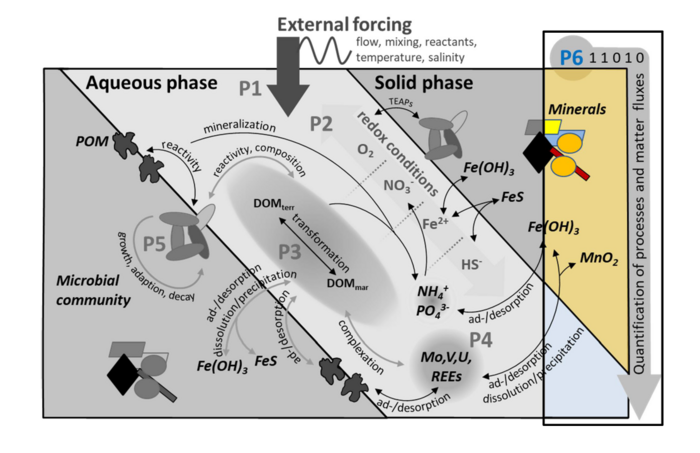
Reactive transport processes in STEs have hardly been studied to date with the support of numerical reactive transport modelling. In groundwater science, reactive transport modelling has proven itself as an indispensable tool to untangle and quantify the coupled, nonlinear and typically non-intuitive interplay of hydrodynamic and biogeochemical processes. Applying reactive transport models in the postulated deep dynamic bioreactor below high energy beaches is a challenging yet promising way to unravel and elucidate the many intertwined processes.
In Phase 1, subproject P6 started to support the proposed research unit in its aim to understand these complex processes in the deep STE subject to highly transient boundary conditions. In close cooperation with the project partners (P1-P5) first reactive transport models were capable of describing the processes and effects in the targeted laboratory experiments, as well as the composite behavior of the field-scale system. In Phase 2, subproject P6 will further support the proposed research unit in its aims to (i) understand the complex processes in the deep subterranean estuary (STE) subject to highly transient boundary conditions, and (ii) quantify turnover of the elements C, N, P, and Fe within the world’s STEs and their fluxes to the global coastal oceans. For that, a principle biogeochemical model will be developed and verified against our core study site Spiekeroog, Germany, and two additional validation study sites Truc Vert, France, and De Panne, Belgium, respectively. A computationally efficient surrogate model (e.g., via multivariate regression or supervised machine learning techniques) will be constructed subsequently. Applying the surrogate model in concert with a global database of hydrogeological and biogeochemical site parameters, STE element fluxes for the entire global coastline will be computed, accounting for both present-day as well as projected climate data. The global database will be compiled in cooperation with subproject P7. Further, a Monte-Carlo-based uncertainty analysis on the computed global element fluxes will be carried out.