
P4: Trace elements and metal isotopes: Transformation and fractionation
Principal Investigators
Prof. Dr. Katharina Pahnke-May
Institute for Chemistry and Biology of the Marine Environment
Carl von Ossietzky University of Oldenburg
Dr. Anja Reckhardt
Institute for Chemistry and Biology of the Marine Environment
Carl von Ossietzky University of Oldenburg
P4: Trace elements and metal isotopes: Transformation and fractionation
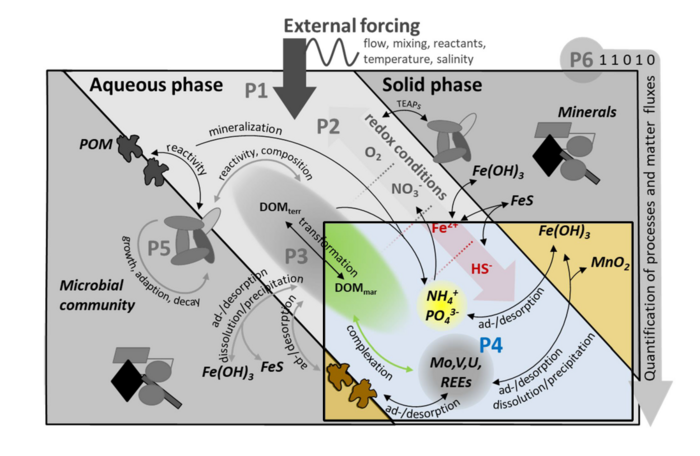
In Phase 1, subproject P4 started to study trace element and metal isotope dynamics related to biogeochemical processes in the STE on Spiekeroog Island. In Phase 2, subproject P4 will assess metal transformations at specific hot spots and during ‘hot moments’ of biogeochemical variability in the deep and dynamic subterranean estuary (STE) of the Spiekeroog beach and challenge the transferability of observed reaction zones, biogeochemical processes and dynamics at two other high-energy beach sites. To achieve these goals, we will participate in regular and event-specific field campaigns on Spiekeroog and two validation sites in France and Belgium. We will conduct targeted laboratory experiments to identify trace metal behaviour and isotope fractionation during re-oxidation of reduced metal species and hence characterise the trace metal and isotope signatures communicated to the coastal ocean. We hypothesise, that the general distribution of trace metal reaction zones and biogeochemical processes affecting metal mobility and fractionation found on Spiekeroog, that will be further constrained on specific spatio-temporal scales in Phase 2 of DynaDeep, are transferable to other high-energy beach sites. We will use trace metal concentrations (Fe, Mn, Co, Mo, Re, Tl, U, V) and stable isotopes (Mo, Fe, S, O) in groundwater and reactive solid phases to decipher metal transformations and to disentangle the biotic and abiotic processes controlling trace metal mobility. Ancillary parameters essential for the assessment of the overall STE functionality and dynamics, such as major ions, electric conductivity, nutrients, O2, pH, alkalinity, H2S, as well as the mineralogy and geochemical composition of the solid phase, will be determined by this subproject and made available to the entire research unit.