
P2: Metabolic rates: From heterotrophic to autotrophic processes
Principal Investigators
Dr. Moritz Holtappels
Alfred-Wegener-Institute, Helmholtz Centre for Polar and Marine Research
Prof. Dr. Martin Könneke
Institute for Chemistry and Biology of the Marine Environment
Prof. Dr. Marcel Kuypers (Phase 1)
Max-Planck-Institute for Marine Microbiology
Dr. Hannah Marchant (Phase 1)
Max-Planck-Institute for Marine Microbiology
P2: Metabolic rates: From heterotrophic to autotrophic processes
High-energy beaches form a dynamic land-sea transition zone in which the alteration and mixing of terrestrial groundwater and marine salt water takes place in the subsurface. In this bioreactor, different chemical redox and salinity conditions come together. This creates unique niches for microorganisms that have to adapt to constantly changing conditions.
In Phase 1, the subproject P2 showed that OM degradation rates are strongly dependent on the seasonal input and the residence time of the marine POM and that high rates can only be found in the upper decimeters of the sediment. Furthermore, we found a high, seasonal input of oxygen leading to re-oxidation processes in deep layers and indicating limitation of OM. Relatively high CO2 fixation rates and high abundances of chemolithoautotrophic microorganisms indicated the important role of dark primary production in the C-cycle.
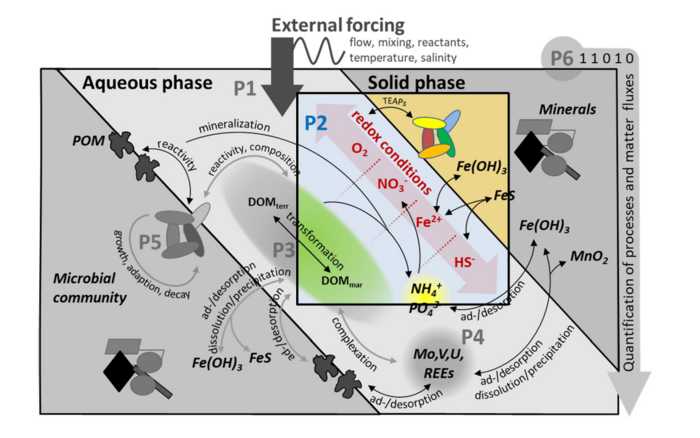
In Phase 2, P2 is organized into three work packages (WPs), in which the biogeochemical C-cycle at Spiekeroog beach and the comparison sites will be studied. WP1 will investigate the factors and effects of OM limitation that have a significant impact on the biogeochemistry of the deep layers of the beach reactor. To unravel the origin of OM, 14C analyses of OM and microbial lipid biomarkers will be performed. Furthermore, we postulate that fresh OM can also be formed within the sediment by chemosynthesis which may promote metabolic rates of chemoorganoheterotrophes as energy or C-source. Therefore, in WP2 we will study different chemolithotrophic processes and microorganisms by means of incubation experiments. By adding 13C-bicarbonate, potential rates of autotrophic C-assimilation will be monitored and the respective autotrophic microorganisms will be identified by DNA- or RNA-SIP (stable-isotopic probing). Exemplarily, the ecophysiology of the ammonia-oxidizing archaea will be investigated by metagenomic studies, functional marker gene analyses and selective cultivation approaches in cooperation with the projects P4 and P5. In WP3, the transferability of our biogeochemical findings on the C-cycle will be tested in close consultation with P6 and P7, by newly developed empirical models. Accordingly, it will be tested at the validation sites whether the extrapolated C-turnover can be generalized with the help of selected parameters (descriptors) and whether up-scaling from regional to global models is possible. In sum, P2 will expand our knowledge of the C-cycle and the energy fluxes of high-energy beaches and aims to contribute to the improvement of environmental models by quantifying material fluxes and metabolic rates as well as by deciphering microbial processes.