
P5: Microbial niche space within subterranean estuaries of high-energy beaches
Principal Investigator
Dr. Bert Engelen
Institute for Chemistry and Biology of the Marine Environment
Carl von Ossietzky University of Oldenburg
Dr. Julius Degenhardt
Institute for Chemistry and Biology of the Marine Environment
Carl von Ossietzky Universität Oldenburg
P5: Microbial niche space within subterranean estuaries of high-energy beaches
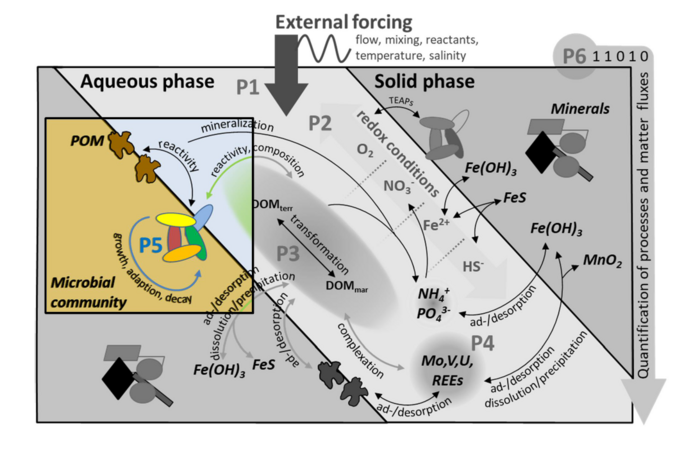
In Phase 1, subproject P5 identified variations in microbial community structures and their metabolic response to the dynamic changes in electron acceptor availability and electron donor quality within the subsurface of high-energy beaches. In phase 2, the subproject P5 builds on the results of Phase 1 and will investigate microbial adaptations to frequently changing redox conditions coupled with apparent carbon limitation in the deeper parts of the STE (“hot spots“). We will broaden our investigations on our core-field site Spiekeroog to obtain long-term results and include specific aspects like the role of stormfloods (“hot moments“). We further extend our investigation to two additional validation sites (Truc Vert, De Panne) to test to what extent the Spiekeroog results can be generalized for high-energy beaches. We hypothesize that i) The niche separation between sediment-attached and interstitial microbial communities is a common feature of STEs, ii) Recalcitrant DOM within the deep STE is altered by microbial activity during stable conditions while DOM released by redox shifts under transient conditions sustains microbial communities and boosts activity on short time scales, and iii) The high precentage of amplicon frequencies of ultra-small Nanoarchaeota and members of the CPR indicate a natural enrichment in the porewaters and leads to an in-depth analysis of their specific lifestyles within the aquifer. During joint field campaigns, P5 will determine cell numbers and community patterns of 16S rRNA genes and gene transcripts in sediments and corresponding porewaters. Selected sediment horizons will be target for metagenome analyses. The metabolic response to changing redox conditions and resulting biogeochemical transformations of DOM will be followed in controlled laboratory experiments. All microbiological findings of P5 will be related to the respective geochemical parameters to unravel the coupling of microbial transformations to DOM composition (subproject P3) as well as conversion of redox-sensitive elements (subproject P4). Information on microbial distribution patterns and their metabolic network will be shared with subproject P2 to specifically investigate heterotrophic (P5) and autotrophic processes (P2).