
Project structure and subprojects
Project structure and subprojects
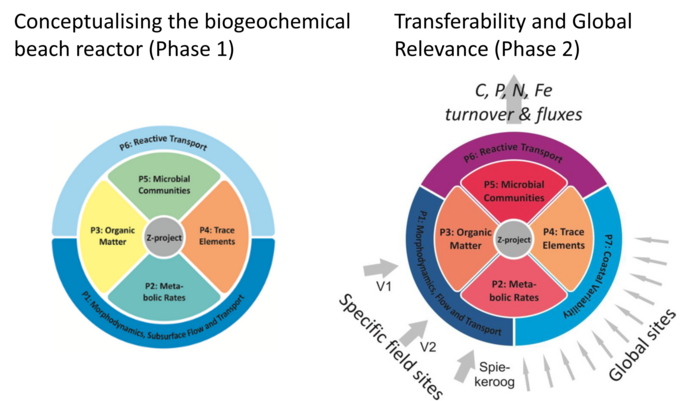
In phase 1, morphodynamics and related subsurface flow and solute transport were studied in P1, delivering baseline information on the flow field, fluxes, mixing and salinity distribution to the biogeochemical projects P2-P5: These subprojects focused on metabolic rates under varying redox conditions (P2), related abiotic transformations and microbial interactions with organic matter (P3), transformation and fractionation of trace elements and metal isotopes (P4) as well as on diversity and metabolic functioning of microbial communities (P5). Together, all subprojects conceptualized the dynamic deep bioreactor within the subsurface of high-energy beaches, whose integrated functioning was studied in reactive transport models (P6).
In phase 2, we will address new research questions regarding the role of reactive zones (‘hot spots’), events (‘hot moments’), and compounds (‘hot stuff’) for the overall turnover of the biogeochemical reactor that evolved during Phase 1 at our core field site Spiekeroog. We will further challenge the transferability and generalisability of our results by conducting research at additional high-energy field sites (De Panne, Belgium and Truc Vert, France) and with different global model approaches. Ultimately, DynaDeep will elucidate the global relevance of the dynamic deep subsurface of high-energy beaches for carbon, nutrient and trace element cycling.
The entire project is coordinated in the Z-project.