
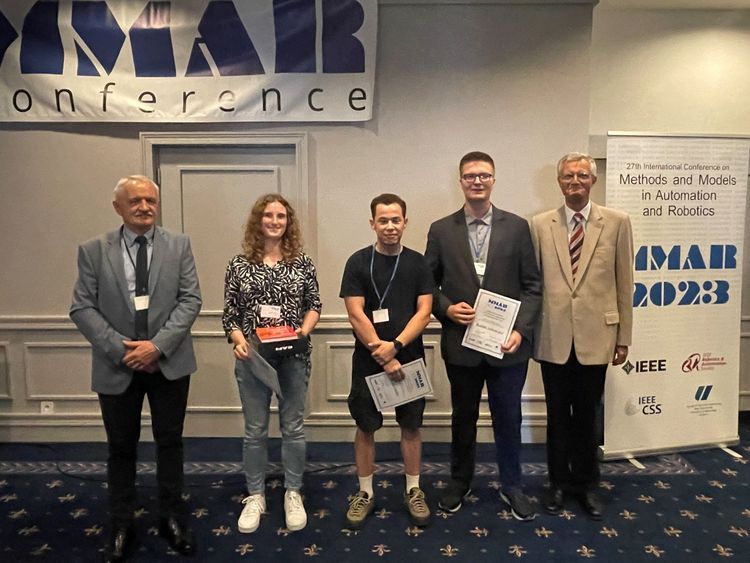

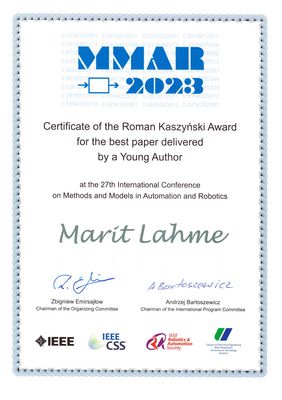
At the 27th IEEE Conference Methods and Models in Automation and Robotics, which took place from 22-25 August in Międzyzdroje, Poland, the paper "Online Identification of the Open-Circuit Voltage Characteristic of Lithium-Ion Batteries with a Contractor-Based Procedure", written by Marit Lahme, M.Sc. was awarded the Young Author Best Paper Award. With her contribution, Ms Lahme, who has been a research assistant in the Distributed Control in Networked Systems Department of Distributed Control in Networked Systems department since April 2022, beat 22 other submissions. The decisive criteria for the award were the first authorship of the article and an excellent evaluation by the international programme committee in all of the following three categories Appraisal of the scientific quality of the article, the presentation and the subsequent technical discussion. The entire team of the Department of Distributed Control in Networked Systems congratulates Mrs Lahme on this success!
The paper "Online Identification of the Open-Circuit Voltage Characteristic of Lithium-Ion Batteries with a Contractor-Based Procedure" submitted by Ms Lahme in the specialist track "Modelling, Identification, Simulation" deals with the methodological extension of an interval-based routine for identifying the open-circuit voltage characteristic of lithium-ion batteries with a contractor approach. The aim of this work is to model the dynamic behaviour of a battery cell as well as possible despite uncertainties in the measurements, whereby the identification approach developed should be able to be implemented in-situ in battery management systems on the basis of the current and voltage measurements available in the nominal operation of batteries. The novel identification approach is used, among other things, to charge the individual battery cells of a battery pack safely and efficiently and to equalise their charge states. With the help of the identified open-circuit voltage characteristic, factors that influence the dynamic behaviour of the individual battery cells can be taken into account. These are, for example, irreversible ageing phenomena and reversible temperature influences. The identification routine in this article is based on interval arithmetic methods. The identification result could be significantly improved compared to previous work with the help of the contractor approach.
The research focus of the Department of Distributed Control in Networked Systems department, this method is an essential component for the development of model-based methods for state estimation, ageing detection and fault diagnosis as well as for the efficient control and implementation of charging strategies and battery management systems. In addition to the methodological development, the experimental validation of these procedures on the department's own test benches, such as the 16-channel charge/discharge tester 17216M-10-6 from Chroma, is an integral part of the research.