
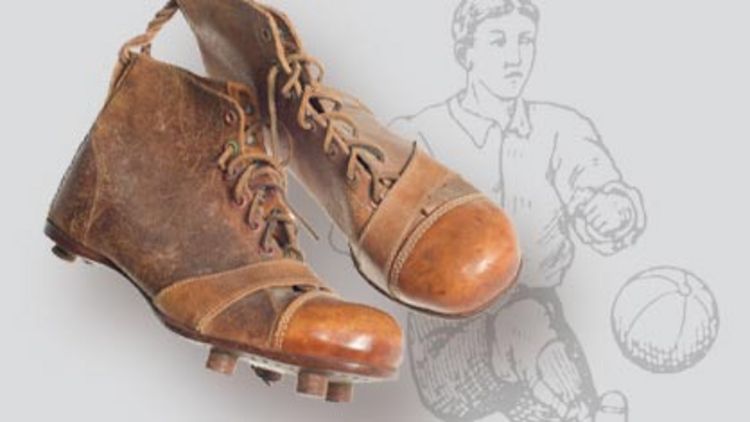
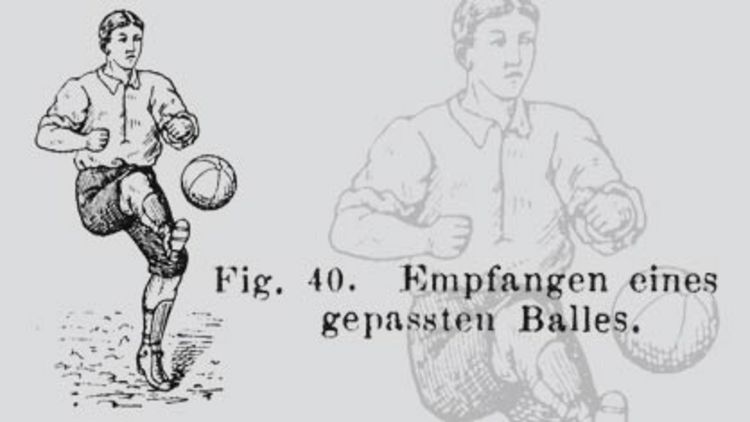

Almost everyone knows it: Football today is a mass phenomenon. When the sport was introduced in the German Empire, things were very different. In this interview, Jörn Esch explains why this was the case - and why the idea of football as a working-class sport is a myth. QUESTION: Mr Esch, if you don't play yourself, you at least talk about whether you are a supporter of Borussia Dortmund or Bayern Munich or neither of these teams: Football is undoubtedly a mass phenomenon today. Was it the same when the game was introduced in Germany in the second half of the 19th century? ESCH: No, certainly not. Before the 1870s, gymnastics was the main activity in Germany. Gymnastics had a long tradition, and it was very nationally charged. Gymnasts were always telling themselves and others that they had played a decisive role in the wars of liberation against Napoleon and the Franco-German War. Football, on the other hand, had quite a difficult time - as a practice that had received a fixed canon of rules for the first time in England and was therefore considered "English". QUESTION: In your doctoral thesis "The Subject of Football", which you are currently working on, you are investigating how the game was established in the German Empire between 1875 and 1918. How did it come to Germany from England? ESCH: Firstly, through English merchants, engineers, students and others who played with German colleagues, friends or fellow students. Secondly, by "copying". The Braunschweig secondary school teacher Konrad Koch translated the football rules that applied at the public school in Marlborough, England, into German - and had his pupils play football according to these rules. QUESTION: What did these rules look like? ESCH: It was more of a form of football that is known today as rugby football, so there were lots of forwards and few defenders. And it was a mixture of foot and handball. Accordingly, the basic tactical formation - as in today's rugby - was characterised by a focus on the forward lines. QUESTION: No hint of a back four? ESCH: In today's football language, the system at the time would be described as a 2-3-5. But this is better described in Jonathan Wilson's brilliant account of the development of football tactics, "Inverting the Pyramid". In it, he describes precisely this development from a pyramid tending towards the defence in the opposite direction. In other words, from 2-3-5 to 4-5-1 or, even more recently, 4-2-3-1, not to mention floating or false nines. QUESTION: So the rules were translated - and the game quickly spread throughout the German Empire? Esch: No, it didn't happen that quickly. Until well into the 1890s, football remained one game among many that was occasionally played in schools. In large cities such as Berlin, Hamburg and Munich, the game also found a certain non-school following. That was all it was back then. QUESTION: What happened next? ESCH: There were four key points in the development of the game in Germany up to 1918. The first point was, as I said, the translation of the rules into German. The second point was in the 1880s. Doctors and educationalists argued about whether pupils were possibly being exposed to too much "intellectual" teaching. The argument was that our boys were learning languages, maths and all sorts of other things, but there was too little time for exercise; they were becoming ill and weak. Among many other games, football was also recommended at this time, as one game among many. In the 1890s, a certain "football landscape" increasingly developed. For example, special interest magazines emerged, a kind of "kicker" for the German Empire. QUESTION: What did these magazines say? ESCH: They reported on the league matches that were now being organised in some cities and gave advice on how to play football properly. Towards the end of the 1890s, football textbooks were published. The third point in the development did not occur until the turn of the century. The DFB was founded in January 1900. An umbrella organisation was created, which took care of the nationwide organisation of matches, initiated league and cup competitions and so on. And by 1904 at the latest, when a separate rugby section was set up, the DFB made it possible to play football as we still know it today. However, football was still not a mass phenomenon. And it was mainly played by members of the middle classes - the idea of football as a working-class sport is a myth that applies neither to the German Empire nor to its beginnings in England. QUESTION: And the fourth point in the development? ESCH: The First World War. During the war, the teams, mainly men from working-class backgrounds, learnt how to play football from their superiors. They knew the game from their time as grammar school pupils. In contrast to tennis or hockey, football had one decisive advantage: you didn't need much to play. One ball, two goals - however they were set up - and you were ready to go. QUESTION: Did the importance of football continue to grow after 1918? ESCH: Although that is no longer the subject of my doctorate: Football finally became a mass phenomenon in the Weimar Republic. More and more people knew about football. And gymnasts and footballers put aside their mutual animosities "for the good of the fatherland" as early as the First World War. QUESTION: What material do you actually draw on for your research? ESCH: I work with textbooks, magazine articles and pictures. The textbooks are particularly interesting because they contain idealised ideas about what you have to do to become a footballer. QUESTION: Do you have a specific example? ESCH: Many of these books contain interesting rules about how you should organise your entire life in order to become a "real" footballer. This ranges from breakfast eggs in the morning to a ban on masturbation in the evening. I am interested in pictures in two ways: firstly, I ask myself how to design a picture in such a way that the viewer can use it to learn how to play a header, for example. Do you need arrows? Do you have to depict the ball? Should opponents perhaps be included in the picture? Secondly, I'm interested in what things the pictures don't make explicit. QUESTION: Is there a picture that is particularly important to you? ESCH: Yes, one that I show again and again in lectures. It's from Philipp Heineken's textbook on the game of football and shows the "receiving of a passed ball". I once played through this posture with colleagues for fun, receiving the ball as shown. However, it didn't really work out.
Jörn Esch, scholarship holder of the Hans Böckler Foundation, is doing his doctorate on "The subject of football" in the research training group " Self-formations".
More on the topic
Research Training Group Self-education
Contact
Jörn Esch
Research Training Group Self-Education
Tel: 0441-798/2378