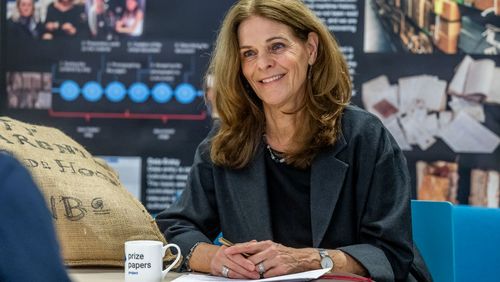


The Centre for Intercultural Jewish Studies is committed to portraying Jewish life as an integral part of German and European culture. In this interview, its Chair, Andrea Strübind, talks about the centre’s co-operation with the Jewish community – and about how anti-Semitism can be countered in society.
Ms Strübind, people in Oldenburg and across Germany are currently marking the anniversary year celebrating 1,700 years of Jewish life in Germany – partly to counter rising anti-Semitism. As a theologian, how do you view anti-Semitism in Germany?
Anti-Semitism is, unfortunately, deeply ingrained in our society – partly due to the Christian tradition. There is a millennia-old hostility towards Jews that has been decisively shaped by the Christian churches. It was only in the wake of the Shoah that the churches and theology began to revise their own teachings and develop a different view of Judaism. In the second half of the 20th century, Jewish-Christian dialogue led to a profound redefinition of the relationship with Judaism across all denominations. However, many anti-Semitic stereotypes are so deeply ingrained that all it takes is a current political trigger for them to resurface. A recent example is the widespread anti-Semitic conspiracy theories on social media. In certain circles and musical subcultures, age-old anti-Semitic stereotypes – many of which originated in the Middle Ages – are being dusted off. And in the wake of the recent resurgence of the Middle East conflict, we have even witnessed acts of violence with anti-Semitic undertones taking place outside synagogues. I find this deeply distressing.
How can we, as a society, tackle this problem?
By, for example, reporting on it and educating people about how hatred of Jews and anti-Semitism arose throughout history. But we shouldn’t just talk about it. Rather, it is also important to engage with Jewish people. For it is often only through such encounters that it becomes clear what terrible consequences latent anti-Semitism can have in our society. I experienced this personally, for instance, when I was a guest at the Oldenburg Jewish Community’s Sukkot celebrations the day after the attack in Halle. The atmosphere there was sombre; the community was under heightened police protection. It was good that the Lord Mayor was also present and expressed his solidarity.
You have been working closely with the Jewish Community of Oldenburg for some time now...
Yes, we have been working very closely with the Leo Trepp Study Centre of the Jewish Community of Oldenburg for 10 years now – and in doing so, we facilitate encounters on a variety of levels. Among other things, we jointly organise a public lecture series every year. This is a series in which, for the most part, Jewish scholars from all over the world present different perspectives on Jewish history, religion and culture. Through this lecture series, we also aim to raise public awareness of Jewish life in Oldenburg and highlight the contribution of Judaism to European and German culture. As part of the Jewish Studies programme, we also run seminars with Oldenburg’s rabbi, Alina Treiger, and give our students the opportunity to undertake a placement in Jewish institutions.
Students have now been able to receive further education in ‘Jewish Studies’ at the University of Oldenburg for more than 25 years. An anniversary that you will be celebrating on 4 July. What is special about this programme?
From the very beginning, Jewish Studies – as a discipline within the cultural and humanities fields – was designed to be interdisciplinary, involving lecturers from the subjects of Protestant Theology, History and Philosophy. The focus was on presenting Jewish history and religion as an integral part of German and European history and culture. We also aim to train our students to act as cultural mediators between Jewish and Christian traditions, and in relation to Islam as well. Our times are characterised by highly polarised debates – such as those on migration or the conflict-ridden disputes in the Middle East – and by rising anti-Semitism. A thorough interfaith and intercultural education, particularly for teachers, is therefore especially important.
‘Jewish Studies’ was originally established as a minor subject at Master’s level. How did that come about at the time?
The programme was established on the initiative of the then Vice-Chancellor, Michael Daxner. It was deliberately not conceived as a typical Jewish Studies degree and was initially situated within the social sciences. Professor Daxner himself, together with a large group of colleagues, established Jewish Studies as an interdisciplinary programme. The curriculum focused on the 19th and 20th centuries. The degree programme’s founders saw it as an educational and political duty to counter anti-Semitism. This remains the case today: we bring together subjects from a variety of subjects. We offer an important complement for those who wish to engage with history, religion, culture and their impact, as well as with Judaism in contemporary German society. This also involves examining anti-Semitism and its historical roots. This is enriching for everyone – including students from completely different degree programmes, such as those in the natural sciences.
What does the degree programme look like today?
As part of the Bologna Process reforms, the original ‘Jewish Studies’ minor for the Magister degree had been phased out. However, the ‘Jewish Studies’ department at the university wanted to integrate Jewish Studies into the modularised degree programme so that it could continue to be studied. Together with my colleague Dagmar Freist from the Institute of History, and in close consultation with the then Chair of the Oldenburg Jewish Community, Sara-Ruth Schumann, we signed a cooperation agreement with the Leo Trepp Lehrhaus in 2011 and introduced the Master’s certificate programme ‘Intercultural Jewish Studies’, which was aimed at students of history, philosophy and theology. The certificate enabled students of the humanities to gain an additional qualification for their future careers in the non-school sector, for example in museums, journalism or publishing.
Since the 2020/21 winter semester, we have been continuing “Jewish Studies” as part of the broader professional development programme “Transcultural Interreligious Studies”. This programme builds on the existing Jewish Studies and expands the range of courses on offer. Planning for the Master’s programme is currently underway. ‘Transcultural Interreligious Studies’ provides a grounding in Jewish, Christian and Islamic religion and culture, as well as in interreligious education. This foundational knowledge is, furthermore, closely linked to the study of the interconnections between Jewish, Christian and Muslim ways of life and theologies. This programme allows us to gain new perspectives and reach a wider range of students – not least because we are offering it on a cross-school basis. For example, we also have students from the fields of chemistry and economics. Clearly, there is a need to acquire a basic understanding of religions, their history of cultural influence and interfaith dialogue.
What are your hopes for the future?
I hope that the new ‘Transcultural Studies’ Bachelor’s programme continues to be well received, so that students from outside the humanities can also add a new dimension to their studies. And, of course, we would like to continue our successful collaboration with the Leo Trepp Lehrhaus. It would also be desirable to have a professorship in Jewish Studies to enhance the programme and firmly establish it within university life.
Interview: Constanze Böttcher