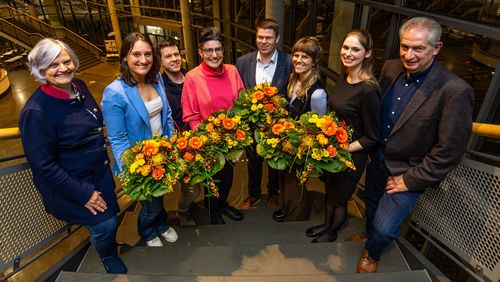


University teaching of the future will not only be more digital, but also more varied overall. Students will have more opportunities to get involved and become active themselves. The participate@UOL project is working on implementing new formats.
The Learning Lab is still almost an insider tip. The bright, friendly room in the labyrinthine upper floors of the library is open to all students: as a place where you can learn and work together and which offers many technical possibilities. The Learning Lab is one of the most visible results of the participate@UOL project, which has been running since 2021 and has just been extended for a year until the end of 2025. The "Innovation in University Teaching" foundation provided the university with 3.9 million euros to try out new teaching-learning formats, develop them further, identify the best ones and ultimately implement them in practice.
The central aim of the project is to change university teaching, for example by introducing more interactive elements and new technologies. "What drives us is that we want to make studying more attractive," emphasises Peter England from the Department for Study Affairs, who is pulling the strings as project coordinator. The project team of around 20 people is closely interwoven with many other areas of the university: Some members of staff are based at the Schools, others work in university didactics, and IT services and BIS are also involved.
The project is based on many small improvements, which will initially be trialled and then become permanent. The innovations include training courses for teaching staff on new digital tools, various free educational materials, known as open educational resources, and digital support programmes for first-year students, including a virtual tour of the library. There are courses that utilise the possibilities of virtual reality (VR) and workshops by students for students on topics such as mindfulness or creating a learning plan.
The idea of participation, which is already expressed in the project title, is at the centre of everything. "We start with the needs of the students," emphasises England. In order to identify these, student project staff Friederike Ulses and Isabel Larisch were actively involved in the design of the Learning Lab. The two had the task of finding out how students imagine an ideal learning environment and what constitutes an "attractive learning atmosphere".
"We found the peer-to-peer principle to be particularly effective," reports Larisch, who recently completed her teaching degree. She and Ulses met with student bodies and student committees and talked to other students about their ideas in workshops. It turned out that some wishes, such as the provision of power sockets and stable Wi-Fi, are shared by many, but that there are also very different needs.
"You can move everything and leave it as it is. You don't have to be quiet, you can have lively discussions."
The Learning Lab has become a space that offers maximum flexibility. Groups can work together on the smartboard in a cosy atmosphere or arrange the seating in a loose circle for a workshop. Two people can lean over a laptop on cosy sofas with a partition wall or practise giving a presentation in a virtual environment. There are foldable group tables, beanbags and individual workstations. "You can move everything around and leave it as it is. You don't have to be quiet, you can have lively discussions," says Lars Seehausen, a specialist in digital teaching, who is on hand to help users with any questions they may have.
The Learning Lab also offers special technical equipment: computers are available for editing films, others can be used to try out AIs, there are VR glasses, a podcast studio, a 3D camera and a multi-touch table. Students have every opportunity here to produce new formats such as podcasts, films or digital exhibition tours in addition to traditional credits such as seminar papers or lectures.
This could become more common in the future - because new, mostly digital technologies are also finding their way into courses. Peter England emphasises that good teaching does not necessarily have to be digital: "Traditional seminars can also be livened up with interactive elements, such as a quiz or peer-to-peer learning, where students impart knowledge to each other." It is important to bring more interaction and therefore more fun into teaching.
Making decisions in the virtual emergency room
Digital teaching formats offer particularly fascinating possibilities. This can be seen at
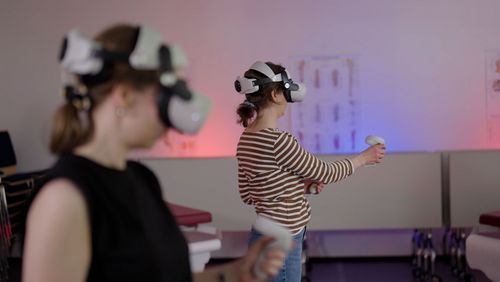
Dr Susanne Quintes, a member of staff at participate@UOL in School V - School of Medicine and Health Sciences. She is responsible for the "virtual emergency room", a learning programme for medical students. In a seminar room, Quintes presents several VR goggles, the corresponding controllers, two laptops and a powerful desktop computer. "That's all you need," she says. The virtual emergency room works very much like a computer game: the user is in a virtual hospital and receives a message that a sick patient is in the treatment room. The next step is to decide what to do next. Fellow students can follow the progress of the simulation on a large screen.
The purpose of the exercise is to teach future doctors how to correctly assess emergencies under time pressure, prioritise tasks, make an initial diagnosis and initiate treatment - all in a safe environment where mistakes have no consequences. Last winter semester, the virtual emergency department was used in two seminars with more than 80 students. Quintes does not see the format as a replacement for established teaching methods, such as units with drama patients, but rather as an extension to practise or experience things that are otherwise difficult to do in a degree programme. For example, the stress that arises in an emergency situation.
The evaluation showed that the new teaching method was well received. Many of the students rated themselves as more competent after the VR training than before and felt that they were better prepared to deal with emergencies. "VR will be used in one form or another in many degree programmes," Quintes is convinced. For example, in chemistry to visualise the geometry of complicated molecules or in history to immerse students in historical scenarios. Student teachers could learn to master difficult situations in the classroom virtually.
Experimenting and trying things out becomes easier
In order for such new formats to become established in university teaching, teachers also need to be enthusiastic about them. The project team is also focussing on participation in this area and, for example, supports courses in which new things are tried out. The employees also offer a great deal of support beyond this, for example helping with the use of new technology such as VR accessories. They also regularly present new digital tools for teaching in small training sessions, explaining how they work and which teaching concepts they fit in with. England has found that those teachers who successfully trial innovative formats act as multipliers: "They tell their colleagues about it. They then come to us and want to try it out too."
To make it easier to experiment and try things out in teaching in the future, a "Teaching Lab" is currently being created for all Schools. Similar to the Learning Lab, it is intended to be as flexible a space as possible. England's dream vision: "Ideally, even walls can be adjusted or platforms moved so that every conceivable didactic scenario can be realised."
This article was first published in the current issue of the university newspaper UNI INFO university magazine.