
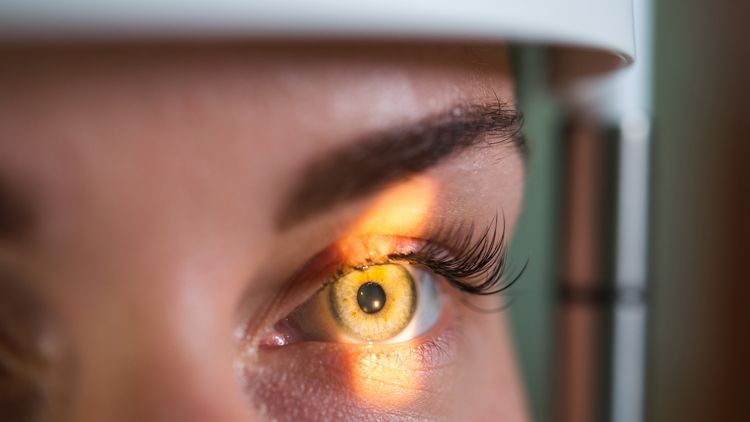

Macular degeneration is the most common cause of age-related blindness in western industrialised countries. PhD student Oliya Abdullaeva has now developed a procedure to help those affected.
Over three million people in Germany suffer from macular degeneration. There is no cure for the disease. However, so-called visual prostheses can alleviate the symptoms. These convert light into electrical impulses and stimulate the nerve cells in the eye in a targeted manner. PhD student Oliya Abdullaeva from the Institute of Physics and the Institute of Biology and Environmental Sciences at the University of Oldenburg has now developed a prototype for such a prosthesis. Her results were recently published in the scientific journal "Advanced Functional Materials".
The macula is a tiny area of the eye's retina where people have the sharpest vision. This area, which is just a few square millimetres in size, contains a particularly large number of sensory cells. In age-related macular degeneration (AMD), the nerve cells are destroyed by deposits or pathologically altered blood vessels. The vision of those affected is considerably impaired - to the point of blindness.
Prototype made from organic semiconductors
For some time now, researchers have been testing visual prostheses made of inorganic silicon to at least partially restore patients' sight. However, these have some disadvantages. So far, they can only be used for a maximum of two years and require external batteries to power them. Patients also have to wear special glasses. Abdullaeva has now developed a prototype consisting of organic semiconductors. On the one hand, these materials are generally better tolerated by biological tissue than silicon chips, and on the other, they can convert light into electricity like a solar cell. These current pulses are intended to stimulate the nerve cells of the retina and thus restore their sensitivity to light. The prerequisite for this is that only the light-sensitive part of the nerve cells is destroyed in the affected person. The long-term goal is to implant the organic visual prostheses directly into the retina.
Abdullaeva's prototypes currently still consist of a square glass plate with an edge length of one centimetre, on which model cells grow that resemble human nerve cells. Above this are tiny electrodes and an additional coating. This is only one hundred nanometres thick, which is less than the diameter of a human hair. When light falls on the semiconductor layer, it converts the light into electrical impulses, which are then transmitted to the surrounding cells. The special feature here is that a visual prosthesis constructed in this way would not need an external power supply. Abdullaeva's prototypes also adapt to the retina. Their surface is designed in such a way that nerve cells can quickly colonise it.
Light-intensive process
Another advantage of organic semiconductors is that they can be designed in such a way that they only produce electricity when light of a certain wavelength hits them. Abdullaeva's prototypes only react to red light, for example. While visual prostheses made of silicon chips cannot distinguish between different colours of light, colour vision would therefore also be possible in principle with organic semiconductors.
However, it will be some time before prostheses made from organic semiconductors can be used in practice. The biggest problem is that light that is many times stronger than the glaring midday sun is currently required to activate the organic semiconductors. "We have shown that the method works. Now we need to fine-tune it," says Prof Dr Manuela Schiek from the Institute of Physics at the University of Oldenburg, who supervised Abdullaeva during her doctorate. In the future, she and her team will primarily work on making the semiconductors more sensitive. She is currently receiving support from the PRO RETINA Foundation.
Abdullaeva completed her doctorate in the Research Training Group "Molecular Basis of Sensory Biology", which is funded by the German Research Foundation. She is now a postdoctoral researcher at the Laboratory of Organic Electronics at the University of Linköping, Sweden. Her doctoral thesis was written in close collaboration with the Neurosensorics working group of Prof Dr Karin Dedek at the University of Oldenburg, and the semiconductor materials were produced at the University of Bonn.