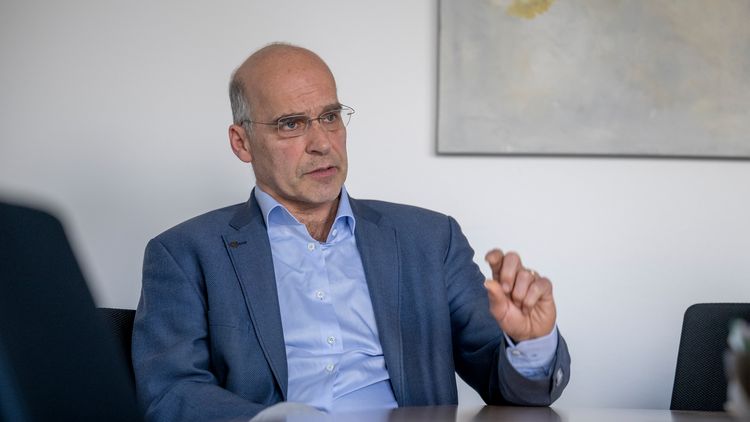

School V - School of Medicine and Health Sciences will be twelve years old this year. Prof Dr Hans Gerd Nothwang has been at its helm for more than six years as the university's only full-time dean. He is now beginning his second, now eight-year term of office. A review and a look ahead.
Mr Nothwang, what has changed the most during your time in office?
The biggest change is the dynamic growth that the School has experienced. Around 40 professors have been appointed since I took over the position in 2017, initially on an interim basis and then full-time a year later. With a total of 70 professorships and around 600 employees, we are now the second largest School at the university. Turning the many voices into a functioning orchestra is a challenge.
Added to this is the coordination with four cooperating hospitals. How do you bring the various players together?
Personnel continuity is an important factor, which didn't exist in the first few years. Thanks to the many years of cooperation, you gain trust in each other, can address issues openly and are aware of the particularities of the respective partner. There are also many discussions with the various stakeholders. Finally, the shared commitment to the people here in the north-west and the joint advocacy for the expansion of University Medicine Oldenburg UMO in response to the hesitant actions of state politicians also unites us.
What milestones during your time in office are you proud of?
First and foremost, the positive evaluation by the German Council of Science and Humanities (WR) in 2019, which demonstrates an impressive joint effort by all those involved at the site. It marks the end of the start-up phase and the successful development of the "European Medical School" project into a fully-fledged university medical centre. We were also able to increase the number of study places in human medicine from 40 per year to 120 today and establish further degree programmes in medicine-related fields.
The establishment of the model degree programme in human medicine was only possible because the region strongly supported this project. Does the UMO fulfil the expectations of medical training?
Yes, and I would even say: completely. We have built up an excellent degree programme whose modern teaching methods are expressly praised by the WR. The quality of the cross-border training in Oldenburg and Groningen has also reached the German government, which also wants to support us financially with several million euros in the coming years. Most importantly, more than half of the graduates currently remain in the region after graduation and work as doctors here.
Research has also become more differentiated. How is UMO recognised nationally and internationally?
Hearing research, of course, whose expertise is used in 80 per cent of hearing aids worldwide. Neurosensory research is also highly visible and is broadening thematically in the direction of neuroscience with the new Neuromodulation Research Training Group funded by the German Research Foundation (DFG). Healthcare research has become nationally visible, for example as the host of the DFG Academy for Young Researchers or with the establishment of the Cross-Border Institute of Healthcare Systems and Prevention. We are also present with research into emergency care. In the clinical field, we also have very high-quality diagnostics and lighthouses such as precision medicine for lung cancer and telemedicine. We are therefore very successfully combining basic research, clinical research and healthcare research.
The state government has been criticised time and again for not putting the UMO on a solid financial footing. Which issue still concerns you today, even though you thought it would be dealt with quickly when you took up your post?
I actually didn't expect that we would still be dealing with the expansion to 200 study places twelve years after it was founded. In 2018, we agreed with politicians that we would expand quickly and develop the urgently needed infrastructure accordingly. The fact that we have still not been able to tick this box says a lot about the standing of the north-west in state politics. Other Federal States act much more decisively and consistently when it comes to establishing new university medical centres. Time and again, the importance of University Medicine Oldenburg as the third university medical centre in the state of Lower Saxony is vehemently emphasised. Nevertheless, we still have to fight for appropriate funding from the state. This was recently demonstrated again in the "Strategically developing potential" call for proposals, for which we as a university medical centre are not eligible to apply.
What are the next steps in this respect?
In view of the state government's finance conference in the summer, we are launching another campaign. Among other things, we are planning a signature campaign in which anyone and everyone can participate in order to fight with us for more study places and thus more doctors for the region. We also want to win over our regional partners in politics and business as supporters; after all, good healthcare provision is a decisive location factor for the entire north-west. The state government must now finally deliver.
Where will the UMO be at the end of your current term of office, i.e. 2032?
By then, we will have implemented our "Healthcare4all" vision and established a north-west healthcare region in which personalised, lifelike and participation-oriented care is accessible to all. The university medical centres at the cooperating hospitals have continued to grow together and in our collaboration we have overcome all the administrative hurdles that still cost us far too much energy in our day-to-day work. The necessary buildings are finished or about to be finished and, of course, we finally have 200 study places in human medicine. At least.
Interview: Sonja Niemann