

The Pacific oyster in the North German Wadden Sea - one of the best-known examples of bioinvasion. Oldenburg scientists have tackled the problem and calculated the global transport routes of invasive species.
Globalisation with the accompanying steady increase in freight transport is causing a new wave of bioinvasion: animals and plants are travelling as stowaways on cargo ships, hidden in ballast water tanks or attached to the hull of the ships. Scientists from the Universities of Oldenburg and Bristol (UK) have tackled this problem. They have developed the most precise models currently available for predicting bioinvasion in shipping. For example, the researchers are able to determine global bioinvasion hotspots and assign an invasion risk to each ship, harbour or region. The scientists have now published their research results in the current issue of the scientific journal for ecology "Ecology Letters". "Our model combines data on ship movements, ship sizes, water temperatures and biogeography to determine the probability of an invasion," says Prof. Dr Bernd Blasius, Professor of Mathematical Modelling and head of the study.
If alien species arrive alive in harbours during their journey across the seven seas, they can permanently change previously untouched waters. They may displace native species and change entire ecosystems. In some regions, such as the North American Chesapeake Bay or the Mediterranean, several new species are discovered every year. The damage caused by the invaders amounts to several billion US dollars annually. How can this invasion be prevented? To answer this question, the most precise possible predictions about the bioinvasion are required. Stakeholders need to know when and where the next alien species is likely to appear.
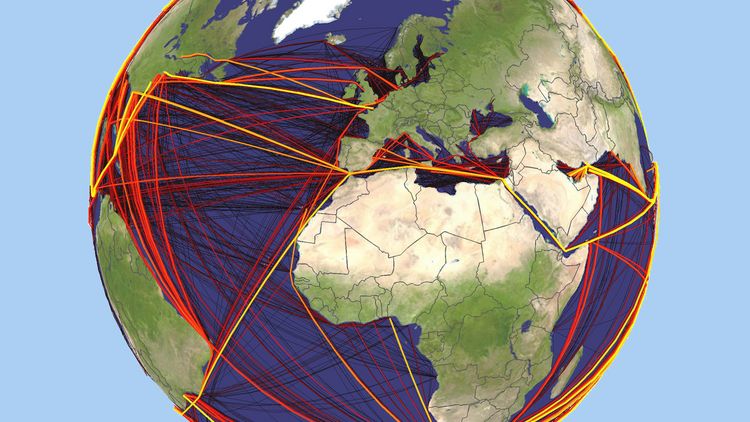
And this is where the scientists come into play with their analyses and model calculations: the scientists analysed almost three million ship movements in 2007 and 2008. For each route that a ship travelled, they calculated the probability of a species surviving the journey and establishing itself as a new population in the port of destination.
"Bioinvasion is a complex process. We simulated and calculated scenarios of varying complexity. They all show the same hotspots and high-risk routes for bioinvasion," explains Dr Michael Gastner, biologist at the University of Bristol and co-author. Ship traffic on the main routes plays the biggest role in the calculation of bioinvasion. This is because the probability of bioinvasion increases with every additional ship. However, water temperature and geographical features can also influence bioinvasion. The scientists also included the type of ship and the volume of the ballast water tank in their models. For example, container ships travel faster than oil tankers and can therefore accelerate the spread of foreign species.
In their project "Bioinvasion and Epidemic Spread in Complex Transportation Networks", funded by the Volkswagen Foundation, the scientists identified large Asian ports such as Singapore and Hong Kong, as well as American ports such as New York and Long Beach, as centres of bioinvasion. Ports with a high traffic density. But traffic density is not everything - as the scientists show using the North Sea as an example. Despite the high volume of shipping, bioinvasion is comparatively rare there. The reason: alien species have little chance of survival due to the low water temperatures. Only the North American east coast has similar conditions to the North Sea - which leads to a high probability of bioinvasion from this region. "We compared our model results with field data. And indeed, most of the invasive species that occur in the North Sea are native to the North American East Coast. Our simulations therefore make it possible to compare the probability of bioinvasion and the transport routes of the invaders," explains Oldenburg biologist and author of the article Dr Hanno Seebens.
As serious as the problem of future invasions may be, the study also contains a ray of hope: "It sounds banal. The best protection against bioinvasion is simply not to let it happen. This means that potential invaders are simply not allowed to leave the ship. This is achieved by constantly cleaning the ballast water using filters, chemicals and UV radiation," explains Blasius. This is the only way to significantly reduce the risk of invasion. The scientists were able to show in their model: If the number of species in the ballast water tank is reduced by 25 per cent, the risk of bioinvasion is reduced by 56 per cent.
More on the topic
Transport routes of the bioinvasionContact
Prof Dr Bernd Blasius
Institute of Chemistry and Biology of the Marine Environment
Tel: 0441-798/3997