
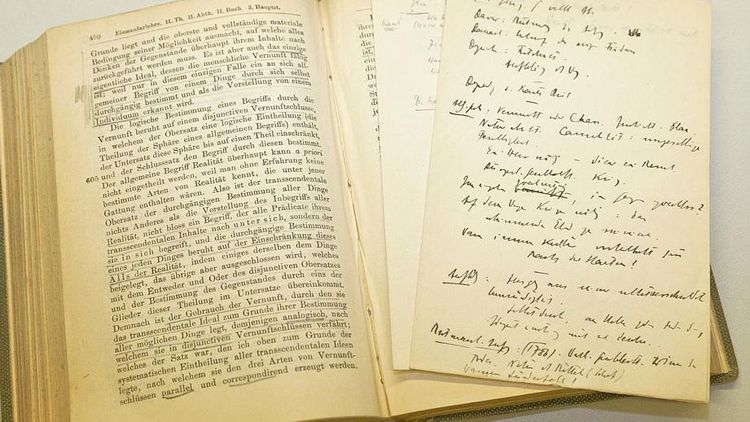

18 years, 50 volumes: in November, the "Joint Science Conference" of the federal and state governments (GWK) approved the project for a complete edition of the philosopher Karl Jaspers. It is a high point in the study of Jaspers, who was born in Oldenburg.
In November, the "Joint Science Conference" of the federal and state governments (GWK) approved the project "Annotation and complete edition of the works of Karl Jaspers as well as a selection of his letters and estate". The project is scheduled to run for 18 years and will comprise more than 50 volumes. The complete edition will be compiled from 2012 under the auspices of the Heidelberg Academy of Sciences and Humanities in co-operation with the Karl Jaspers Foundation in Basel at the Universities of Heidelberg and Oldenburg.
It is the culmination of an engagement with Jaspers that began early on: with the "Karl Jaspers Lectures on Questions of Time" (since 1990), the "Jaspers Year" on the occasion of Karl Jaspers' 125th birthday (2008), the acquisition of Jaspers' private library (2009), the approval of a Heisenberg Professorship by the German Research Foundation (2011) and the purchase and renovation of a Karl Jaspers House.
Karl Jaspers was born in Oldenburg on 23 February 1883 and initially studied law in Heidelberg and Munich, then medicine in Berlin, Göttingen and Heidelberg. In Heidelberg, Jaspers initially worked as a psychiatrist and psychologist, then from 1920 as a professor of philosophy and became one of the most renowned philosophers of the 20th century. After his expulsion from the university administration (1933), forced retirement (1937) and a publication ban (1938) by the National Socialists, Jaspers was reinstated to his university posts in 1945. In 1948, he accepted a call to Basel, where he died in 1969.
He is now returning posthumously to his first place of academic activity in Heidelberg and to the place of his childhood and youth in Oldenburg. The editors of the edition project, led by Heidelberg academics Prof. Dr Dr Thomas Fuchs (Psychiatry/Philosophy) and Prof. Dr Jens Halfwassen (Philosophy), include Dr Hans Saner, Karl Jaspers' last personal assistant, as well as the philosophers Prof. Dr Anton Hügli (Basel), Prof. Dr Kurt Salamun (Graz) and Prof. Dr Reinhard Schulz (Oldenburg).
Following the successful completion of the Carl von Ossietzky and Kurt Tucholsky edition projects, the approval of this major Jaspers project represents a further milestone for research in the humanities in Oldenburg, which will also benefit from the unique infrastructure of the Jaspers House as the future location for the 11,000 volumes of Jaspers' private library.
While the Heidelberg editorial focus is on the clinical and philosophical writings, in Oldenburg, in addition to the Hannah Arendt Centre, Jaspers' political writings will be at the forefront of editorial interest. The Heidelberg Academy of Sciences and Humanities, founded in 1909, is the scientific academy of the state of Baden-Württemberg and one of the eight German Academies of Sciences and Humanities. As a non-university research institution, it is currently responsible for 21 research projects, employing around 230 people.