
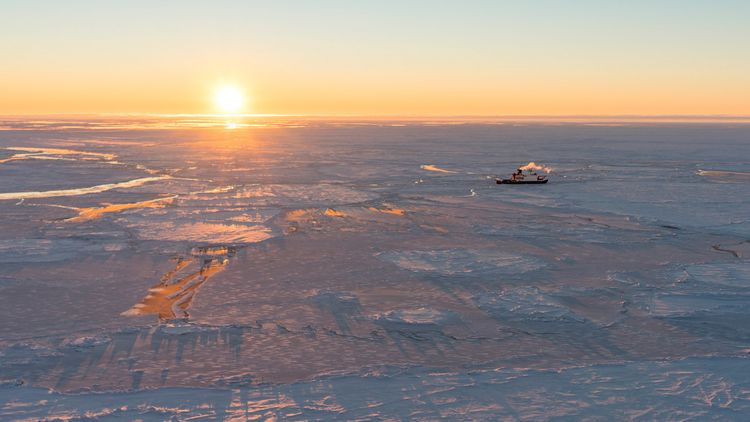

Scientists from Oldenburg are currently travelling to the Antarctic on the research vessel Polarstern. Led by marine biologist Bettina Meyer, they are investigating, among other things, how climate change is affecting krill stocks in the Atlantic part of the Southern Ocean. The small crustacean krill and the gelatinous salps are at the centre of the expedition by scientists from the Institute of Chemistry and Biology of the Marine Environment (ICBM) at the University of Oldenburg and the Alfred Wegener Institute Helmholtz Centre for Polar and Marine Research (AWI). On 18 March, the researchers set off from Punta Arenas (Chile) in the direction of the Antarctic Peninsula. The results of the voyage should also help to support sustainable krill fishing in the region. The research trip will also end in Punta Arenas on 6 May. The Antarctic krill (Euphausia superba), which is only a few centimetres in size, is an important part of the so-called zooplankton - small animals that drift with the currents. They play a central role in the Antarctic food web: many large predators such as whales, seals and penguins feed on them. The gelatinous salps belonging to the tunicates, mainly Salpa thompsoni, are also part of the Antarctic zooplankton. In contrast to krill, however, the barrel-shaped animals prefer warmer water with less ice cover. While krill populations have declined in recent years, the populations of salps have increased. Researchers suspect that one reason for this could be the dwindling sea ice in the region as a result of long-term warming. However, the evidence is not yet clear. Rising water temperatures In order to collect new data on krill and salps, research divers will take samples and take photos and film recordings during the expedition. "The expedition will provide important data for various research projects dealing with the biology of krill and salps and their ecological interactions," explains Prof Dr Bettina Meyer. As part of the "PEKRIS" project funded by the Federal Ministry of Education and Research (BMBF), the scientists are investigating how krill and salps can adapt to rising water temperatures and whether the organisms differ in their adaptability. "So far, there have only been a few studies on this, especially with regard to salps," says Meyer. The POSER project, which is funded by the Lower Saxony Ministry of Science (MWK), aims to provide more information: Here, the researchers are investigating how the rise in temperature affects the stocks of krill in comparison to the stocks of salps and how a change in the respective stocks affects the entire plankton community and the carbon flux. Long-term fluctuations "KrillBIS", a project funded by the German Federal Ministry of Food and Agriculture (BMEL), aims to record the stocks of krill and salps north of the Antarctic Peninsula and their fluctuations over the long term. The results of all projects will be incorporated into a mathematical model. The scientists want to use this model to predict how krill stocks will react to different climate scenarios. In addition to the researchers from the ICBM and AWI, scientists from 16 institutions from seven different countries are represented on board the Polarstern. This includes a team from the University of Hamburg and the University of Veterinary Medicine Hannover, who are investigating how different species of baleen whales are distributed in the region and how they behave. Together with the results of the Oldenburg team, the researchers hope to gain important insights into the predator-prey relationship between whales and krill. The researchers are documenting their work on board in a blog.
More on the topic
Working Group Biodiversity and Biological Processes of the Polar Seas Blog: ICBM at sea Polarstern Blog
Contact
Prof Dr Bettina Meyer
Institute of Chemistry and Biology of the Marine Environment
Tel: 0441-798/3567