


John Hattie is one of the world’s most influential educational researchers. His book *Visible Learning* has caused a sensation internationally and is now available in German. At the University of Oldenburg, Hattie has now turned his attention to the question: What determines how well pupils learn?
How can I get a lively discussion going in the classroom? It’s a question that comes up time and again in German staff rooms. For John Hattie, an educational researcher from New Zealand, the answer is obvious: “The only thing I can do as a teacher to get a discussion going in the classroom is to keep my mouth shut.”
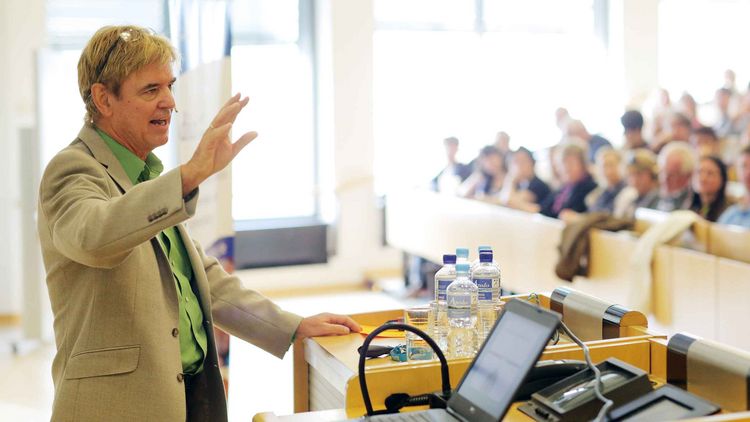
John Hattie is currently one of the world’s most influential educational researchers; his book *Visible Learning*, published in 2009, caused a sensation among international experts. Now, on his only visit to Germany, he stands at the lectern in the lecture theatre at the University of Oldenburg, captivating his audience.
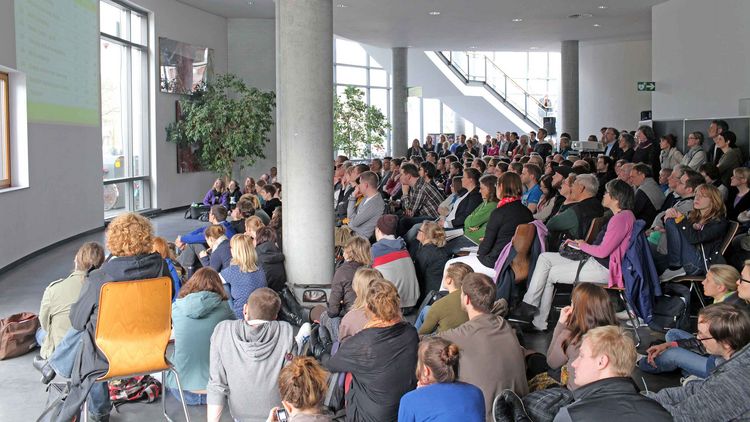
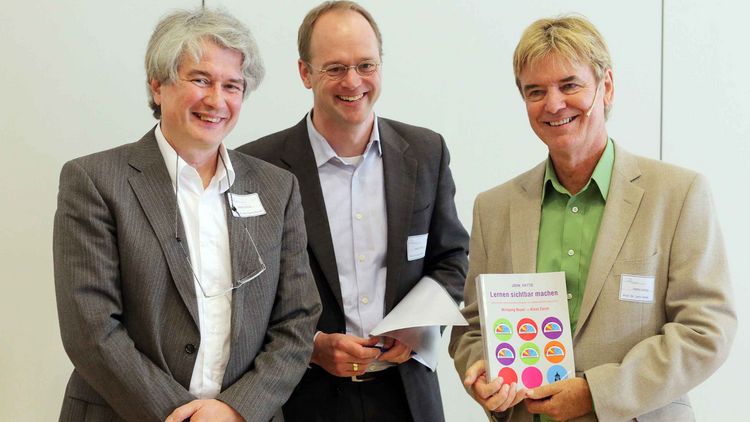
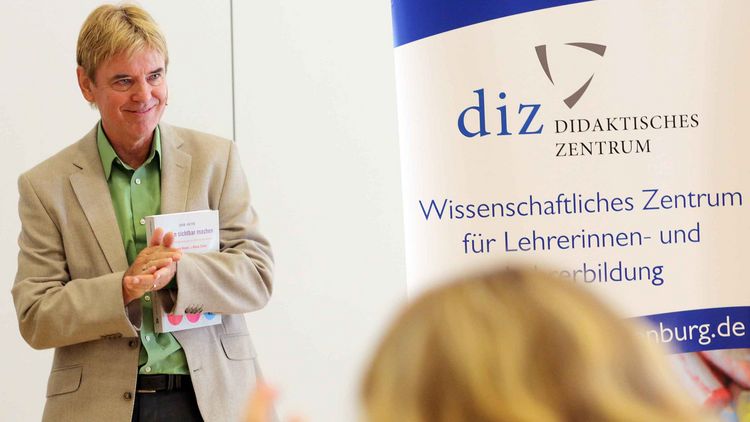
The occasion for his visit is the German translation of *Visible Learning* – now presented by the Oldenburg educational scientist Prof. Dr Klaus Zierer and his Swiss colleague Prof. Dr Wolfgang Beywl. The lecture theatre is packed to capacity. Downstairs in the foyer, too, the crowd is huge: a live broadcast is being shown for the roughly 400 visitors who cannot fit inside.
Hattie speaks off the cuff, deliberately pausing and delivering punchlines. His lecture is a demonstration of a man who is thoroughly immersed in his subject. The word he often uses is ‘passion’. According to him, it is precisely this that makes a teacher good in the first place. A teacher, says Hattie, who, as a ‘change agent’, sparks dialogue and learns to understand their impact.
Hattie knows what he is talking about: at the start of his career, he worked as an English and music teacher. This was followed by roles as a lecturer and research assistant, before he became a professor of educational science at the University of Auckland (New Zealand). Since 2011, Hattie has been Professor of Educational Science at the University of Melbourne (Australia).
‘Making Learning Visible’, as the translated book is titled, runs to 440 pages; the bibliography alone comprises just under 90 pages. The book is the result of rigorous research on which Hattie has spent 15 years. 800 meta-analyses have been incorporated into the work; Hattie utilised data from 250 million pupils for these analyses. From this material, the educational researcher identified 138 factors for effective learning. He ranks these factors according to the extent to which they contribute to pupils’ learning success.
At the very top of Hattie’s ranking is the factor ‘pupils’ confidence in their own performance’. In eighth place is ‘clarity of the lecturer’, and in tenth place is ‘feedback to the lecturer’. ‘Class size’, a topic currently much debated in Germany, has, according to Hattie, relatively little influence on pupils’ learning success: It ranks 106th, whilst ‘holding pupils back a year’ is in third-last place.
Klaus Zierer had already pointed out, even before the German translation was published, that one should not draw hasty conclusions from this ranking. The ranking requires a “nuanced analysis of the results”, he wrote in the *Frankfurter Allgemeine Zeitung* on 15 March. “His predominantly Anglo-American findings can only be applied to the German education system with caution,” said Zierer, who warns against a simplistic interpretation of Hattie’s work: slogans such as ‘The teacher is the most important factor’ place undue pressure on teachers. ‘And they are wrong, because it is not the teacher who is the most important factor, but the pupil themselves.’
Hattie also points this out – with what he calls his ‘mantra’: teachers, he says in the lecture theatre at the University of Oldenburg, must be able to see learning through the eyes of the pupils. They must encourage pupils to see themselves as their own teachers. And sometimes the best way to do this is for the teacher to do something rare: say nothing.
John Hattie: ‘Making Learning Visible’, revised German edition by Wolfgang Beywl and Klaus Zierer, Schneider Verlag, 439 pages, 28 euros. Available in shops from next week.