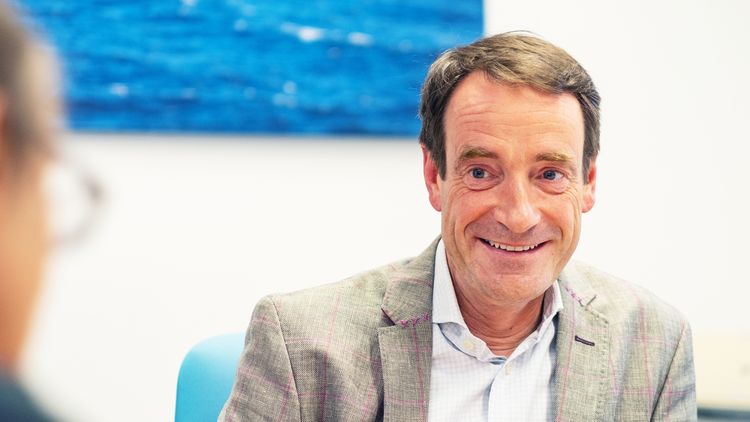

He is committed to sustainable development - on many levels: Bernd Siebenhüner. The Professor of Ecological Economics is concerned with "planetary boundaries" and the United Nations' sustainability goals. His goal: to shape a sustainable, social and ecological future worth living in.
The mountains on one wall, the sea on the other: The picture motifs in Bernd Siebenhüner's office alone tell a story about a researcher who refuses to be pigeonholed. The Oldenburg Professor of Ecological Economics works in various sustainability projects, coordinating, leading or initiating them. The spectrum ranges from collective learning processes and climate adaptation to international environmental policy, sustainable agriculture in Africa and education for sustainable development through to participatory processes for implementing sustainability.
Siebenhüner formulates transdisciplinarity as the central motif of his work for this colourful bouquet of research focuses. "My research is solution-orientated, tackles socio-ecological problems and develops sustainable solutions in cooperation with those involved in practice." Siebenhüner sees this as the greatest challenge and at the same time the greatest satisfaction: Research that is geared towards being close to the action from the outset in order to tackle global challenges.
Creative minds, flat hierarchies
The Delmenhorst native, who grew up in Berlin and studied Political Science and Economics at the FU Berlin, came to Oldenburg from Halle in 2002 as a junior professor of Ecological Economics to head the junior research group "Social Learning and Sustainability". "As a reform university, Oldenburg already had a very good reputation back then: lots of creative minds in economics, a focus on environmental research, flat hierarchies and open doors. That's what attracted me. And I was able to realise projects that I would never have been able to implement as a junior professor in Halle, such as designing a new sustainability degree programme," says the ecological economist. This was possible in Oldenburg: the Master's degree programme in Sustainability Economics and Management was launched in 2006.
At the time, Siebenhüner was working in parallel as a visiting scientist at the Potsdam Institute for Climate Impact Research (PIK): "I was given the opportunity to lead junior research groups at both institutes. And - as I often do when I can't make up my mind - I accepted both offers." From 2002 to 2005, he worked in a dual role in Potsdam and Oldenburg: "That was an exciting time, as the climate discourse was conducted differently in non-university research than at the university." Prof Dr Hans Joachim Schellnhuber - one of the world's most renowned climate researchers and long-standing PIK Director - also dropped in on the junior professor at the time: "So, what questions are the people of Oldenburg currently asking?" asked Schellnhuber. He himself has his academic roots in Oldenburg, habilitated at the university and was Director of the Institute of Chemistry and Biology of the Marine Environment (ICBM) in 1992.
Exchange with students as motivation
In the end, the "Berlin boy" Siebenhüner decided in favour of Oldenburg and the university: "The exchange with other disciplines results in a greater diversity in the sustainability discourse than in a non-university research institute that is thematically focused." Another plus point of the university: "I love the dialogue with the students because they are so often highly motivated to push things forward and implement them. I learn a lot myself in the process," says the 52-year-old. For example, the Scientists for Future group in Oldenburg, which Siebenhüner helps to coordinate, was set up at the suggestion of students. The group's aim is to strengthen the topic of climate protection at the university and raise awareness of the climate crisis among the general population.
Conversely, Siebenhüner believes it is important to offer students opportunities to "get them on board". The university's sustainability report is a good example of this. It was published for the third time under his leadership in 2021. It was compiled by 20 students from various Master's degree programmes. The result: the university has reduced its direct greenhouse gas emissions by almost 70 per cent compared to the previous report. "This is mainly due to the fact that the university has switched to green electricity. In doing so, it is setting an example for other large institutions and employers in the region. Such decisions can ultimately influence the market," explains the political scientist and economist.
Doing business within planetary boundaries
The idea of sustainability forms the framework for Siebenhüner's academic work and endeavours. For the scientist, it is clear that society needs an economic system that takes the conditions and functionality of ecosystems as its basis and satisfies people's needs. "We call this formula of sustainable economic activity in an ecological sense 'economic activity within planetary boundaries'," explains Siebenhüner.
While traditional economics argues that the purpose of economic activity is to satisfy people's needs in the best possible way and to maximise benefits, and sees other systems such as nature, the climate and the environment as mere contributors, ecological economics reverses the approach: society is embedded in various ecological systems, and economic activity is only an instrument and not the ultimate goal.
But how sustainable does the private life of someone who is committed to sustainable business practices in their academic appointment actually look? "An important question," says Siebenhüner, which everyone involved in the sustainability discourse should ask themselves: "Do we put into practice in our private lives what we teach or research?" Siebenhüner is trying - the city of Oldenburg offers him a good starting point for minimising his ecological rucksack. For example, the father of three does not own a car: "Short distances, everything by bike or on foot: I enjoy living here," says Bernd Siebenhüner.
He is convinced that the University of Oldenburg has long played a pioneering role with regard to a sustainable society. This role needs to be developed further - the university should become a model for the future of society. "We need to be thought leaders and act as drivers in local society in order to promote solutions in the city and the region."
Concrete solutions for Oldenburg
Siebenhüner is already looking for concrete solutions for the city at the former Fliegerhorst military base in Oldenburg: the interdisciplinary research project "Energetic Neighbourhood Quarter Fliegerhorst Oldenburg" (ENaQ) aims to create a climate-neutral residential quarter by 2023 that will serve as a model and provide concepts for future smart cities. The project focuses on the areas of technology, digitalisation and participation.
One idea is particularly close to Siebenhüner's heart, and not just at ENaQ: "There are already great technical achievements, but as long as we don't succeed in convincing people of the benefits of technology, these innovations will not catch on." For a functioning social system that operates within planetary boundaries, both technical changes and behavioural changes are needed. "But that only works together," says Siebenhüner.
This makes it all the more important to put citizens at the centre of the project. This is the only way to create a climate-neutral residential neighbourhood that meets the needs, wishes and interests of those involved. "It's a huge gift to be able to help shape a neighbourhood like this," says Siebenhüner.
Africa: a strong partner
However, the ecological economist is not only looking for sustainable solutions locally - but also on other continents. "I got to know and love the African continent through the University of Oldenburg's co-operation with South and East Africa. At the end of projects, I saw how much there is to do to tackle the problems on the ground," says Siebenhüner. However, he rejects the outdated approach to development cooperation of trying to impose one's own ideas on other countries. "Thinking has changed: It has become a togetherness, because we are all in the same boat when it comes to the UN Sustainable Development Goals. And that's why we need African partners on an equal footing," says the former Vice President of the University of Oldenburg, who worked at South Africa's Nelson Mandela University in Port Elizabeth from October 2014 to March 2015.
Alongside the University of Dar es Salaam in Tanzania, the university played a key role in the "Ecosystem-based solutions for resilient urban agriculture in Africa" (ECOSOLA) project, which Siebenhüner coordinated and which focussed, among other things, on food security. The scientists investigated how urbanisation, housing, food security, availability of bioenergy and infrastructure can be designed sustainably without overexploiting the ecosystem. A rural community in the coastal region of Tanzania in the immediate vicinity of the outskirts of Dar es Salaam served as a real-life laboratory. Siebenhüner's "Ecological Economics" working group and the "Landscape Ecology" working group led by ecologist Prof Dr Michael Kleyer worked closely with African colleagues during the three-year project, which ended in 2021.
UN Sustainable Development Goal: "Quality education for all"
Another project close to Siebenhüner's heart is the Centre of Excellence for Educational Research Methodologies and Management (CERM-ESA) at Moi University in western Kenya. Siebenhüner helped launch it in 2014 and it is now bearing fruit. It is dedicated to modernising the education system in the regions of East and Southern Africa. "Education has the potential to strengthen the United Nations Sustainable Development Goals. This enables us to effectively advance ecological, social and economic goals," explains Siebenhüner. What particularly impresses him is that five universities from Germany and Africa are jointly providing impetus for a future-oriented education culture: "And we are all learning from each other in the process."