
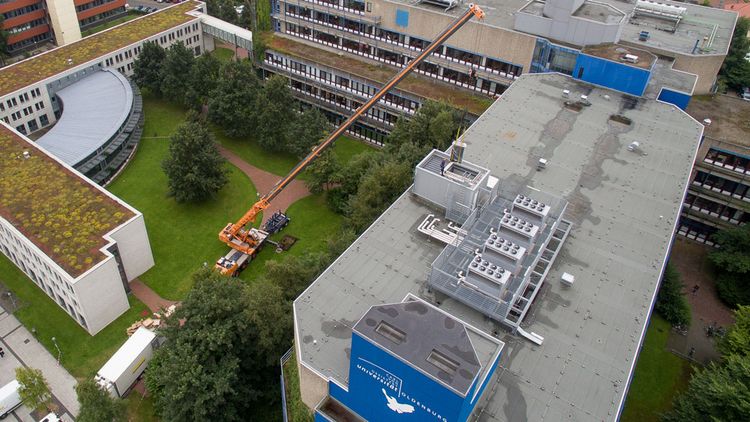

The university has two new high-performance computers. A crane transported the computing cluster's cabinets, which weigh several tonnes, over the roof into the IT services server room in Uhlhornsweg. The two computers are nine times more powerful than the previous system. This makes the new system one of the most powerful computers in northern Germany.
The computing power is financed by two funding sources: one computer is funded by the German Research Foundation (DFG) and the state of Lower Saxony, while the second was procured by the Centre for Wind Energy Research ForWind with funds from the Federal Ministry for Economic Affairs and Energy. The total investment volume amounts to five million euros. The two large devices will be officially put into operation in December.
"The new high-performance computers are a strategic investment in Oldenburg as a university location. They enable computationally intensive projects as part of large, forward-looking research projects - in a variety of disciplines," says University President Prof Dr Dr Hans Michael Piper. More than 200 scientists from 25 research groups will be able to utilise the new capacities in future, Piper continued. Together, the two computers offer around 10,000 computing cores and a theoretical total computing power of 340 tera-FLOPS - the acronym FLOPS stands for computing operations per second, of which 340 trillion are therefore possible.
The university's IT services operate the computing clusters and ensure that the computing power can be used by the Oldenburg scientists for numerical simulations. The questions for the DFG-funded cluster come primarily from the key research areas of energy of the future, sustainability, biodiversity and marine research, neurosensor technology and hearing research.
The second mainframe computer, which can be connected to the DFG-funded computer if required, is used by wind energy research in Oldenburg. Combined with the new experimental wind tunnel, which is nearing completion, and the "DFWind" free-field test field, the system will form part of a globally unique research infrastructure.
Both computers will also be used to prepare large-scale projects on the parallel computers of the "North German Network for High Performance Computing" and the federal government's supercomputers.