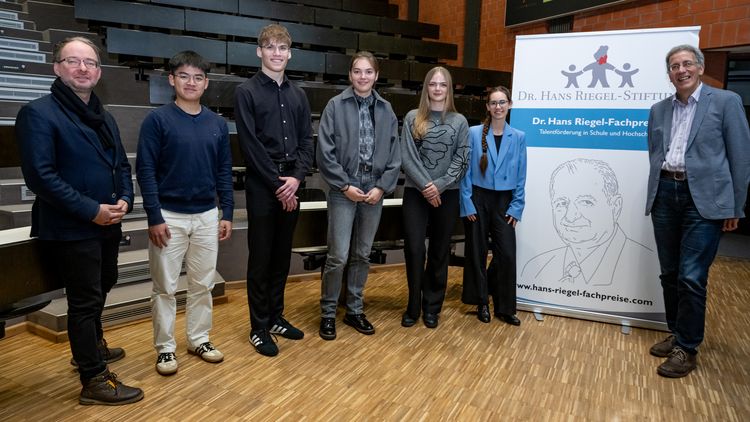

Their research focused on the antibacterial properties of kitchen herbs, the energy efficiency of smart-home systems and the synthesis of ammonia: twelve school pupils from the region have been honoured by the university for their outstanding work. For the 16th time, the university, in collaboration with the Dr Hans Riegel Foundation, presented subject-specific awards in biology, chemistry, Computing Science and physics.
At the presentation of the Dr Hans Riegel subject prizes on the Wechloy campus, Prof. Dr Anne Frühbis-Krüger from the Institute of Mathematics, Dean of School V (School of Mathematics and Science), praised the projects submitted this year. “It is wonderful to see young people observing their surroundings with a keen eye, developing their own research questions and then giving free rein to their thirst for discovery. Once again this year, many excellent projects – some with surprising research questions – were submitted for the Hans Riegel Prize,” said the mathematician.
The focus of the 55 specialist projects submitted was on the so-called STEM subjects – that is, mathematics, Computing Science, natural sciences and technology. A jury from the university assessed the projects according to scientific criteria, with particularly original topics and a clearly recognisable personal contribution – such as experiments carried out independently – playing a significant role in the award decisions.
The Dr Hans Riegel subject prizes are endowed with 600 euros for first place, 400 euros for second place and 300 euros for third place in each subject. In addition, the schools of the first-place winners receive a non-cash prize worth around 250 euros. An overview of the award winners:
Biology
- Prize: Melina Bürgel (Helene-Lange-Schule Oldenburg, HLS): ‘CO₂ fixation by a microalgal community as a function of temperature and nutrient availability’
- Prize: Lena Goetsch (Halepaghen-Schule Grammar School, Buxtehude): “Investigation of the antibacterial effects of kitchen herbs”
- Prize: Rene Hieu-Toan Nguyen (Herbartgymnasium Oldenburg, HGO): “Caffeine as a model substance: Gender-specific differences in the effects of pharmaceuticals”
Chemistry
- Prize: Paula Schoe (Marianum Grammar School, Meppen): ‘Multispectroscopic analysis of a novel betanin/chlorophyll-TiO₂ antenna complex’
- Prize: Anna Pophanken (Altes Gymnasium Oldenburg): “Chemistry in the light – photocatalysis with titanium oxide”
- Prize: Ibrahim Fares (Sulingen Grammar School): “Comparison of catalysts based on the synthesis of ammonia”
Physics
- Prize: Taalke Lübben (HLS): “A model-based investigation into the efficiency of multi-rotor wind turbines using Betz’s law”
- Prize: Johanna Christin Hoops (Windthorst-Gymnasium, Meppen): ‘Tracking the urban heat island effect in major cities using satellites’
- Prize: Liam Kapöhn (Marianum Grammar School): “Cloud phenomena and light effects in the sky”
Computing Science
- Prize: Joost Groen (Europaschule Gymnasium Papenburg): “Automated email classification in first-level support: planning, development, implementation and evaluation of a support vector machine model”
- Prize: Lennart Derguti (HGO): “A comparison of human and machine decisions in selected application areas”
- Prize: Tom Kloppenburg (HGO): “To what extent can modern smart-home systems make a reliably quantifiable contribution to energy efficiency and climate protection, and what technological, environmental and social constraints come into play?”