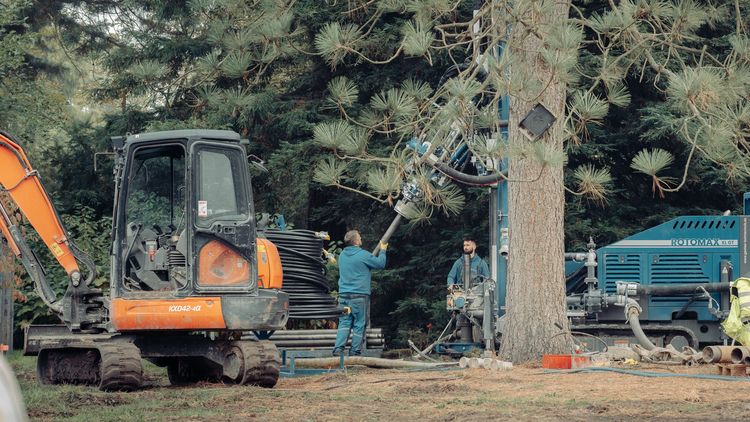


Drilling is currently taking place every day in the Botanical Garden. This is creating what is known as a geothermal probe field. It forms the centrepiece of a geothermal plant that will, in future, provide heating and cooling for the Tropical House and the new exhibition building.
On the large lawn, there are sacks of building materials, whilst opposite, large cable reels with black cables are piled high. A mini-excavator and a drilling rig are standing by, ready for action. Construction work has been underway at the University’s Botanical Garden for several months now – and at the moment, a great deal of it is taking place underground. “We are constructing a geothermal wellfield to provide the Tropical House and the new exhibition building with a sustainable supply of heat,” explains Britta Fromm, project manager for the ‘Geothermal Energy for the Tropical House’ project within the Land Use and Construction Planning Division of the Building Management Department.
It is an ambitious project: a total of 16 boreholes, each reaching 200 metres deep into the ground, are set to supply the required energy. The two buildings require around 600,000 kilowatt-hours per year – roughly the same as 60 newer detached houses. Of this, 500,000 kilowatt-hours are accounted for by the Tropenhaus alone, which must be maintained at a temperature of 25 degrees Celsius all year round. “Being able to heat the Tropical House in a climate-neutral way is so important to us because it is one of the main attractions for visitors,” explains Prof. Dr Dirk Albach, Director of the Botanical Garden. It offers all sections of the population a vivid insight into the hot and humid world of tropical rainforests. It is also important for research to be able to cultivate tropical plants.
Work is progressing well: one borehole is currently being drilled each day. The ground beneath the Botanical Garden consists initially of a layer of clay around five metres thick, but beneath that it is predominantly sand. The drill bits are able to work their way down to the desired depth without any problems.
The temperature at depth remains at 16 degrees Celsius all year round
Previously, staff from the Botanical Garden and construction firms had already installed a network of pipes several hundred metres long connecting the 16 geothermal probes, a distribution shaft and the two buildings. “The pipe from the probe field to the Tropical House alone is around 400 metres long,” reports Fromm. Ordinary water circulates through the pipes, containing a biodegradable antifreeze to prevent the pipes from freezing in winter. “It is a closed circuit; the heat transfer fluid does not come into contact with the ground,” explains Fromm.
This fluid takes on the ambient temperature of the ground: at depth, this remains at around 16 degrees Celsius all year round. The heat is transported from the borehole field to the two buildings via the pipes. Two large heat pumps – one at the Tropical House and one in the exhibition building – use the energy from underground to maintain the desired temperature in the buildings. The technical term for such a system is a ‘cold local heating network’.
The geothermal system benefits from the differing requirements of the two buildings: whilst the Tropical House requires heating for much of the year, the exhibition building houses three climate chambers, each measuring around 50 square metres, which primarily need to be cooled. The waste heat extracted from these rooms is returned to the ground via the pipes, thereby regenerating the geothermal probe field. “This is important to ensure that temperatures at depth – particularly in the groundwater – do not drop over the long term,” emphasises Fromm. Without the exhibition building, explains the mechanical engineer, the geothermal field would have had to be designed on a much larger scale. “It’s wonderful that there is this synergy between the Tropical House and the exhibition building.” Sensors are installed in a further borehole to monitor temperature trends in the ground.
The cost of the system is around 600,000 euros, most of which comes from special federal funding under the ‘Klimagarten Nordwest’ project. “We want to switch the university’s entire heating supply to electricity,” explains Fromm, “so it’s important to show that this is also possible with an energy-intensive building like the Tropical House.” Her impression is that the people of Oldenburg are following the work with interest. “Parents with young children, in particular, stop to look at the construction machinery and examine everything very closely.”