


Medical physicists at the University of Oldenburg are investigating not only terrestrial but also cosmic radiation - a connection that only appears unusual at first glance.
The infinite expanse of space begins only around one hundred kilometres above the Earth's surface. There, the atmosphere becomes so thin that it could no longer support aeroplanes. Beyond this limit, space is almost empty - but not quite: charged elementary particles, dust particles, small rocks and space debris surround our planet.
A team led by Oldenburg physicist Prof Dr Björn Poppe is investigating exactly how many particles are flying around near the Earth and in the rest of the solar system and how these objects and the radiation affect astronauts and space probes. With their findings, the researchers have been contributing to a better understanding of the Earth's immediate neighbourhood in space - the so-called space environment - for several years. The working group co-operates with the European Space Agency ESA, among others. An important part of the team is physicist Dr Gerhard Drolshagen, who was responsible for researching the space environment at the European Space Research and Technology Centre (ESTEC) in Noordwijk in the Netherlands until his retirement in 2016.
"The topic has become very topical in recent years because missions to Mars or long-term stays on the moon have become more likely. Radiation exposure plays a very important role here," says Poppe, Head of the University Clinic for Medical Radiation Physics. His team is primarily concerned with issues arising from the use of radiation in medicine. In Oldenburg, detectors for measuring this radiation have been developed and used in radiotherapy for many years.
Test under space conditions
But how does the connection to astrophysics come about? Both fields deal with radiation, explains Poppe: "Cosmic radiation usually has a significantly higher energy, but we can use the same detectors and similar mathematical approaches in space physics as in medicine." He and his team can therefore contribute their expertise in device development and radiation measurement to space research.
In October 2018, the Oldenburg team analysed a beam of lead ions at the LHC particle accelerator, which belongs to the CERN research centre in Switzerland. The high-energy lead beam was intended to simulate radiation as it occurs in the Earth's environment. Space agencies used the opportunity to test components under space conditions. In order to assess the resulting damage, the distribution of lead ions within the beam had to be precisely measured beforehand. "Here we were able to make a truly new contribution to high-energy physics from the field of medicine," says Poppe. In another project commissioned by ESA, the team is investigating whether certain detectors used on satellites are suitable for detecting charged particles entering the solar system from distant regions of the Milky Way. Previously, these devices were only used to measure the less energetic radiation from the sun.
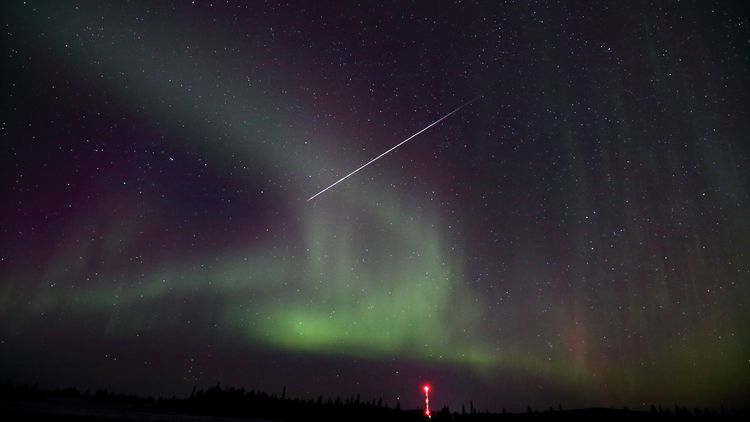
The researchers are also looking at tiny dust particles and somewhat larger particles that can be found in the Earth's environment. When these crumbs, called meteoroids, hit the atmosphere, they produce shooting stars or larger fireballs. Little is known about meteoroids and asteroids in the size range between a few centimetres and a few metres, but it is precisely these that could be dangerous to space travellers. "The size ratio between small meteoroids and the Earth is similar to that between a proton and a human being," says Poppe. Models and approaches from radiation medicine can therefore be used to understand the distribution of dust near the Earth.
Looking into the Earth's orbit
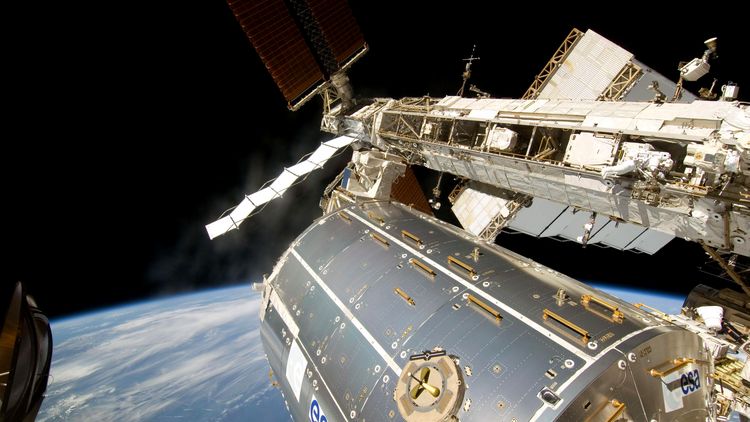
On the one hand, the Oldenburg researchers are looking into the Earth's orbit: During a measurement campaign in September 2018, a camera on the robotic arm of the International Space Station (ISS) scanned the outer skin of the European research module Columbus twice for eight hours. This resulted in images of numerous millimetre-sized impact craters on the metal surface. Based on their number and distribution, the team now wants to determine the frequency of meteoroids and space debris in orbit.
The Oldenburg scientists are also searching for traces of space debris from the ground. For example, they are involved in setting up a network of cameras in Germany. The devices are to observe the entire visible sky at one location and record fireballs at night. The astrophysicists are also analysing social media such as Facebook and Twitter, where users report sightings of luminous phenomena, and they have access to data from the Comprehensive Nuclear-Test-Ban Treaty Organisation (CTBTO), which monitors explosions of all kinds using special infrasound stations, among other things. The team published an initial projection of the total number of meteoroids in 2017 in the renowned journal Planetary and Space Science. According to this, an average of around 32 tonnes of cosmic debris with a diameter of up to half a metre hit the Earth every day.
Fortunately, the planet is well protected from the hail of particles by its atmosphere